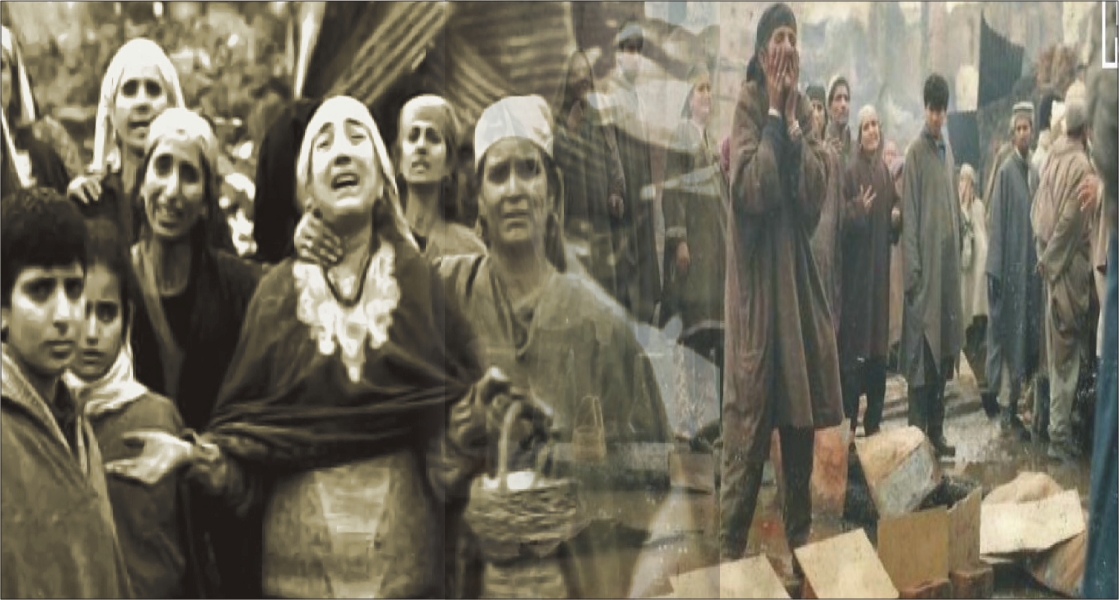
Srinagar: In Indian illegally occupied Jammu and Kashmir, justice continues to elude the families of of the victims of the gruesome Sopore massacre, even 33 years after more than 60 innocent civilians were brutally martyred by Indian paramilitary Border Security Force (BSF) personnel in Sopore town on January 6, 1993.
According to Kashmir Media Service, the massacre left over 60 civilians martyred and more than 400 shops and other structures, including residential houses, gutted on this day in 1993 after Indian troops set the Sopore town ablaze. Despite the passage of more than three decades, the perpetrators of the heinous crime continue to roam free.
Locals, who witnessed the gruesome massacre, said that marauding Indian BSF personnel dragged a bus driver out from the vehicle and pumped bullets into the bodies of passengers killing 20 of them on the spot. “After killing the passengers, the troops started spraying gun powder, petrol and kerosene on the surrounding buildings and then torched them,” they said.
A witness said, that among the martyred civilians, 48 died due to bullet shots and rest were burnt alive. He added more than 400 commercial establishments and 75 residential houses were set ablaze in five localities of Sopore – Armpora, Muslimpeer, Krultang, Shallapora, Shahabad and Bobimir Sahab. Among the burnt buildings there were some landmark buildings like women’s degree college, he said. “We couldn’t comprehend anything when we watched BSF personnel targeting every civilian with bullets. Days after the gruesome massacre, we came to know that a BSF man was robbed of his rifle by an unknown man and to avenge that incident, they targeted innocent civilians,” said another eyewitness.
One witness Ghulam Rasool Ganai, who witnessed the massacre and arson, said that the troops dragged out the driver of a bus (JKY-1901) from the vehicle and fired into the passengers, killing 20 of them. “The BSF personnel then set shops and buildings on fire after sprinkling gunpowder. About 400 shops and buildings,” he said.
The Shalla family of Shalpora suffered the highest number of casualties as four of its men were killed.
Muhammad Shafi Shalla, a member of the family, said, “We had fruit business. A day before the massacre one of our fruit-laden trucks had got stuck in a drain. Four members of our family, who were retrieving the truck on the day of the massacre, had taken shelter in a shop when the BSF started firing at people. The BSF men entered the shop and killed them all.”
Tariq Ahmed Kanjawal, said, “The image of a burning shopkeeper emerging out of his shop and shouting hysterically has stayed with me all these 33 years. His head was in flames. I remember a BSF officer telling his colleagues not to shoot him as he will be die soon,” said Tariq.
The Sopore massacre also drew international attention. Time magazine covered the incident under the headline “Blood Tide Rising”, reporting that at least 55 people were killed in the massacre.
Srinagar-based English daily Greater Kashmir, in a January 2007 report, recalled the massacre of 57 unarmed civilians, describing it as one of the worst atrocities committed by Indian forces since 1989.
Srinagar-based English daily, Greater Kashmir (GK), in a January 2007 report, recalled the massacre of 57 unarmed civilians in Spore town 14 years back in 1993. It was one of the many massacres perpetrated by Indian troops since 1989. Greater Kashmir quoted the Time magazine, which had described the massacre and the following protests in its report on 18th of January 1993 thus: “Perhaps there is a special corner in hell reserved for troopers who fire their weapons indiscriminately into a crowd of unarmed civilians. That, at least, must have been the hope of every resident who defied an army-enforced curfew in the Kashmiri town of Sopore to protest a massacre that left 55 people dead and scores injured.”
The GK report extendedly quoting form the magazine, says, “It was India’s latest blow in a three-year campaign to crush the predominantly Muslim state’s bid for independence. In retaliation for the killing of one soldier, paramilitary forces rampaged through Sopore’s market setting buildings ablaze and shooting bystanders. The Indian government pronounced the event “unfortunate” and claimed that an ammunition dump had been hit by gunfire, setting off fires that killed most of the victims.”
GK report added that in the reconstructed Iqbal Market, it was hard to find the traces of the carnage Indian troopers carried out that year, killing 57 persons, most of them roasted alive in shops, buses, and houses. The troopers set about 100 houses and 300 shops on fire after dousing them with gunpowder, the local residents recall.
Quoting the names of the 57 massacred Kashmiri civilians, the GK report recalled that the troopers had gone berserk and opened indiscriminate fire on unarmed civilians and set on fire markets, mainly Iqbal Market, and Women’s Degree College. The local residents regard the incident as one of the worst massacres in the history of Kashmir.
“I cannot forget that horrendous incident till I am alive; the troops were on rampage; I lost two relatives in the incident,” said Ali Muhammad, an eyewitness and survivor of the carnage.
Another resident, Muhammad Abbas, said, “I wonder can doomsday be worse,” adding the mayhem continued for more than 2 hours with helpless people watching the devastation from a distance. “The massacre would haunt us as long as we are alive,” he said.