Islamabad seminar urges youth to drive Kashmir cause forward
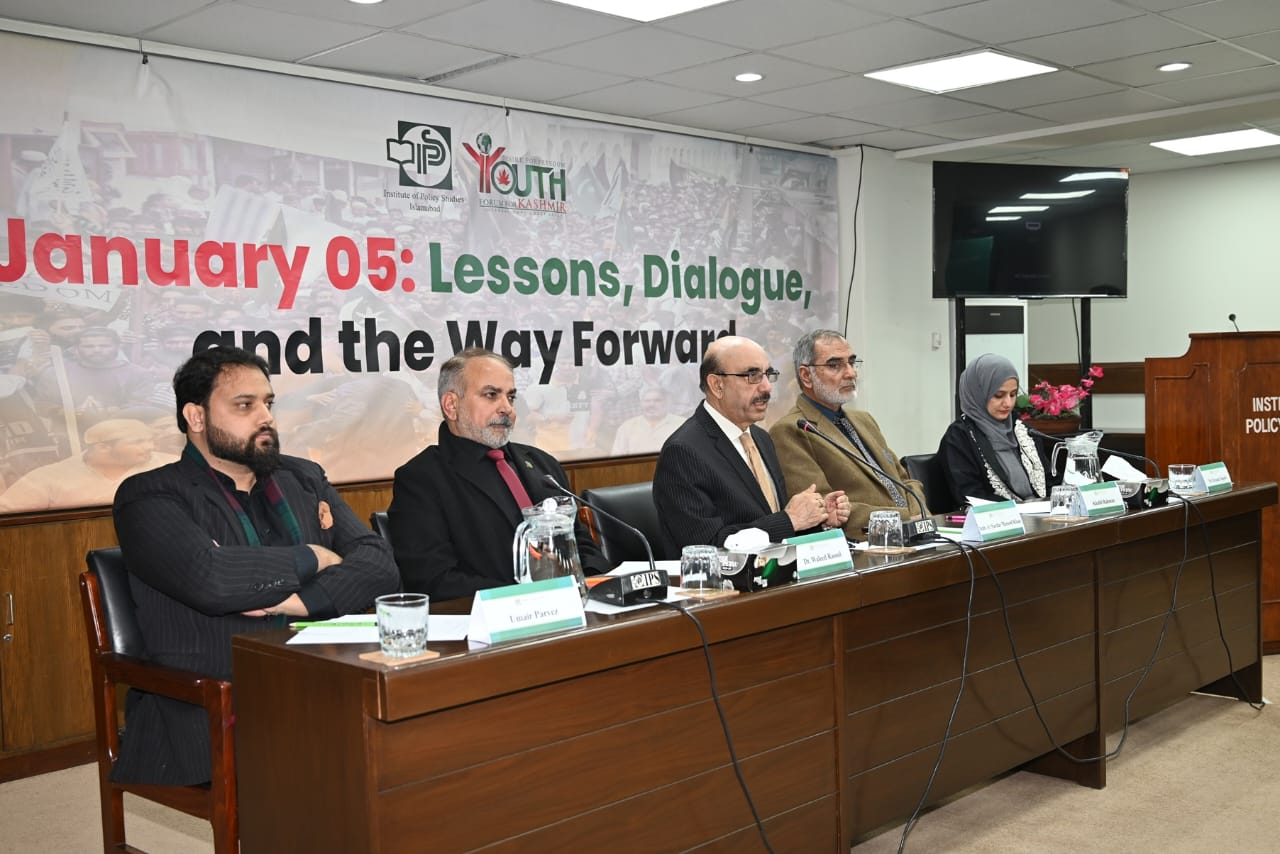 Islamabad: Speakers at a seminar in Islamabad reiterated that the Kashmir issue remains a legally valid and internationally recognized struggle for the right to self-determination, in accordance with the United Nations Security Council resolutions.
According to Kashmir Media Service, the seminar, organized the Institute of Policy Studies (IPS) in Islamabad in collaboration with the Youth Forum for Kashmir (YFK), highlighted that geopolitical power asymmetries have obstructed the resolution of Kashmir dispute, thereby placing renewed responsibility on Pakistan’s youth to carry forward the cause while remaining guided by the principles of Pakistan’s ideology.
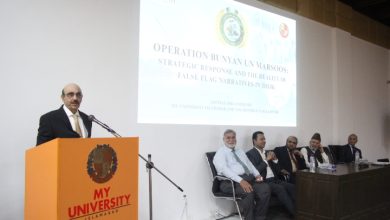
Titled “January 05: Lessons, Dialogue, and the Way Forward,” the seminar focused on the unresolved Jammu and Kashmir problem and its enduring legal, political, and moral dimensions. It brought together diplomats, scholars, and university students, fostering intergenerational discussion on the issue. The speakers included former AJK President and diplomat Sardar Masood Khan, IPS Chairman Khalid Rehman, Secretary of IPS Working Group on Kashmir Farzana Yaqub, Executive Director of the Institute of Dialogue, Development and Diplomatic Studies Dr. Waleed Rasool, Omer Pervez from the National Defence University, and Executive Director of the YFK Zaman Bajwa.
Sardar Masood Khan said that Generation Z, owing to its high exposure to social media, is uniquely empowered by unprecedented access to information and platforms for expression. This, in turn, places upon this generation the responsibility of highlighting the Kashmir cause at multiple levels. He suggested that the youth should regard themselves as the architects of the nation and, in this context, revisit the Kashmir issue while anchoring their ambitions within the ideological foundations of Pakistan. He also noted that successive generations have sacrificed in pursuit of a just resolution of the Kashmir issue, and it is now the responsibility of Pakistan’s youth to carry that legacy forward. He reiterated that Pakistanis and Kashmiris constitute a single entity, bound together by a shared ideology of brotherhood, and the events of May 2025 have further reinforced this collective resolve.

Dr. Waleed Rasool noted that January 5, 1949, is a significant day in Kashmiri history, as the United Nations Security Council clearly acknowledged the right of the Kashmiri people to decide their political future through a free and impartial plebiscite. Despite the passage of seven decades, the UN-mandated framework for self-determination remains unimplemented, largely due to the interests of major powers and prevailing power asymmetries within the international system. However, the failure to implement these resolutions does not diminish the legal validity of the issue; rather, it exposes the selective application of international law.
Umair Parvez argued that resolving the Kashmir issue is imperative because it concerns the Kashmiri people’s fundamental right to self-determination, a right affirmed by multiple UN resolutions. He observed that while inspiration may be drawn from peaceful self-determination movements, such as those in Ireland and Scotland, the reality of Indian colonial control in Kashmir means that resistance cannot be delegitimized. In this context, the concept of reputational security becomes relevant, as persistent rights violations in Kashmir undermine India’s international standing and, in turn, reinforce the legitimacy of the Kashmiri cause.
In his concluding remarks, Khalid Rahman highlighted the changing dynamics of the international system, noting that adversaries who fail to persuade their target populations often resort to spreading confusion and chaos to exert control over the masses. He further emphasized that the struggle for achieving any objective requires patience and a long-term, pragmatic vision on the part of stakeholders. At the same time, he stressed the importance of clarity of purpose and diversity in the means employed to achieve it.