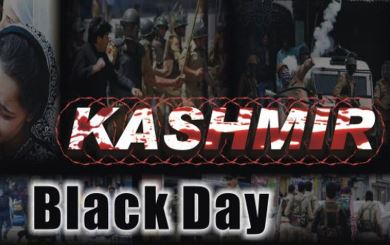

On January 26, while India celebrates its Constitution, Indian illegally occupied Jammu and Kashmir mourns. For us, the Republic Day is not a festival of democracy but a black day—an annual reminder of constitutional terrorism that transformed our homeland into an open-air prison. The tricolor flies over Srinagar as a flag of occupation, not liberation. This is not hyperbole; it is the lived reality of eight million people trapped between India’s democratic façade and its settler-colonial project.
The betrayal began not in 2019, but in 1948. The United Nations promised us a plebiscite to determine our future. India’s own Prime Minister, Jawaharlal Nehru, pledged before the world that Kashmir’s fate would be decided by its people. That promise now lies buried under layers of constitutional subterfuge and military boots. What started as a temporary accession became a permanent occupation, and a disputed territory is now being forcibly assimilated into a Hindu majoritarian state.

August 5, 2019, marked the final assault. In one swift stroke, India abrogated Article 370, dissolved our statehood, and bifurcated us into union territories—reducing an entire people to administrative subjects. This was not constitutional amendment; it was constitutional terrorism. The move was enforced under a total communications blackout, the longest internet shutdown in any democracy, with over 5,000 Kashmiris—including minors—swept into preventive detention under the draconian Public Safety Act and UAPA. Leaders were jailed, and the State Human Rights Commission was dissolved, eliminating even the pretense of domestic redress.
Since then, India has deployed a sophisticated toolkit of disenfranchisement. The domicile law, introduced in 2020, is demographic engineering disguised as policy. It grants residency rights to non-Kashmiris after just 15 years, opening the floodgates for settlers to purchase land and alter our Muslim-majority character. This is classic settler colonialism: change the facts on the ground, then hold a referendum on the new reality. Gerrymandering of assembly segments further dilutes our political voice, carving up constituencies to favor non-local populations and marginalize indigenous communities. Reservation policies are weaponized to exclude Kashmiris from government jobs while privileging outsiders, turning employment into a tool of occupation.
The surveillance state penetrates every mosque and home. Religious leaders are monitored, Waqf properties audited, and Friday sermons policed. The Kashmir Press Club was forcibly shut, its members threatened. Journalists face interrogation, spyware, and arrest under anti-terror laws for reporting facts. Government employees, teachers, and even doctors face punitive termination’s for social media posts deemed “anti-national.” This is not governance; it is carceral control.
The Indian military occupation remains the bedrock of this system. AFSPA grants soldiers immunity for killings, and the PSA allows detention without trial for two years. Bodies of those killed in staged encounters are not returned to families and thus denying the right to burial; compensation is denied as “seditious” demand. Human rights defenders documenting these crimes are incarcerated, offices sealed and fbank accounts frozen Justice is not delayed—it is systematically denied.
India claims this is “normalcy.” It points to local elections where people vote for municipal councils that cannot hire a sweeper without New Delhi’s permission. This is the ultimate democratic deception: preserve the form—ballots, assemblies, courts—while gutting the substance. The Lieutenant Governor, an unelected bureaucrat, holds absolute power over police, finances, and administration. Chief Ministers are reduced to glorified mayors. Citizens can elect, but cannot govern. This is electoral authoritarianism—the Kashmir template now being exported to the mainland through UAPA cases against activists like Anand Teltumbde and Pegasus surveillance of critics.
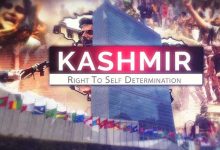
The international community watches in complicit silence. The UN resolutions remain unimplemented, and India’s strategic importance shields it from accountability. Yet Kashmiris have not surrendered the right to self-determination. We demand what was promised: a free and fair plebiscite under UN supervision. India’s denial of this right is not sovereignty; it is imperial hubris.
The Hindutva agenda is explicit. By disempowering Kashmir’s Muslim majority, India tests the machinery of majoritarianism for wider application. The policies perfected here—demographic flooding, constitutional erasure, surveillance capitalism—are already visible in Assam, Karnataka, and against minorities nationwide. Kashmir is not an exception; it is the laboratory.
We do not mourn the Indian Constitution out of spite. We mourn because its promises of equality, federalism, and justice were never exceptable to us . While Indians celebrate their republic, we commemorate it as black day. The black flags we raise on January 26 are not against India’s people, but against a state that has made constitutional terrorism its governing philosophy.
Until the international community enforces the UN-mandated plebiscite, and until India restores our right to determine our destiny, Kashmir will remain what it is: a territory under occupation, a democracy without rights, and a republic in name only. The question for the world is no longer about territorial dispute, but whether international law means anything at all. For Kashmiris, the answer is already written in the black banners that flutter across our valleys every Republic Day—a requiem for a promise betrayed, and a warning to democracies everywhere: if it can happen here, it can happen anywhere.
The writer is research associate at Kashmir Institute of International Relations (KIIR) and can be reached at shaziahashrafkhawaja@gmail.com