A Verdict That Chills Dissent
Human rights, electoral politics and the implications of the Andrabi sentencing in India

- Humayun Aziz Sandeela
When courts hand down life sentences in politically sensitive cases, the judgment rarely remains confined to the courtroom. It travels into the public sphere and shapes how citizens view the state, its institutions, and the meaning of justice itself. The decision by a Delhi court to sentence Kashmiri political figure Aasiya Andrabi to life imprisonment, while awarding 30-year terms to her associates Fehmida Sofi and Nahida Nasreen under India’s stringent Unlawful Activities (Prevention) Act (UAPA), has revived an old and uneasy debate. Where does legitimate counterterrorism end, and where does the suppression of dissent begin?
According to reports about the proceedings, the National Investigation Agency argued that a stern message was necessary and accused the three women of waging war against the Indian state through speeches, social media activity, and organisational work. The prosecution reflects a wider crackdown on pro-freedom voices in Indian illegally occupied Jammu and Kashmir (IIOJK).
Holder of a master’s degree in Arabic literature and a bachelor’s in biochemistry, Andrabi shot to prominence in the late 1980s when she launched a campaign against social evils under the banner of Dukhtaran-e-Millat. For the very first time, she was arrested in 1993 and since then has faced multiple detentions. Last, she was taken into custody in October 2016, released months later under house arrest, and then re-arrested in 2017 and shifted to Amphala Jail, Jammu.


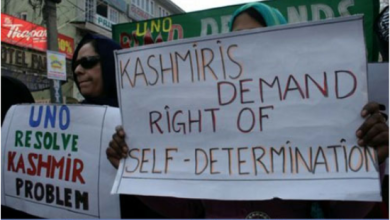
Andrabi’s activism has always been deeply intertwined with her political vision for Kashmir. She has been an avid supporter of the accession of Jammu and Kashmir to Pakistan and has openly expressed her admiration for Pakistan as a nation-state. This stance, highly controversial within India, has shaped both her public persona and the legal scrutiny she has faced. Her speeches and organisational activities often reflected this ideological commitment, which authorities cite as part of the justification for her prosecution. While supporters see her as a voice for Kashmiri self-determination, the Indian state has long framed such advocacy as a direct threat to national integrity.
In July 2018, Andrabi, then 60, was shifted to the punishment ward of Tihar Jail, a facility associated with strict schedules and forced physical labour, historically housing prisoners such as Maqbool Bhat and Afzal Guru. These measures appear designed to break her will and serve as a warning to others advocating for pro-freedom positions.
At the heart of this controversy lies a fundamental human rights question: should speech and political advocacy, even if controversial or deeply unpopular, invite punishments as severe as life imprisonment?
India is a signatory to the International Covenant on Civil and Political Rights (ICCPR), which establishes obligations regarding dissent, expression, and fair trial standards:
Article 19 guarantees freedom of expression, including the freedom to seek, receive, and impart information and ideas of all kinds.
Article 9 protects against arbitrary arrest or detention.
Article 14 ensures a fair and public hearing by a competent, independent, and impartial tribunal.
Similarly, Article 10 of the Universal Declaration of Human Rights guarantees a fair and public hearing.
International human rights jurisprudence emphasises that counterterrorism laws must not be so broadly applied as to criminalise political speech or peaceful advocacy. Over the past decade, several UN special rapporteurs have warned that sweeping national security laws risk eroding civil liberties if used without strict safeguards and judicial restraint.
Whether the Andrabi verdict satisfies these safeguards will ultimately be debated in appellate courts, legal scholarship, and diplomatic forums. Yet the optics, a life sentence linked largely to speech and organisational activity raise immediate questions about proportionality and due process.
This is not the first time a high-profile conviction in India has intersected with broader political developments. Observers often cite the conviction of senior Hurriyat leader Yasin Malik under UAPA following the revocation of Article 370 in 2019, which coincided with sweeping political changes in Kashmir. Similarly, prolonged detentions during protests against the Citizenship Amendment Act drew criticism from UN experts, including the detention of activist Umar Khalid, described as arbitrary and connected to protected rights such as expression and assembly. These cases contribute to what scholars and rights advocates describe as the securitisation of dissent, where political disagreement increasingly becomes framed as a security threat.
The timing of high-profile rulings often invites political interpretation. With elections approaching in states such as Assam, strong legal action against dissenting voices is frequently viewed as reinforcing a law-and-order narrative appealing to certain segments of the electorate. For the ruling Bharatiya Janata Party (BJP), projecting firmness against perceived threats to national unity has long been a central political message. Supporters see such actions as evidence of decisive leadership and commitment to national security. Critics, including Rashtriya Janata Dal leader Manoj Jha, have argued that these actions often serve to consolidate political support ahead of elections, while voters remain concerned about economic issues rather than nationalist rhetoric.
In principle, courts in a democracy should remain insulated from electoral cycles. Yet in highly polarised environments, even judicial decisions risk being interpreted through a partisan lens. Beyond legal arguments and political narratives lies the human dimension: Andrabi has been in custody since 2018, and her family has already endured decades of incarceration related to earlier cases involving her husband. For many in Kashmir, such stories exemplify the prolonged nature of the conflict and the deep mistrust defining relations with the Indian state.
Human rights discourse reminds us that justice must not only be done but be seen to be done. When communities perceive verdicts as politically driven, confidence in institutions erodes. The Andrabi case should therefore prompt broader reflection within India’s democratic framework. Every state has the right and responsibility to confront violence and armed militancy. However, these tools must remain consistent with international law, constitutional guarantees, and principles of proportional justice.
History repeatedly shows that political conflicts rarely find lasting resolution through punitive measures alone. Durable peace emerges when legal accountability is paired with dialogue, transparency, and respect for civil liberties. In that sense, the significance of this verdict extends beyond the fate of three individuals. It tests the credibility of democratic institutions, and in that test, the true measure of justice lies not in the length of a sentence, but in the fairness, independence, and integrity of the process that produced it.