Since the revocation of Article 370 in August 2019, Indian occupied Jammu and Kashmir has witnessed a systematic restructuring of land ownership, residency and legal protections. The developments are not isolated administrative actions but part of a broader pattern of engineered displacement. The policies governing land tenure, eviction and property control have collectively undermined the security of indigenous and local populations, transforming displacement into a structural outcome of state policy.
The scale of dispossession is reflected in official housing data. The government’s latest survey under the Pradhan Mantri Awas Yojana Gramin identifies 502,930 families as houseless and landless in Jammu and Kashmir as of April 2026. This figure highlights a widespread housing crisis that extends beyond poverty and reflects long-standing land insecurity. The identification of over half a million families without adequate housing confirms that displacement is no longer episodic but systemic.
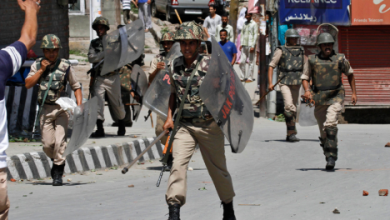
The anti-encroachment drives initiated since 2022 have played a central role in this process. The official figures indicate that more than 150,000 hectares of land have been reclaimed by the administration across Jammu and Kashmir. The authorities have framed these operations as legal land recovery. The implementation, however, has disproportionately targeted marginalized communities, particularly the Gujjar-Bakarwal population, which exceeds 1.2 million. These nomadic and semi-nomadic pastoralists depend on seasonal migration and customary land use. The demolition of their traditional dwellings known as kullas and grazing shelters known as bahaks has been reported in districts such as Anantnag, Ganderbal, Bandipora, Pahalgam, Sonamarg and Gurez. The destruction of these structures has displaced entire communities and disrupted traditional livelihoods.

The scale of land pressure is further evident in official encroachment data. The administration has reported that more than 18 lakh kanals of land are categorized as encroached. In parallel, government statements confirm that 14,359 hectares of forest land have been identified as encroached as of March 2026. These figures are being used to justify eviction campaigns that treat long-standing residents and indigenous populations as unauthorized occupants. The absence of clear distinctions between historical use and recent occupation has resulted in indiscriminate displacement.
The failure to implement protective legislation has intensified vulnerability. The Forest Rights Act of 2006, which provides legal recognition to forest-dwelling communities, remains largely ineffective in Indian occupied Jammu and Kashmir. The data from 2025 indicates that more than 70 percent of claims filed under the Act have either been rejected or remain pending. This administrative inaction has denied indigenous populations legal ownership and protection, effectively criminalizing their traditional presence on the land. The lack of recognition has made eviction both easier and more frequent.
The legal framework has further enabled displacement through property attachment laws. The Unlawful Activities Prevention Act and the Public Safety Act have been used to seize properties on allegations of links to militancy or dissent. The official records indicate that more than 90 properties have been attached between 2023 and early 2026. These seizures often occur without transparent judicial oversight, raising serious concerns regarding due process. The properties include residential homes, orchards and agricultural land, directly affecting livelihoods and housing security.
The changes in domicile and land ownership laws have reinforced this pattern. The repeal of domicile-based land protections in 2020 has allowed non-residents to acquire land in the region. This shift has altered land ownership patterns and facilitated the transfer of land to external actors. The revenue data indicates a steady increase in land transactions involving non-local buyers. The conversion of agricultural and orchard land into commercial projects and security infrastructure has accelerated, reducing access to land for local populations.
The urban dimension of displacement is also becoming more visible. The administrative records indicate that eviction proceedings have been initiated against residential units in urban areas, including Srinagar. The reports confirm that at least 50 residential units have faced eviction actions linked to disputes over land use and occupancy. These actions demonstrate that displacement is not limited to rural or forest areas but is expanding into urban spaces.
The consequences of engineered displacement extend beyond loss of shelter. The displacement of Gujjar-Bakarwal communities disrupts transhumance routes and undermines pastoral livelihoods. The loss of land access directly affects livestock-based economies, leading to economic insecurity and social marginalization. The housing crisis affects access to education, healthcare and employment opportunities, particularly for women and children. The psychological impact of forced eviction and uncertainty further compounds these challenges.
The legal implications are significant. The International Covenant on Economic, Social and Cultural Rights guarantees the right to adequate housing and protection against forced eviction. The United Nations Declaration on the Rights of Indigenous Peoples mandates free, prior and informed consent for actions affecting indigenous land. The current practices in Indian occupied Jammu and Kashmir fall short of these standards. The lack of consultation, absence of rehabilitation measures and reliance on coercive enforcement mechanisms reflect a clear gap between international obligations and ground realities.
The persistence of over 500,000 houseless families, combined with ongoing eviction drives and property seizures, demonstrates that engineered displacement has become embedded within governance structures. The absence of legal safeguards, coupled with expanding state control over land, continues to erode community resilience. The situation demands urgent attention to restore land rights, ensure legal protection and prevent further displacement. The evidence indicates a deliberate and sustained process that is reshaping land ownership, undermining indigenous rights and deepening housing insecurity across the region.
The author is the head of the research and human rights department of Kashmir Institute of International Relations (KIIR). She can be reached at : [email protected] and on X @MHHRsay