India’s human rights plunge amid crackdown on activists, Muslims: Amnesty
Watchdog says India using sedition, anti-terror laws to target journalists, others

London: Global rights watchdog Amnesty International has reported a sharp deterioration in India’s human rights situation over the past year as authorities weaponized sedition and anti-terrorism laws against activists, journalists, comedians, academics and students, while religious minorities — particularly Muslims — have faced escalating discrimination, mass evictions and targeted violence.
According to Kashmir Media Service, in its annual State of the World’s Human Rights 2025/2026 report, Amnesty International documented a sustained crackdown on freedom of expression, with the BJP-led Indian government ordering social media platforms to block accounts critical of its policies. In July, authorities ordered the platform X to block more than 2,000 accounts in India, including the international news service Reuters.
The repor highlighted individual cases illustrating the crackdown: a comedian in Maharashtra faced criminal charges for a stand-up routine containing a veiled reference to the state’s chief minister, while a university professor was arrested for social media posts about a military operation.


Counterterrorism laws were used to keep human rights defenders behind bars without trial. Three of the so-called “Bhima Koregaon 16” activists remained imprisoned at year’s end after years in pretrial detention. Similarly, Umar Khalid and at least five other Muslim students and activists also remained in pretrial detention over alleged involvement in 2020 communal violence in North-East Delhi, in which 53 people, mostly Muslims, were killed.
The report also noted that Muslims bore the brunt of discriminatory legislation. Multiple states advanced laws criminalizing interfaith marriage under the pretext of preventing so-called “love jihad” — a baseless claim that Muslim men seduce Hindu women into converting. Uttarakhand enforced a Uniform Civil Code requiring live-in relationships to be registered with state authorities.
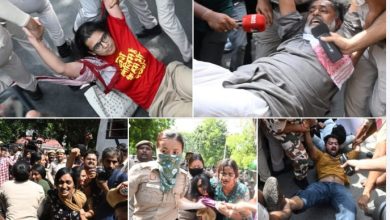
The Indian parliament passed the Waqf Amendment Bill, centralizing state control over Muslim religious assets and endowments. Protests against the law were met with force, resulting in at least three deaths and 150 arrests. Forced evictions of Muslim communities in Assam continued despite a 2024 Supreme Court directive ordering a halt to such actions. Between July and August alone, approximately 3,800 mostly Muslim households were rendered homeless across two separate eviction drives in Goalpara and Golaghat districts.
The report also condemned the forced deportation of at least 40 Rohingya Muslims to Myanmar in May following the Pahalgam attack. Amnesty described the operation, which involved blindfolding the individuals, transporting them via the Andaman Islands, and forcing them overboard ono a naval vessel to swim to a Myanmar island. Amnesty described the move as a serious violation of the principle of non-refoulement.
On environmental issues, the Climate Action Tracker rated the Indian government’s policies as “highly insufficient” and inconsistent with the 1.5°C global warming limit. India slipped 13 places in the 2025 Climate Change Performance Index due to continued coal reliance. In October and November, New Delhi was ranked the world’s most polluted city.
On the international accountability front, at least 19 visit requests from UN special procedures remained unanswered at year’s end, including a request from the Special Rapporteur on torture first submitted in 1999.