Each year, segments of the global Sikh diaspora observe what is often referred to as ‘Khalistan Day’ or ‘Khalistan Declaration Day’, a commemoration that is at once historical, political and deeply emotional. It is observed annually on April 29, marking the 1986 announcement by a 5-member Panthic Committee declaring the creation of an independent Sikh state called Khalistan from the Akal Takht Sahib within the Golden Temple complex in Amritsar, Punjab. The day is marked by global events, prayers, and calls for a Sikh homeland by various groups. To those who mark it, it is rooted in questions of identity, justice and the right to self-determination. Understanding why this day is observed requires stepping beyond headlines and into the layered history of Sikh experience in the subcontinent and abroad.
The idea of Khalistan, a sovereign Sikh homeland, did not emerge in a vacuum. Its ideological seeds are often traced to the tumultuous years surrounding the partition of British India in 1947, when competing nationalisms redrew borders but left unresolved anxieties among minorities. For some Sikh thinkers, the partition underscored a fear: that a community with a distinct religious, cultural and historical identity might remain politically marginalised in a majoritarian framework.
These concerns intensified over the decades, particularly during moments of acute crisis. The events of 1984 remain central to the consciousness surrounding Khalistan Day. In June of that year, the Indian Army launched Operation Blue Star inside the Golden Temple complex in Amritsar, a site of immense spiritual significance to Sikhs. The operation, aimed at removing armed militants, resulted in significant casualties, including great Sikh leader Jarnail Singh Bhindrawale, and damage to the shrine. Later that year, the assassination of Prime Minister Indira Gandhi by her Sikh bodyguards triggered anti-Sikh pogroms in which thousands were killed, particularly in Delhi. For many Sikhs, these events are not simply historical episodes; they are collective trauma.
It is within this context that Khalistan Day is observed. For its proponents, the day serves as a symbolic reaffirmation of a political aspiration and a memorialisation of perceived injustices. It is not uniformly observed across all Sikh communities, indeed, opinion within the Sikh world is far from monolithic, but where it is marked, the emphasis often lies on remembrance, mobilisation and advocacy.
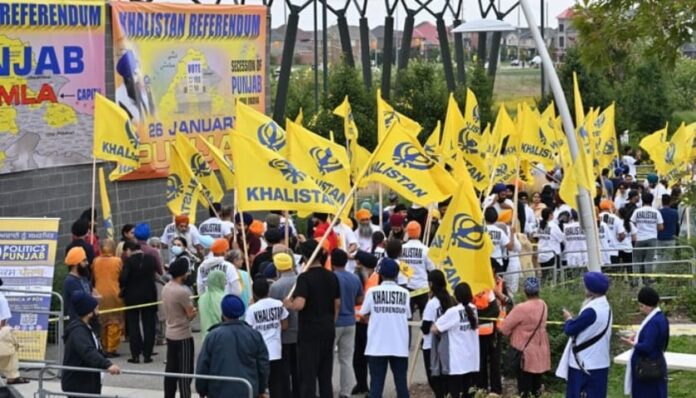
The manner of observance varies across geographies. In cities with significant Sikh diaspora populations, such as London, Vancouver, New York and Melbourne, Khalistan Day may be marked by rallies, conferences and community gatherings. Gurdwaras (Sikh places of worship) sometimes host discussions, prayer services and exhibitions highlighting historical narratives tied to the movement. Banners, flags and speeches often articulate calls for justice, recognition or, in some cases, independence.
One notable feature of recent years has been the internationalisation of the issue. Advocacy groups, particularly in North America and Europe, have sought to frame the Khalistan question within the language of human rights and self-determination. Campaigns such as non-binding referendums organised by diaspora groups aim to draw attention to the cause, even as their legitimacy and impact are widely debated.
Leaders associated with these movements often employ stark rhetoric. Gurpatwant Singh Pannu, a prominent figure linked to the organisation Sikhs for Justice (SFJ), has repeatedly described India in deeply critical terms, alleging systemic persecution of Sikhs over decades. He has often characterised the situation as one of “genocide” and “ethnic cleansing”, which reflects the intensity of feeling among Sikh diaspora.
Recent controversies have further intensified these tensions, lending contemporary urgency to what might otherwise be seen as a largely historical or diasporic cause. The observance of Khalistan Day today is increasingly shaped not only by memories of 1984, but by unfolding developments that many supporters interpret as extensions of the same unresolved conflict. The 2023 assassination of Hardeep Singh Nijjar outside a gurdwara in Surrey, Canada, marked a pivotal moment. Justin Trudeau publicly stated that Canadian security agencies were pursuing “credible allegations” linking agents of the Indian government to the killing.
Subsequent disclosures deepened the crisis. Canadian authorities indicated they were examining evidence suggesting a broader network in which Indian diplomatic officials allegedly gathered intelligence on Sikh activists, with some individuals later targeted through criminal intermediaries. Reports in 2026 further claimed that consular staff in Vancouver may have played a role in facilitating information flows connected to Nijjar’s killing, though these assertions remain contested and under active investigation.
The concerns are not confined to Canada. In the United States, federal prosecutors brought charges in connection with a foiled plot to assassinate Gurpatwant Singh Pannun, in what officials described as a possible extension of a transnational campaign. Parallel warnings issued by Canadian law enforcement to Sikh activists about credible threats to their lives, alongside allegations of surveillance, intimidation and coercion have reinforced a growing perception among advocacy groups that dissent linked to Khalistan is being pursued beyond India’s borders.
For many who observe Khalistan Day, these developments are not isolated incidents but part of a continuum that reinforces their sense of grievance and political purpose. The commemorations, therefore, are no longer solely about remembering past injustices; they are also framed as acts of resistance in the present. The widening diplomatic fallout and competing narratives have ensured that Khalistan Day is observed against a backdrop of renewed global scrutiny, where history and current affairs increasingly converge.
For many Sikhs who observe Khalistan Day, however, the significance is not limited to geopolitical aspirations. It is also about identity preservation in diaspora settings. Commemorative events often blend political messaging with cultural expression, music, poetry and community solidarity, reflecting a broader effort to sustain a sense of belonging across generations and continents.
Khalistan Day, then, is best understood not as a single narrative but as a prism through which multiple stories intersect, of grievance and memory, aspiration and identity, politics and faith. For its supporters, it represents an unfinished quest for justice and autonomy. For its critics, it raises concerns about division and historical revisionism. For observers, it offers a window into how diasporic communities engage with homeland politics in an increasingly interconnected world.
Ultimately, the endurance of Khalistan Day speaks to the power of memory. Decades after the events that galvanised the movement, the questions it raises, about minority rights, state power and the meaning of self-determination, remain unresolved. Whether one views it as a legitimate political aspiration or a contentious cause, it cannot be dismissed as irrelevant. It persists because, for those who observe it, the past is not past and the search for dignity, in whatever form it takes, continues.