From 1931 to the Present: The Enduring Legacy of Kashmir’s Freedom Struggle
 Saba Ghulam Nabi
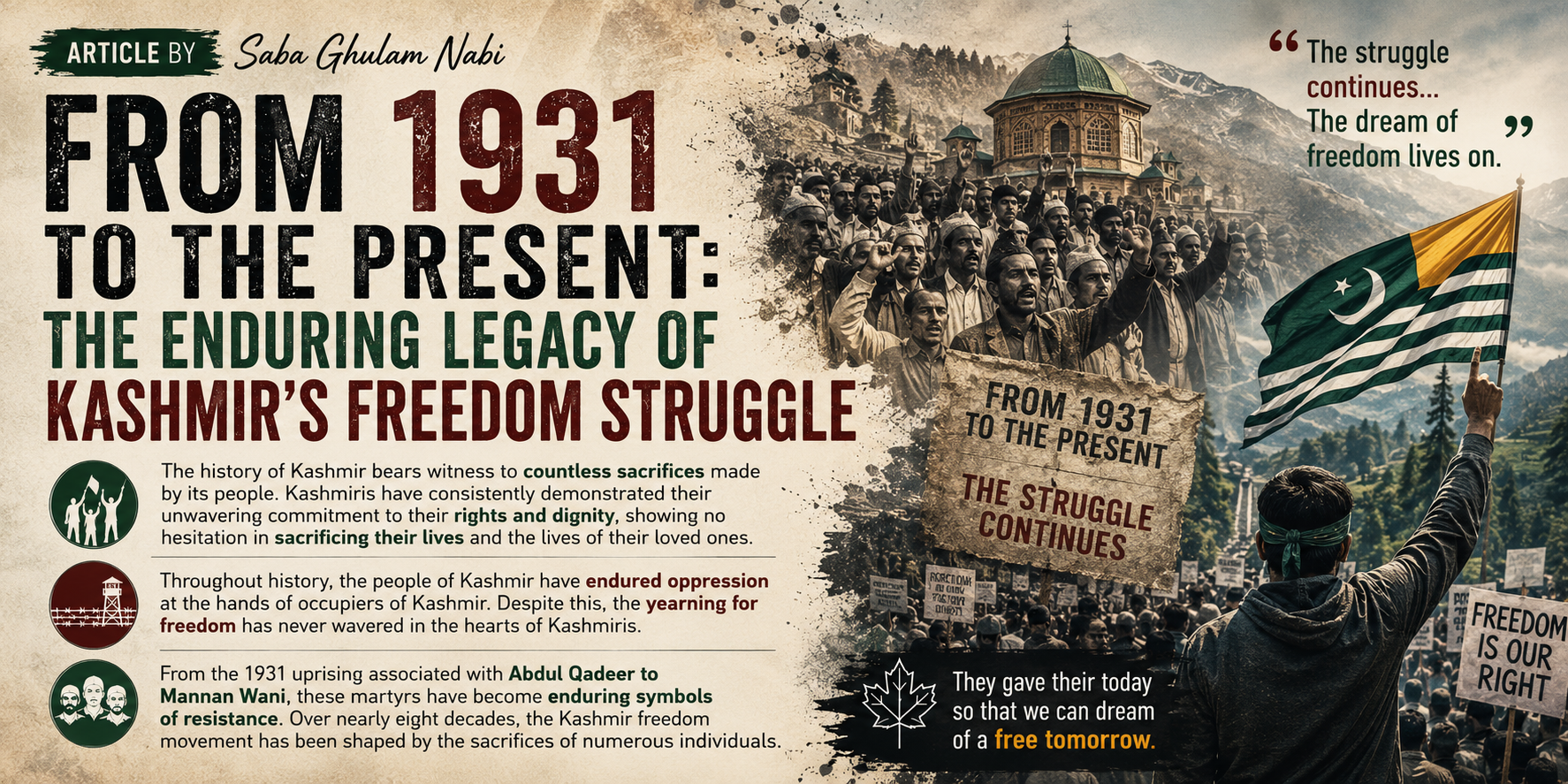
The history of Kashmir bears witness to countless sacrifices made by its people. Kashmiris have consistently demonstrated their unwavering commitment to their rights and dignity, showing no hesitation in sacrificing their lives and the lives of their loved ones. Throughout history, the people of Kashmir have endured oppression at the hands of occupiers of Kashmir. Despite this, the yearning for freedom has never wavered in the hearts of Kashmiris.
From the 1931 uprising associated with Abdul Qadeer to Mannan Wani, these martyrs have become enduring symbols of resistance. Over nearly eight decades, the Kashmir freedom movement has been shaped by the sacrifices of numerous individuals.
One significant event that exemplifies this spirit occurred on 13th July 1931, when 22 Kashmiris were mercilessly gunned down by Dogra forces in Srinagar while striving to complete the call to prayer. During the reign of the Dogra regime, Kashmir witnessed one of its most oppressive eras.


Maharaja Hari Singh, who ascended to the throne in 1920, had initially hoped to govern wisely due to his education and enlightenment. However, he continued the policies of his predecessors, imposing burdensome taxes, restricting the religious practices of Muslim subjects, and subjecting the Muslim community to discrimination.
Meanwhile, political awareness among Kashmiris was on the rise. In 1930 and 1931, incidents of blasphemy took place in Jammu and Kashmir, which deeply offended the tolerant Muslim population. In Srinagar, Muslims organized a protest procession. Amidst the gathering, a young man named Abdul Qadeer Khan took the stage and delivered a scathing speech against the rule of the Maharaja. He was subsequently arrested and put on trial, prompting Kashmiris to demand an open hearing, a request that was denied by the Maharaja’s government.
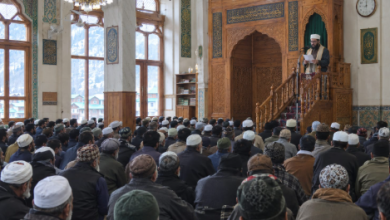
On the day of the trial, Kashmiris gathered outside the jail. When the time for the Zuhr prayer arrived, one individual began the Azan (call to prayer). The police of the Maharaja opened fire, killing the individual. Undeterred, another person took his place and continued the Azan, only to meet the same fate. This cycle repeated until 22 Kashmiris had been shot dead.
This tragic incident marked a turning point in the political landscape of Jammu and Kashmir, shaping the mood and nature of Kashmiri politics. According to Sheikh Abdullah, as described in his book, “Aatish e Chinar,” “the news of the incident spread like wildfire across the Kashmir Valley. Abdullah hurried to the location and found one injured person still alive. Upon reaching him, the dying man uttered, “Sheikh Sb, we have fulfilled our duty; now it’s your turn”. Grieving Muslims carried the martyrs’ bodies to the Jamia Masjid in Srinagar and launched protests against the government. Prominent leaders of Jammu and Kashmir were arrested and imprisoned. It was at this point that Muslims began contemplating the formation of their political party and embracing a democratic path to free themselves from the oppressive rule of the Maharaja.
Thus, the enraged Muslims established the political party “Muslim Conference.” Before the formation of this party, smaller groups of like-minded individuals had been working towards creating awareness and safeguarding rights, but there was no structured political party representing Kashmiri Muslims or the larger Kashmiri populace at that time. The struggle of Kashmiris, which commenced on that fateful day, has persevered and grown stronger over time. Despite facing numerous instances of violence and carnage since 1931, the resilience and spirit of the Kashmiri people have remained unwavering. Each tragic event has only served to fuel their determination, fortifying their resolve in the pursuit of justice, freedom, and self-determination.
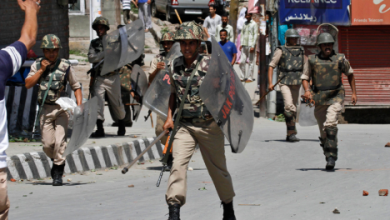
The unwavering spirit of the Kashmiris continues to be a source of inspiration and a testament to their unwavering commitment to securing a better future for themselves and their land. Unfortunately, the fate of Kashmiris remains unchanged. The Modi regime has controversially integrated a portion of Kashmir into India through an illegal process. In the illegally occupied region, Kashmiris are deprived of their voice and are not allowed to raise their concerns on international platforms or any other forum.
Their voices have often been suppressed through the use of force, including firearms, explosives, and other coercive measures. Despite longstanding international attention, the United Nations has been unable to effectively implement its resolutions or prevent continued civilian suffering in Kashmir. Furthermore, some international observers have warned that, without meaningful intervention, the humanitarian situation in the occupied territory could deteriorate significantly. These challenges underscore the prolonged hardships faced by the people of Indian illegally occupied Jammu and Kashmir and highlight the need for a just, peaceful, and sustainable resolution that safeguards their rights and well-being.
The writer is a Research Officer at the Center for International Strategic Studies Azad Jammu and Kashmir (CISS-AJK).