Modi govt bans telegram, intensifies pressure on digital platforms to silence dissent
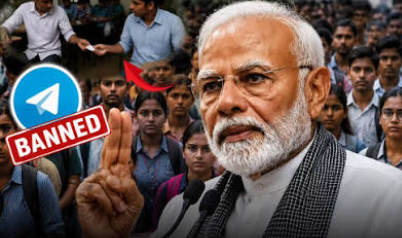
Islamabad: The Modi-led Indian government has temporarily banned Telegram and intensified pressure on digital platforms to silence dissent.
According to Kashmir Media Service, it has extended its assault on democratic norms into the digital sphere, using censorship, platform bans and coercive regulation to suppress criticism of the BJP-led government under Prime Minister Narendra Modi.
In June 2026, the Modi government imposed a nationwide ban on Telegram under Section 69A of the Information Technology Act, blocking a platform used by more than 150 million Indians and restricting message-editing features until 30 June 2026, disrupting communication for millions.


The government justified the ban by citing the NEET-UG 2026 examination involving nearly 2.2 million candidates, but critics argue the move exposed the regime’s willingness to collectively punish millions of users instead of addressing institutional failures and examination leaks.
Telegram was removed from app stores and remained inaccessible across India from June 16–22, 2026, demonstrating the government’s growing reliance on digital shutdowns rather than democratic accountability.
The Delhi High Court upheld the temporary restrictions, reinforcing concerns that judicial institutions are increasingly validating sweeping executive censorship instead of safeguarding constitutional freedoms.
Simultaneously, the Modi government intensified pressure on Meta, summoning senior global executives after Facebook temporarily restricted a video of Prime Minister Narendra Modi and demanding stricter compliance with India’s expanding censorship regime.
Government agencies also targeted WhatsApp, Instagram and Facebook through repeated notices, investigations, accelerated takedown rules, Sahyog portal compliance demands, traceability requirements and increasing regulatory pressure over content moderation.
India’s accelerated takedown framework now requires removal of certain content within as little as three hours, giving authorities unprecedented powers to rapidly suppress online information before meaningful public scrutiny can occur.
Government pressure on digital platforms affects over 500–850 million WhatsApp users, 150 million Telegram users, and hundreds of millions of Facebook and Instagram users, making India’s censorship policies among the world’s largest restrictions on digital communications.
India’s Ministry of Electronics and Information Technology issued approximately 24,300 content-blocking orders during 2025, nearly double the roughly 12,600 orders recorded in 2024, reflecting a dramatic expansion of state-directed online censorship.
India has become Telegram’s largest source of law-enforcement requests globally, while cyber-related investigations are increasingly accompanied by demands for greater government access to private digital communications.
International watchdogs continue documenting India’s deteriorating democratic environment. Reporters Without Borders ranked India 157th out of 180 countries in the 2026 World Press Freedom Index with a score of only 31.96, placing it in the “Very Serious” category after falling six places from the previous year.
Freedom House rated India’s internet freedom only 51 out of 100, classifying the country as merely “Partly Free,” reflecting increasing censorship, surveillance and restrictions on digital expression.
The BJP-led government’s growing confrontation with technology companies illustrates an expanding model of digital authoritarianism in which regulatory pressure, platform bans, content removals and surveillance mechanisms increasingly replace democratic tolerance of dissent.
Rather than strengthening democracy, the Modi government’s expanding censorship architecture has raised concerns that India is constructing a digital iron curtain designed to restrict communication, discourage criticism and control public discourse.