Indian judiciary failing to protect liberty, fundamental rights: former SC judge
Justice Gupta warns prolonged detentions, opaque appointments and majoritarianism threaten Indian democracy

New Delhi : Former Indian Supreme Court judge Justice Deepak Gupta has criticized the judiciary’s failure to protect individual liberty, citing rights activist Umar Khalid’s prolonged incarceration and the Elgar Parishad case. He said “the process has become the punishment” as people are labelled “anti-nationals” and their lives are ruined.
According to Kashmir Media Service, writing in The Tribune, India, in an article titled “The True Meaning of Freedom”, Gupta argued that independence is not merely freedom from foreign rule but also means that citizens should be able to “think and speak without fear”, express dissent and receive equal treatment regardless of caste or religion. He said India can be truly independent only when it gets rid of “corruption, bias, bigotry and intolerance.” He stressed that “no country can claim to be independent unless it has an independent and fearless judiciary.”
Gupta said this requires judges with integrity, intellect and “a spine,” the strength to stand up for justice and the courage to fight injustice and the ability to act “without fear or favour.”

He said that, sadly, constitutional courts in recent years had failed to demonstrate the “requisite sensitivity or strength” in protecting and upholding citizens’ fundamental rights. Referring specifically to the right to liberty under Article 21 of the constitution, he said that the right was being violated “with impunity” and that courts in many cases had become “mute spectators.”
Addressing the issue of bail and prolonged pre-trial detention, Gupta said while “bail, not jail, is the rule” is a frequently cited legal principle, but in practice “jail, not bail” has become the rule. He noted that about 75% of people behind bars are undertrials, compared with about 24% who are convicts, describing it as shocking that there are roughly three undertrials for every convicted person.
Blow to BJP’s anti-book policy as IIOJK court quashes scholar’s PSA detention
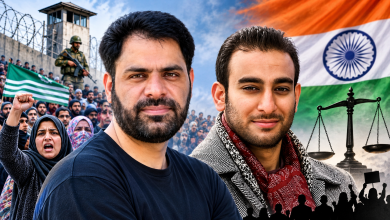
Against this backdrop, Gupta highlighted the case of rights activist Umar Khalid, writing, “Umar Khalid has been behind bars for more than six years and the trial has not even started. What about his right to liberty? What about his right to speedy trial?”
He also referred to the Elgar Parishad case, noting that the accused had remained behind bars for years and that one of them had died in jail, while the trial had still not begun eight years after the incident. The case involves the arrest of multiple human rights activists, lawyers, and academics whom Indian authorities have accused of having links to the banned Communist Party of India (Maoist).
Gupta questioned why, if the allegations were as serious as claimed, the prosecution had not shown the same urgency in commencing the trial. He said that “the process has become the punishment”, arguing that people are condemned and their lives ruined by being labelled “anti-nationals”, while courts have failed to protect their fundamental rights.
He also discussed the detention of Ladakhi activist Sonam Wangchuk, criticizing repeated adjournments by the Indian top court in the habeas corpus proceedings.
Gupta further expressed concern about what he described as majoritarianism within the Indian judiciary. While democracy is based on majority rule, he wrote, majoritarianism, where the voice of the other side is not heard, is “anathema to democracy”, adding that “courts at all levels are moving towards majoritarianism.”
He cited the Ram Janmabhoomi and Gyanvapi mosque cases in this context, saying the latter had opened the “floodgates of litigation” that could affect relations between communities. He described the decision as one taken to “appease the majority.”
Gupta also contrasted the treatment of people from different communities in bail matters, writing that members of one community who consumed chicken in a boat on the Ganga were denied bail for months, while members of the majority community who consumed liquor on the same river were granted bail within hours.
He said that such differential treatment was not the justice, liberty, equality or fraternity guaranteed by the Constitution.
Gupta also criticized the collegium system for judicial appointments, calling it “totally opaque” and saying important decisions were taken without sufficient explanation. He raised concerns about the social composition of the higher judiciary, noting that many recent appointments to the Supreme Court had come from upper-caste backgrounds.
Concluding his article, Gupta warned that if people lose faith in the judiciary, it could become irrelevant and “sound the death knell for a democratic India.”