Sinha’s ‘civilisational revival’ push raises concerns over Hinduization of IIOJK
India’s pre-Islamic narrative seeks to marginalize Kashmir’s Muslim heritage
Srinagar : Political analysts have expressed concern over the Indian government’s growing emphasis on a so-called “civilisational revival” in Indian illegally occupied Jammu and Kashmir, saying the promotion of a predominantly pre-Islamic cultural narrative risks marginalizing the territory’s centuries-old Muslim heritage and distinct identity.
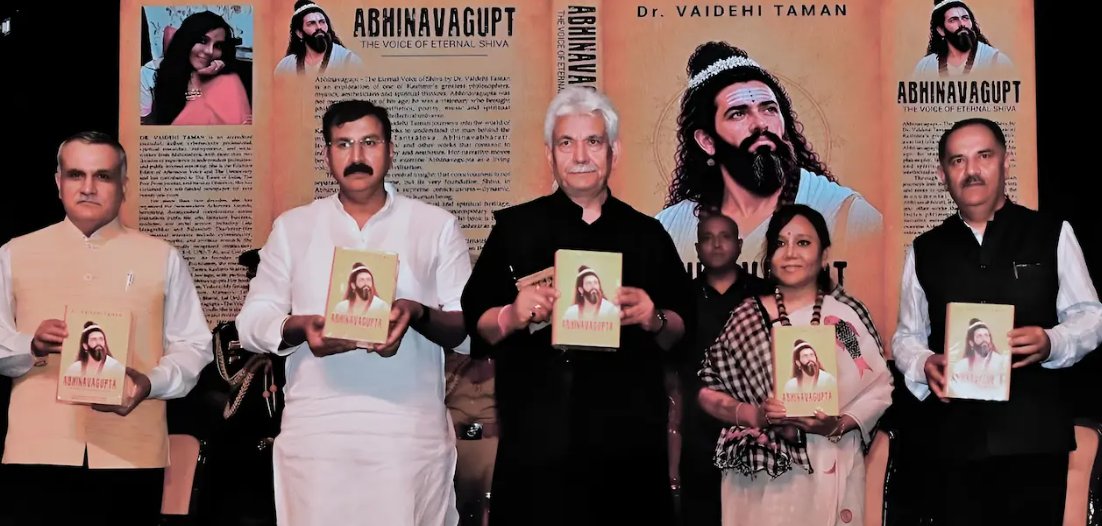
According to Kashmir Media Service, the concerns were reinforced after Indian illegally occupied Jammu and Kashmir’s Lieutenant Governor Manoj Sinha released a book on the 10th-century Kashmir Shaivite philosopher Abhinavagupt and called for the revival of what he described as Jammu and Kashmir’s “civilisational legacy.”
Sinha released Dr Vaidehi Taman’s Abhinavagupt – The Eternal Voice of Shiva at an event in Jammu and described the neglect of Abhinavagupt’s contributions as “damage to civilizational memory”. He urged universities, schools and cultural institutions to promote research and education on ancient thinkers and called for greater institutional support for such work.

“The time has now come to correct these historical oversights,” Sinha said, adding that young people had the right to know “how vast, how ancient, and how connected to the global community is the intellectual depth of the civilization they inherit.”
Political analysts said that while the study and preservation of Kashmir’s ancient intellectual traditions is not inherently objectionable, the selective projection of pre-Islamic heritage by the Indian authorities must be viewed in the context of the broader political and constitutional changes imposed on IIOJK since August 2019.
They said Kashmir is an overwhelmingly Muslim-majority territory whose religious, cultural and social character has evolved over centuries, with Islam and the indigenous Rishi-Sufi tradition forming a central part of its contemporary identity. In their view, presenting Kashmir primarily through a pre-Islamic civilisational framework can contribute to an attempt to recast the territory’s historical identity while downplaying the contributions and heritage of its Muslim majority.
The analysts said the issue assumes greater significance because the Bharatiya Janata Party (BJP)-led Indian government revoked occupied Jammu and Kashmir’s special status in August 2019 and subsequently introduced a series of administrative, legal and demographic changes. They argued that cultural and historical narratives are an important component of this wider transformation.
They pointed to Sinha’s recent speeches in which he has repeatedly used terms such as “civilisational resurgence” and “renaissance” while describing post-2019 changes in Jammu and Kashmir. In a recent address in Chicago, Sinha said the abrogation of Article 370 had “transformed the destiny” of Jammu and Kashmir and described the changes as “not just progress but a renaissance.”
Political analysts said the repeated invocation of a civilisational revival, coupled with initiatives centred on ancient Hindu and Shaivite heritage, has fuelled apprehensions among Kashmiris that their Muslim identity is being progressively pushed to the margins.
They maintained that Kashmir’s historical legacy cannot be reduced to one religious tradition and cautioned against using ancient heritage as a political instrument to redefine the identity of the present-day population.
The analysts further noted that efforts to revive Hindu heritage in Kashmir have increasingly been linked by proponents to a broader idea of restoring an ancient Indian civilisational connection. Recent material promoting the restoration of Kashmir’s temples and sacred sites, for instance, explicitly describes such initiatives as part of a wider effort to reconnect Kashmir with a larger “Bharatiya civilisational” narrative.
They said Kashmiris remain deeply conscious of their distinct Muslim identity and are likely to resist any effort to impose a politically motivated cultural narrative on the territory.