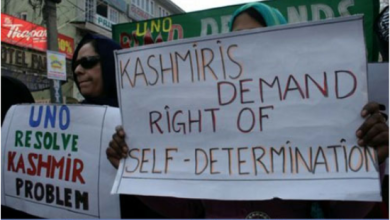
 For more than three decades, Yasin Malik has stood as one of the most recognisable faces of the Kashmiri struggle for self-determination. Today, he is imprisoned in Delhi’s Tihar Jail, where he is serving a life sentence. His health has reportedly deteriorated, and his voice has increasingly been expressed through written affidavits filed by his lawyers. His story is no longer just about one man. It has become a symbol of how India deals with anyone who dares to speak for Kashmir’s right to decide its own future.
Malik once led the Jammu Kashmir Liberation Front (JKLF), a group that gave up armed struggle in 1994 and turned instead to peaceful political campaigning for Kashmiri self-determination. For years, he was seen even by Indian officials as someone worth talking to, a man who met prime ministers, took part in dialogue efforts, and tried to build a peaceful path forward for his people.
That history makes his current punishment harder to justify. In 2022, a special Indian court sentenced Malik to life imprisonment in a fabricated case, accusing him of receiving money to support unrest in the valley, including the mass protests of 2010 and 2016. His organisation, the JKLF, was banned in 2019, and that ban was renewed for another five years in 2024, a sign that the Indian state has no intention of allowing his political movement to exist in any form, even on paper.
Rights groups have long argued that laws like the Unlawful Activities (Prevention) Act, used to convict him, are written broadly enough to criminalise political dissent itself, not just violence. Malik’s case is one of the clearest examples cited by international observers of how such laws are used against Kashmiri political leaders rather than against proven acts of terror.
The past few weeks have brought a fresh and painful chapter. In early September 2026, Malik filed a lengthy affidavit before the court handling a separate, decades-old case from 1990. In it, he said he would no longer contest the case, though he continues to deny any involvement in the killing. He also asked the court to sentence him to death, and announced that he was ending his marriage to his wife, Mashaal Hussain Malik, saying he did not want her to spend her life carrying the weight of his imprisonment.
Whatever one makes of the legal case itself, the human picture here is stark: a man in his late fifties, held for years without trial for long stretches, choosing to stop fighting for his own life and asking, instead, to be put to death rather than continue enduring incarceration. Supporters and Kashmiri civil society figures have described this less as an admission of guilt and more as the visible toll of prolonged, punitive detention: a man worn down not by conscience, but by a system built to wear him down.
Reports over the years have repeatedly raised concerns about his health, citing cardiac and kidney problems, and about delays in providing him proper medical treatment. Courts have had to intervene more than once simply to ensure Tihar Jail authorities gave him basic care.
Malik’s ordeal cannot be separated from the wider human rights record in Indian illegally occupied Jammu and Kashmir. United Nations experts have documented thousands of arbitrary detentions, the use of preventive-detention laws to hold journalists and activists indefinitely, communication blackouts, and restrictions on basic freedoms since India revoked Jammu and Kashmir’s special status in 2019. Independent monitors, including UN-mandated experts, have called for the release of individuals held without proper due process, language that fits Malik’s case closely.
International rights organisations have also flagged the near-total impunity enjoyed by Indian forces’ personnel in the region, even as ordinary Kashmiris, human rights defenders, and political leaders face swift and harsh prosecution. Malik’s continued imprisonment, critics argue, sends a clear message: that any Kashmiri who organises politically for self-determination, even peacefully, even at the negotiating table, risks the same fate.
Yasin Malik’s case raises a question that goes beyond one courtroom in Delhi: can a state claim to offer justice while treating political dissent as terrorism? For Kashmiris watching his health decline behind bars, and for a movement that has lost its one of most recognisable voice to a life sentence, the answer feels painfully clear.
His story is not over. But as things stand, one of Kashmir’s most prominent advocates for self-determination remains silenced, not defeated in argument, but muzzled by a legal system his supporters say was never built to hear him out.
The author is a student of International Relations at the International Islamic University, Islamabad. Currently, she is serving as a Researcher at the Kashmir Institute of International Relations Islamabad.