Statehood Is Not the Kashmir Question
Humayun Aziz Sandeela
Restoring statehood may return political powers to an elected government in IIOJK, but it cannot resolve the deeper question at the heart of Kashmir. Statehood can change the machinery of governance; it cannot settle the political future of the Kashmiri people.
Seven years after New Delhi revoked occupied Jammu and Kashmir’s special constitutional status and reorganised the former state as a Union Territory, the latest demand for restoration of statehood from its elected Assembly has exposed a question that goes well beyond administrative powers: what, exactly, is being restored, and what remains unresolved?
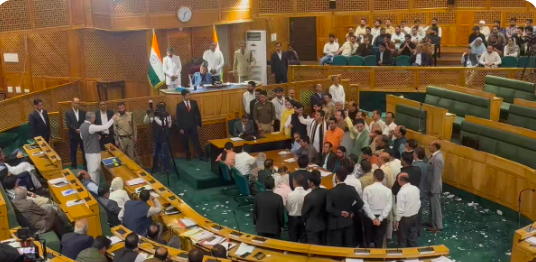
On September 28, the Jammu and Kashmir Legislative Assembly passed a resolution calling for the “immediate and urgent restoration” of full statehood. Chief Minister Omar Abdullah described statehood as “our right”, while Bharatiya Janata Party legislators opposed the resolution, protested in the House and walked out before the vote. According to The Indian Express, the BJP objected particularly to references to Jammu and Kashmir’s position before August 5, 2019.
The dispute over the wording was significant. The Indian Express reported that ten amendments were moved, eight seeking the restoration of the special status that existed before August 2019. The amendments were not pressed after Omar Abdullah appealed for their withdrawal. The resolution that eventually passed therefore centred on statehood, while retaining references to earlier Assembly positions.
That distinction matters because statehood and the constitutional arrangement that existed before 2019 are not the same question.
Restoring statehood would change the administrative and political relationship between Srinagar and New Delhi. It would return greater authority to an elected state government after the former state was divided into Union Territories and its status was downgraded. India’s Supreme Court, while upholding the 2019 constitutional changes in December 2023, directed that elections be held by September 2024 and stated that “restoration of statehood shall take place at the earliest and as soon as possible”.
Elections have since been held, but statehood has not been restored. That delay has inevitably become part of the political argument.
Omar Abdullah has repeatedly questioned what the Indian government means by restoring statehood at an “appropriate time”. As reported by The Indian Express, he told the Assembly that the elected government had been waiting for two years for New Delhi to fulfil its commitment. He also linked the difficulties faced by his government in exercising authority over various departments and institutions to the Union Territory arrangement.
There are competing interpretations of why statehood has remained pending. Some Kashmir observers see the delay as more than a question of timing. In their view, New Delhi may have been reluctant to surrender an issue that can still be presented as a significant concession to Jammu and Kashmir, allowing the eventual restoration of statehood to appear as a political gesture rather than simply the fulfilment of a commitment already made. There is also a view that the timing may have been influenced by the possibility of restoring statehood under a government led by the Bharatiya Janata Party in Jammu and Kashmir, giving the party greater ownership of the decision and allowing it to shape the political narrative around it. Neither interpretation can be established as fact, but both help explain why the delay continues to attract political scrutiny.
The BJP, for its part, has said it supports restoration of statehood while rejecting any suggestion that statehood should mean a return to the constitutional position that existed before August 2019. Its opposition inside the Assembly therefore illustrates a fundamental disagreement over what restoration should encompass.
Yet the Assembly debate also reveals the limits of treating statehood as the whole Kashmir question.
For New Delhi, the issue can be framed primarily as one of federal structure and administration. For the National Conference-led government, it is also about recovering political authority and institutional space lost after 2019. For majority of Kashmiris, however, the political question has historically been much larger.
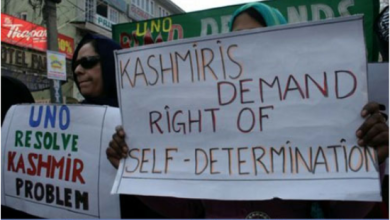
The Kashmir dispute cannot be reduced to the question of whether an elected government in Srinagar has regained its statehood. At its heart lies the unresolved question of the political future of the Kashmiri people and their right to determine that future. Elections conducted under India’s constitutional and administrative framework may provide a mechanism for choosing a government, but they do not, by themselves, settle the question of self-determination. The restoration of statehood, important as it may be for governance, therefore cannot be presented as a substitute for addressing the larger political dispute over Jammu and Kashmir.
That is why the Assembly resolution should be understood in its proper context. It reflects the concerns of an elected government functioning under a Union Territory system and its demand for greater constitutional and administrative authority. It does not, however, speak for every political constituency in occupied Jammu and Kashmir, nor does it settle competing claims over the territory’s future.
Nor does restoration of statehood automatically restore the pre-2019 constitutional order. Those are separate issues, as the disagreement between the National Conference-led government and the BJP has made clear.
The wider political debate also includes questions of civil liberties and political space. In 2025, UN Special Procedures experts raised concerns over allegations involving arbitrary detention, excessive use of force, torture, demolitions and restrictions on the media, among other issues. Such communications raise serious questions, but allegations made by UN experts should not be presented as established judicial findings. They nevertheless form part of the continuing international discussion about rights and freedoms in IIOJK and it shows that the international dimension has not disappeared.
Pakistan continues to describe Kashmir as an unresolved dispute and to call for a political settlement reflecting the aspirations of the Kashmiri people. In his September 2026 address to the UN General Assembly, Prime Minister Shehbaz Sharif again raised Kashmir and called for a “just and fair solution. Turkish President Recep Tayyip Erdogan also referred to Kashmir in his UN General Assembly address, calling for dialogue within the framework of the UN Charter and relevant resolutions.
India rejects international mediation and maintains that Jammu and Kashmir is an integral part of the country. That position remains fundamentally at odds with Pakistan’s position and with the demands advanced by pro-freedom Kashmiri groups. The continuing disagreement at the international level is itself evidence that the Kashmir question has not simply become an internal debate about statehood.
Even the controversy surrounding the Assembly proceedings illustrates the unusual character of the present arrangement. According to The Indian Express, the Law Secretary Achal Sethi sent a letter to the Speaker Abdul Rahim Rather arguing that the statehood resolution was sub judice and should not be taken up. Legislators criticised the intervention as bureaucratic overreach, while the BJP said the letter supported its position. The episode brought into the open a basic tension within the IIOJK’s system: the relationship between an elected legislature and a BJP-ruled administrative structure in which the Lieutenant Governor and New Delhi retain substantial powers.
One point, however, should remain beyond ambiguity: statehood cannot bear the weight of the entire Kashmir dispute. It addresses the constitutional and administrative status of Jammu and Kashmir within India’s political system, but it does not resolve the larger question of the territory’s political future. Restoring statehood may return powers to an elected government in Srinagar, but it cannot, by itself, answer the question of self-determination or remove the longstanding dispute surrounding Jammu and Kashmir.
If New Delhi restores statehood, it would restore meaningful powers to an elected government and address one of the most consequential grievances arising from the post-2019 order. But that would be a change in the machinery of governance, not a resolution of the Kashmir dispute. Statehood can restore an elected government to power; it cannot determine the political future of the Kashmiri people, answer the question of self-determination or bring an end to a dispute that extends far beyond the corridors of government in Srinagar.
Statehood may restore a government. It cannot settle the Kashmir question.