939 Kashmiri children killed by Indian forces in 38 years: KMS report
World Children's Day: Kashmir’s children continue to bear burden of decades of occupation, military crackdowns and HR violations
#JusticeForIIOJKChildren
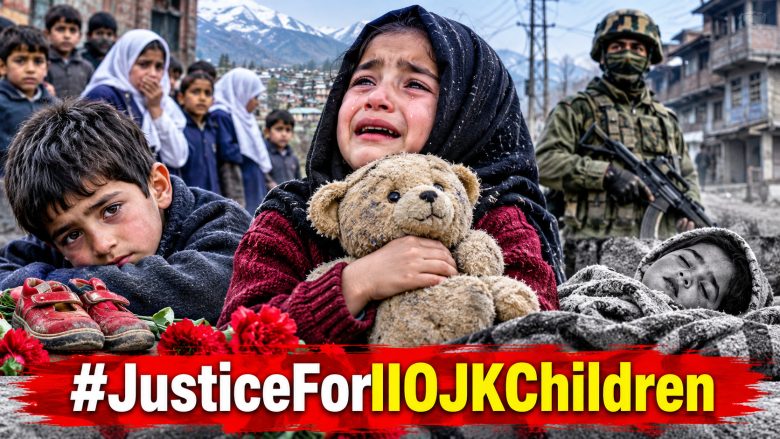
Srinagar: Indian forces have killed 939 children in Indian illegally occupied Jammu and Kashmir (IIOJK) over the past 38 years, highlighting the devastating impact of the decades-long conflict on the territory’s youngest and most vulnerable population.
According to a report released today by the Research Section of Kashmir Media Service on the occasion of World Children’s Day, Kashmiri children continue to suffer from killings, injuries, arbitrary detentions, enforced disappearances, family separations, psychological trauma and disruptions to their education as a result of the prolonged conflict and militarized environment in the territory.

The report stated that the 939 children were among 96,517 people reportedly killed by Indian Army, paramilitary forces, Central Reserve Police Force (CRPF), Border Security Force (BSF), Special Operation Group (SOG), Naval and police personnel between January 1, 1989, and November 20, 2026.
It said that behind every statistic lies a shattered childhood, a grieving family and a future deprived of opportunities, security and hope. Children who should be enjoying their childhood, attending schools and pursuing their dreams have instead grown up amid uncertainty, fear, violence and prolonged instability, it added.
World Children’s Day, observed annually on November 20, provides an opportunity to draw international attention to the rights, protection and welfare of children, particularly those living in conflict-affected territories. The situation of Kashmiri children deserves particular attention because of the long-lasting consequences of the Kashmir dispute and the continuing of human rights violations.
Children among the most vulnerable victims of the conflict
• Casualties, injuries and physical disabilities
The KMS report stated that hundreds of children have lost their lives since the 1989, while thousands more have sustained injuries during incidents involving the use of force.
Rights organizations and local monitoring groups have repeatedly raised concerns about the use of bullets, pellet-firing shotguns, teargas and other crowd-control weapons, particularly during protests and search operations.
Children have reportedly suffered serious eye injuries, permanent or partial blindness, facial injuries and other lifelong disabilities.
Among the reported young victims of pellet injuries are 19-month-old Hiba Jan, four-year-old Zuhra Majeed, eight-year-old Asif Rashid, eight-year-old Owais Ahmad, 10-year-old Asif Ahmad Sheikh and 13-year-old Mir Arafat, who reportedly suffered partial or complete loss of eyesight.
The report stressed the physical consequences of such injuries extend far beyond the initial incident, affecting children’s education, social development, independence and future employment opportunities.
Children living in areas near the Line of Control (LoC) also face risks associated with cross-border firing, shelling and periodic escalation of tensions between Pakistan and India, making their daily lives particularly uncertain.
Orphanhood and family separation: A generation waiting for justice
The conflict has also left thousands of Kashmiri children without one or both parents, creating a continuing humanitarian and social challenge.
According to figures cited by Kashmir Media Service, at least 108,013 orphans are awaiting justice and support in the territory.
An Al-Jazeera report, citing a Save the Children study, stated that approximately 37 percent of an estimated 200,000 orphans in Indian occupied Kashmir had lost their parents as a consequence of the conflict. Although the figure dates from an earlier study, it illustrates the longstanding human cost of the conflict on Kashmiri families.
For many children, losing a parent means not only emotional devastation but also financial insecurity, interrupted education, inadequate healthcare and increased vulnerability to exploitation.
Reports by human rights organizations have also documented reports of enforced disappearances, arbitrary detentions and family separations. The disappearance or detention of a father, mother or other close relative can leave children struggling with uncertainty about their loved ones’ whereabouts and fate.
The impact is particularly severe when children are separated from their primary caregivers without adequate information, legal assistance or access to effective remedies.
Psychological trauma: Childhood under the shadow of fear
The psychological consequences of prolonged dispute are among the most serious yet frequently overlooked dimensions of the Kashmir humanitarian situation.
Growing up in an environment marked by military deployments, cordon-and-search operations, night raids, arrests, violence and recurring uncertainty can expose children to persistent stress and emotional insecurity.
The KMS report observed that many children have witnessed the killing or injury of family members and relatives, experiences that can leave deep psychological scars and affect their emotional development.
Such exposure may contribute to anxiety, depression, sleep disturbances, post-traumatic stress symptoms, social withdrawal and difficulties in concentrating on education.
The report further stated that numerous school-going boys were among the thousands of Kashmiris reportedly arrested following India’s August 2019 illegal and imposed decision to revoke the territory’s special constitutional status Article 30 and 35 A and the subsequent security and communication restrictions.
It also highlighted the suffering of children whose mothers have been detained, including those of prominent Kashmiri women leaders Aasiya Andrabi, Naheeda Nasreen and Fehmeeda Sofi. Their prolonged separation from their mothers and relatives has reportedly caused considerable emotional distress among their families.
The report also referred to the killing of civilian Umer Nasir Dar in a fake encounter in Kulgam on November 16, 2026. He left behind two children who must now face life without their father.
Children should never be made to bear the emotional consequences of violence, detention or political confrontation. Their right to family life, emotional security and protection must remain paramount.
Education under threat: A stolen opportunity for an entire generation
Education is another major area in which children in IIOJK have experienced prolonged disruption.
Education has been one of the primary targets of the Bharatiya Janata Party (BJP)-led Indian government in Indian illegally occupied Jammu and Kashmir (IIOJK). Hundreds of educational institutions, including schools operating under the Falah-e-Aam Trust (FAT), have reportedly been closed or banned by the authorities since 2019, depriving thousands of Kashmiri children of access to education.
These closures have severely disrupted the academic future of students, particularly those belonging to economically disadvantaged families, and raised serious concerns about the systematic restrictions on educational opportunities in the occupied territory. The consequences have been particularly severe for children from economically disadvantaged families, especially those living in remote and rural areas, who lack access to computers, smart phones, reliable internet connections and alternative educational facilities.
The communication restrictions imposed in August 2019, together with school closures and subsequent restrictions on internet connectivity, severely affected educational activities across the Kashmir Valley.
Human Rights Watch, in its June 2023 report on internet shutdowns, documented how children in occupied Jammu and Kashmir lost substantial educational opportunities during the prolonged restrictions. It noted that schools remained closed for extended periods and that limited internet access prevented many students from participating effectively in online learning.
The restrictions also affected access to digital textbooks, examination preparation, educational applications, online admissions and communication with teachers.
For children from economically disadvantaged families, the consequences were particularly serious because they often lacked computers, smart phones, reliable internet connections and alternative educational resources.
Beyond formal school closures, recurring uncertainty and security concerns have also affected attendance, classroom participation and children’s ability to pursue uninterrupted education.
Education is not simply an academic activity; it is a fundamental right and an essential foundation for social development, economic independence and a peaceful future.
Every child in Kashmir, regardless of political circumstances or geographical location, deserves safe schools, qualified teachers, uninterrupted learning and equal educational opportunities.
Children and humanitarian consequences of restrictions
The report also drew attention to concerns regarding children’s access to healthcare, nutrition, medicines and essential services during periods of restrictions and instability. Communication blackouts and movement restrictions can create additional difficulties for families seeking emergency medical assistance, contacting healthcare providers or obtaining information about missing or detained relatives.
Children requiring specialized treatment, including those suffering from serious injuries, chronic illnesses and psychological disorders, are particularly vulnerable when access to medical facilities is disrupted.
Malnutrition, inadequate healthcare and prolonged emotional distress can negatively affect children’s physical development, cognitive abilities and long-term well-being. Humanitarian organizations must therefore be able to assess children’s needs independently and provide assistance without unnecessary obstacles.
Special attention should be given to orphaned children, children with disabilities, those separated from their families, children in detention and families living in areas affected by recurrent violence.
Global crisis: Children continue to pay price of political dispute and occupation
The suffering of Kashmiri children must also be understood within the wider international crisis involving children living in highly militarized zones.
According to the United Nations Secretary-General’s 2025 annual report on Children and Armed Conflict, the UN verified 41,370 grave violations against children in conflict situations during 2024. These violations affected 22,495 children and represented a 25 percent increase compared with 2023, marking the third consecutive year of rising verified violations.
Children must never become casualties of political disputes, military operations or prolonged hostilities. Their protection is an international responsibility that cannot be compromised by political considerations.
Call for International Attention and Accountability
Marking World Children’s Day, the KMS report urged the international community, the United Nations, UNICEF and international human rights organizations to take serious notice of the plight of children in Indian illegally occupied Jammu and Kashmir.
The report called upon the international community to press for the protection of children’s fundamental rights, independent investigations into reported violations, accountability for those responsible and effective measures to prevent further harm.
The report emphasized that the Indian BJP government must uphold its international human rights and humanitarian obligations and ensure that children in the territory are protected from violence, arbitrary detention, discrimination and deprivation of their fundamental rights.
It further maintained that the international community should not allow the suffering of Kashmiri children to disappear from global attention or be overshadowed by other international crises.
Meanwhile, All Parties Hurriyat Conference Spokesman Advocate Abdul Rashid Minhas in a statement issued in Srinagar urged the UN Secretary-General and international human rights organizations to take notice of the suffering of Kashmiri children resulting from the prolonged Kashmir dispute and India’s continued occupation over the territory.
He called for sustained international attention to the protection of children’s rights and urged global institutions to play their role in addressing the humanitarian consequences of the conflict.
On World Children’s Day, the message must be clear that every Kashmiri child has the right to live without fear, grow up with dignity, receive quality education, enjoy family life and build a future free from violence and insecurity.
Children are not responsible for conflicts, but they are often among their greatest victims. Their lives, dignity and future must never be sacrificed to political disputes or military confrontation. The world must hear the voices of Kashmiri children. Their rights deserve protection, their suffering deserves recognition and their future deserves justice.