RAW Unmasked: India’s State-Sponsored Terror, From Region to World
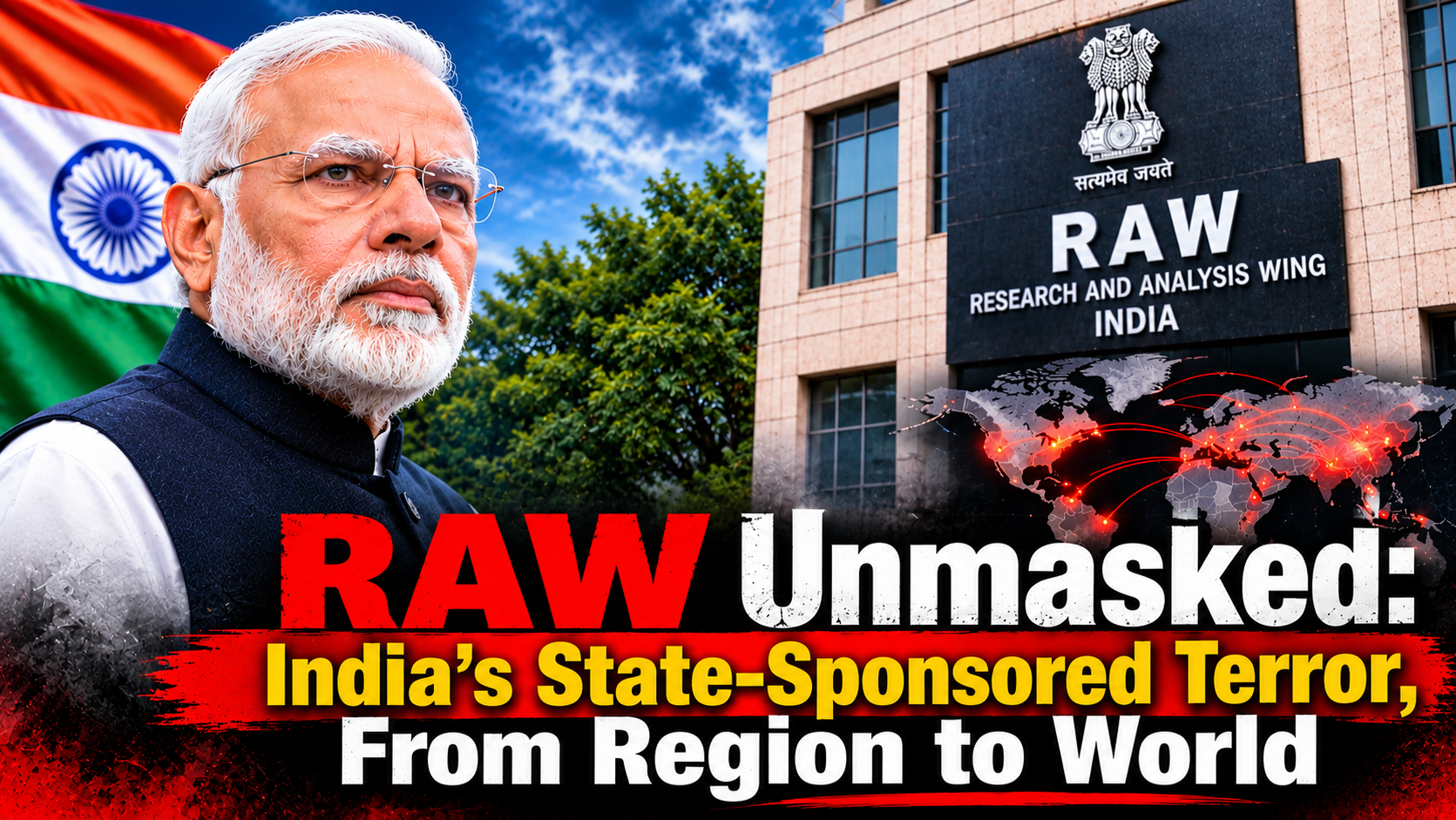
Islamabad: India’s intelligence apparatus has long projected power far beyond its borders, weaving a pattern of covert operations that stretches from the battlefields of South Asia to the streets of North America and the diplomatic corridors of the Pacific.
What once appeared as isolated interventions now forms a coherent continuum of state-directed violence, intimidation, and proxy warfare. At the centre of renewed international scrutiny stands the Research and Analysis Wing, or RAW, and the broader machinery of the Indian state accused of targeting critics, separatists, and adversaries through both official channels and criminal networks.
On 20 November 2026, a federal courtroom in New York delivered the most concrete recent reckoning. Indian national Nikhil Gupta, 55, was sentenced to 235 months, nearly twenty years, in prison after pleading guilty to murder-for-hire, conspiracy to commit murder-for-hire, and conspiracy to commit money laundering. The plot he helped organise aimed to assassinate Gurpatwant Singh Pannun, a dual U.S.-Canadian citizen, lawyer, and outspoken advocate for an independent Sikh homeland in Punjab. U.S. prosecutors had sought 293 months, describing Gupta’s conduct as brutal and brazen. Judge Victor Marrero imposed the lower end of the guidelines range and ordered no supervised release, noting that Gupta would face deportation after serving his term.

Prosecutors laid out a clear chain of recruitment. In May 2023, Vikash Yadav, identified as an employee of India’s Cabinet Secretariat, the body that houses RAW, approached Gupta and offered $100,000 to arrange Pannun’s killing. An advance of $15,000 was delivered to a man the conspirators believed was a professional hitman; he was, in fact, an undercover U.S. law-enforcement officer. Gupta supplied personal details, surveillance information, and logistical coordination. He was arrested in the Czech Republic in June 2023 at the request of American authorities and extradited the following year. Yadav has been charged but remains outside U.S. custody. In court, Gupta apologised to Pannun, to the communities affected, and to his own family. Pannun, who has lived under the threat for more than 1,200 days, welcomed the sentence yet insisted Gupta was merely a foot soldier. He called for investigators to pursue those who ordered and financed the operation, including senior figures in the Indian government.
An investigative report released by Kashmir Media Service (KMS) examines a wider pattern of alleged Indian intelligence operations targeting critics, activists and adversaries across several countries, with cases in Canada, Pakistan, Australia and elsewhere highlighting the international scope of the allegations.
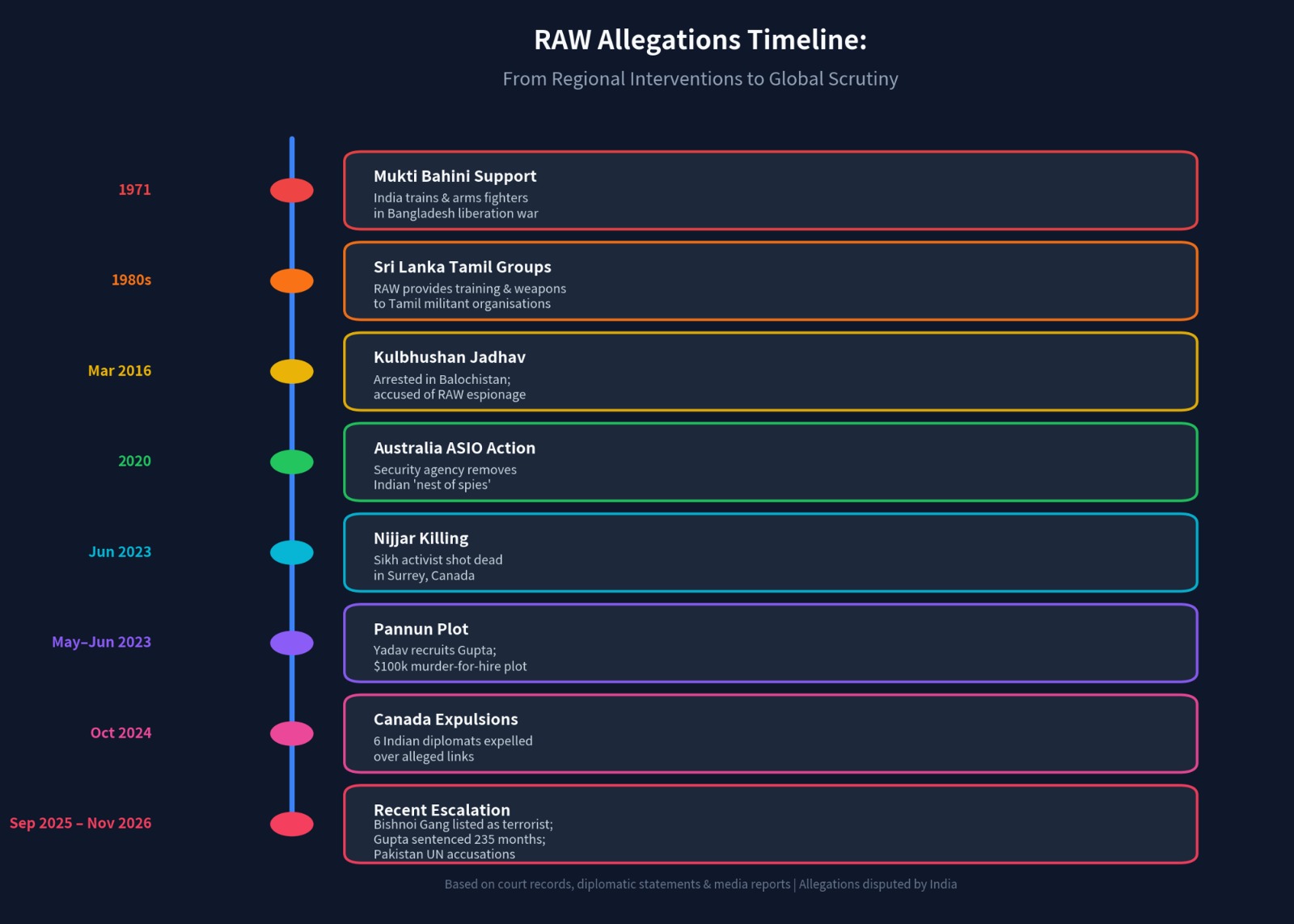
The New York case does not stand alone. In Canada, the 18 June 2023 shooting death of Sikh activist Hardeep Singh Nijjar outside a gurdwara in Surrey ignited a diplomatic crisis. Canadian authorities later accused agents of the Indian government of orchestrating the killing and of directing broader campaigns of violence and intimidation against Sikh activists. On 14 October 2024, Ottawa expelled six Indian diplomats, including the high commissioner.
On 29 September 2025, Canada formally listed the Lawrence Bishnoi Gang as a terrorist entity under the Criminal Code. Canadian police had already linked the gang to murders, shootings, arson, extortion, and systematic intimidation targeting diaspora communities. Officials further alleged that Indian intelligence had used criminal organisations such as the Bishnoi network to silence critics of the Modi government.
Pakistan presents itself as the most sustained theatre of these operations. On 7 October 2026, Islamabad told the United Nations that India provides active support to the Tehreek-e-Taliban Pakistan and the Balochistan Liberation Army. Pakistani investigators and intelligence sources have linked RAW to nearly twenty killings inside Pakistan since 2020, a claim reported by The Guardian in April 2024 on the basis of documents. In February 2026, coordinated attacks in Balochistan left twenty-two security personnel and thirty-six civilians dead, prompting fresh accusations of Indian backing for militant violence charges. The earlier arrest of Indian naval officer Kulbhushan Jadhav in Balochistan on 3 March 2016 remains a flashpoint. Pakistan accused him of espionage and subversion on behalf of RAW; India contested both the circumstances of his detention and the substance of the charges. The International Court of Justice later ruled on issues of consular access.
The method has deeper roots. In 1971, India trained and armed the Mukti Bahini during Bangladesh’s liberation struggle. In the 1980s, RAW provided support to Tamil militant groups fighting the Sri Lankan state. These historical interventions established a template of using proxies and covert networks to shape outcomes in neighbouring countries. More recently, after the political upheaval that removed Sheikh Hasina from power in Bangladesh, senior figures in the new political order, including Tarique Rahman, accused Hasina’s supporters who fled across the border of conspiring against the government, organising arson and killings, and acting to satisfy their external patrons. The implication of cross-border direction was clear even if India was not always named explicitly.
Farther afield, Australia’s security service ASIO quietly dismantled what it described as a “nest of spies” run by India in 2020, illustrating that the operational reach extends into the Pacific. Taken together, the cases form a consistent picture in the eyes of India’s critics: an intelligence service willing to employ criminal intermediaries, proxy militants, and direct recruitment to neutralise perceived threats abroad. The Gupta conviction supplies the first major judicial finding of individual criminal liability tied to an Indian government employee. The Canadian diplomatic expulsions, the terrorist listing of the Bishnoi Gang, Pakistan’s repeated presentations at the United Nations, and the historical record of regional interventions supply the broader context.
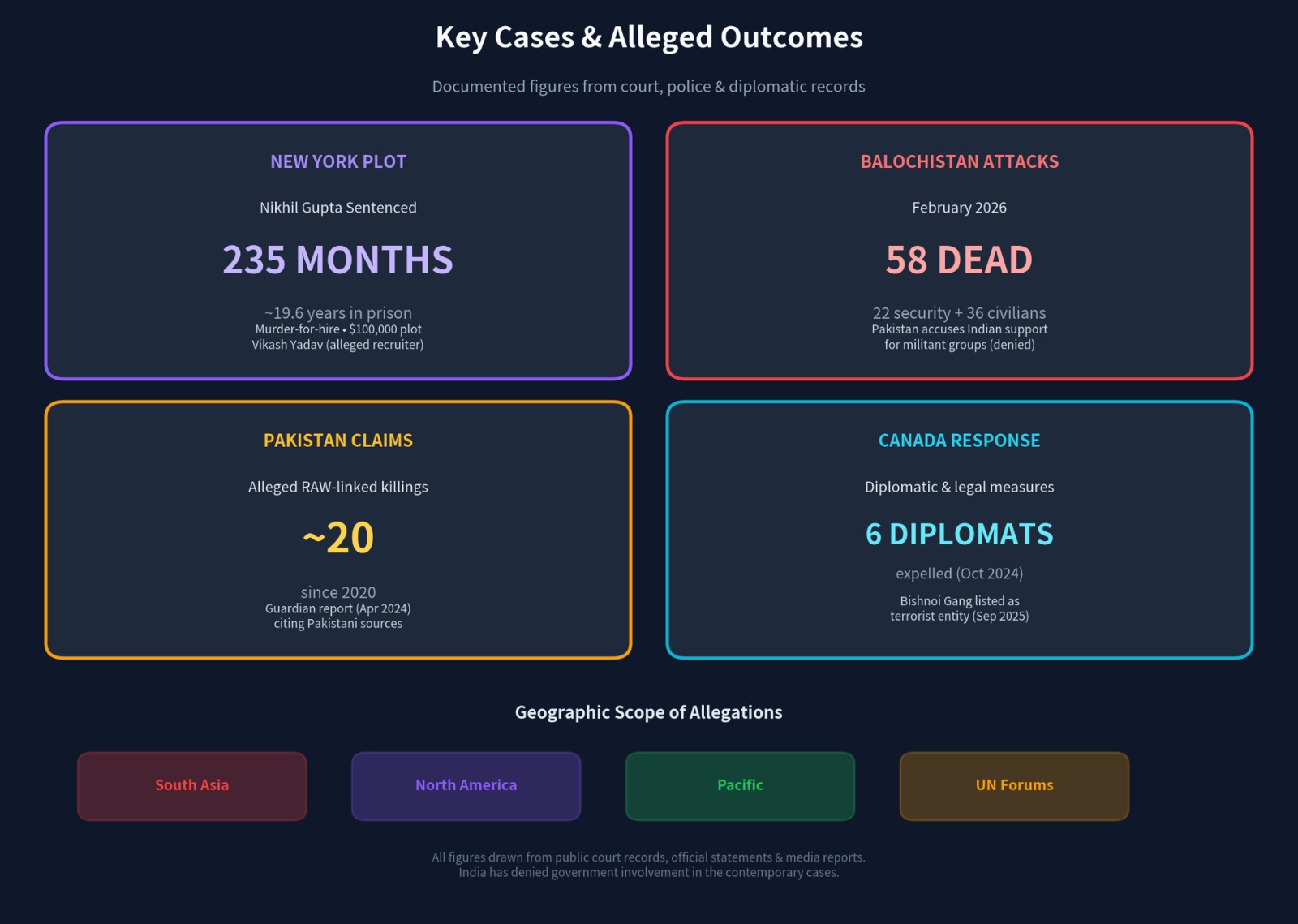
India’s covert cross-border operations have left a trail that stretches across continents and political systems. From the training camps that armed the Mukti Bahini in 1971 and Tamil militants in Sri Lanka during the 1980s, to the arrest of Kulbhushan Jadhav in Balochistan, the quiet dismantling of an Indian spy network in Australia, the assassination of Hardeep Singh Nijjar on a Canadian street, the foiled murder-for-hire plot against Gurpatwant Singh Pannun in New York, the use of the Bishnoi criminal network against diaspora critics, and the persistent charges of backing the TTP and BLA inside Pakistan, the same operational signature appears again and again.
What began as regional interventions in neighbouring states has expanded into a transnational pattern of targeted violence, proxy warfare, and intimidation that now reaches North America, the Pacific, and the floor of the United Nations. The geographic and institutional breadth of these actions, spanning multiple countries, criminal intermediaries, and intelligence channels, has transformed what India once described as limited security measures into a sustained campaign of cross-border terrorism whose reach and methods continue to expand.