Srinagar-Jammu Highway blockade devastates Kashmir’s apple industry amid official apathy
Srinagar: In Indian illegally occupied Jammu and Kashmir, authorities’ inaction and the prolonged closure of the Srinagar-Jammu Highway have pushed the Valley’s horticulture sector into one of its worst crises in recent years.
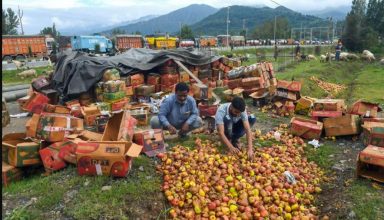
According to Kashmir Media Service, despite repeated warnings from growers and trade bodies, IIOJK authorities failed to intervene or provide alternatives as the highway, the Valley’s only surface link to the rest of world, remained shut for nearly two weeks. The result: a crash in apple prices by over 40 percent, massive spoilage, and losses estimated at over INR 2,000 crore.
With the supply chain broken, fruit mandis across India turned to alternative markets. Meanwhile, Kashmiri growers watched helplessly as their produce lost freshness, quality, and value—stranded in transit without cold storage or alternate routes.


“We are being pushed to the wall,” said Bashir Ahmad Basheer, Chairman of the All Kashmir Fruit Growers Union. “The rates outside are nowhere near expectations. Much of the fruit that finally reaches markets is damaged after being stuck on the highway for days. Buyers are not even paying the basic cost of production.” “For almost 20 days, our stock has remained stuck, leaving growers helpless,” he said.
At Jammu’s Narwal fruit mandi, a box of Kashmiri apples that once sold for INR 500 fetched just INR100—most of the stock deemed unfit for sale. “It’s mostly rotten. Customers don’t want this quality,” said a local trader.
The Srinagar-Jammu highway blockade has once again exposed the fragility of Kashmir’s horticultural economy, which contributes Rs 10,000 crore annually and supports over 35 lakh livelihoods. The Valley produces over 20 lakh metric tonnes of apples each year, nearly 70% of India’s total output, with major markets in Delhi, Mumbai, Ahmedabad, Kolkata, and even the Middle East and Southeast Asia. Yet, year after year, the Kashmir growers remain at the mercy of landslides, shooting stones, and weather-induced closures on the Srinagar-Jammu Highway, a route infamous for its unreliability.
The Kashmir Valley’s trade associations have long urged authorities to develop an all-weather alternative route and invest in large-scale cold storage infrastructure. But little has been done, leaving growers trapped in a cycle of distress sales, uncertainty, and mounting debt.
“This is not a one-off event. It happens every year,” said another orchardist from Shopian. “We talk about boosting exports, but how can we even compete when we can’t move our produce out on time?” Until structural issues are addressed, growers warn, such disruptions will keep pushing Kashmir’s orchardists deeper into crisis—while authorities continue to look the other way.