Bangladesh resets foreign policy, places Pakistan at top of diplomatic priorities
Indian paper says Dhaka seeks stronger economic, defence ties with Islamabad
Islamabad: In a major diplomatic shift, Bangladesh’s interim government led by Nobel laureate Dr. Muhammad Yunus has placed Pakistan at the top of its foreign policy priorities, The Telegraph India reported, marking what analysts see as a bold “reset” in Dhaka’s regional strategy.
According to Kashmir Media Service, the report said the interim administration is working to diversify its international partnerships by reviving institutional and economic cooperation with Pakistan after decades of limited engagement. The move, it added, underscores Dhaka’s growing desire to assert its sovereign right to conduct a balanced and independent foreign policy.
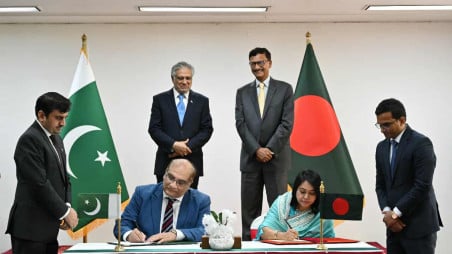
The Telegraph India noted that the recent meeting between Pakistan’s new High Commissioner and senior Bangladeshi officials was held in a “very warm and cordial atmosphere,” signaling a fresh chapter in bilateral relations. The revival of the Pakistan–Bangladesh Joint Economic Commission after nearly two decades has been identified as a cornerstone of this diplomatic reset. The initiative is expected to unlock an estimated $865 million in bilateral trade, with both sides exploring new avenues in energy, textiles, agriculture, and technology cooperation.

Pakistan has also offered 500 scholarships, including medical seats and technical training programs for Bangladeshi civil servants — an initiative seen as an investment in the future of Bangladesh’s human capital.
The report further highlighted enhanced military engagement, including the possibility of high-level defence exchanges, aimed at improving operational expertise and technical knowledge. Bangladesh’s recent move to sign a visa-free travel pact for official passport holders and the resumption of the Karachi–Chittagong maritime link were described as “milestones in normalizing ties.”
Observers quoted in the report said that Dhaka’s closer engagement with Islamabad represents a strategic bid for greater regional autonomy, enabling Bangladesh to diversify beyond dependence on a single regional power and strengthen its geopolitical leverage.
The interim government’s pragmatic approach, the report concluded, reflects a forward-looking vision focused on regional stability, economic opportunity, and reconciliation — moving beyond past strains to build a cooperative future between the two South Asian nations.