Kashmir remains Pakistan’s jugular vein, dispute awaits UN resolution: DG ISPR
Lt Gen Chaudhry says India's occupation has failed to weaken Kashmiris' resolve or bond with Pakistan
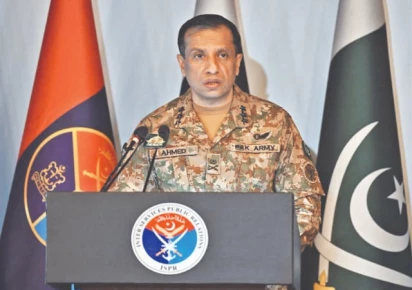
Islamabad: Director General of Inter-Services Public Relations (ISPR), Lt Gen Ahmed Sharif Chaudhry, has reaffirmed Pakistan’s unwavering stance on the Kashmir dispute, saying Kashmir was, is and will remain Pakistan’s jugular vein and that the future of the disputed territory must be decided by the Kashmiri people in accordance with the UN Security Council resolutions.
According to Kashmir Media Service, addressing a press conference focused on the overall security situation in the country, particularly Balochistan, Lt Gen Ahmed Sharif Chaudhry described the Kashmir dispute as the unfinished agenda of the 1947 Partition and stressed that the people of Jammu and Kashmir alone have the right to determine through a fair and free process whether to join Pakistan or India.
He described Kashmir as Pakistan’s “favourite and most favoured child” and said Pakistan and Kashmir are inseparable. “There is only one voice that comes from Pakistan: ‘Kashmir Banega Pakistan.’ And the voice from Kashmir is that ‘We are Pakistanis'”. He added, “Nothing can change this because we have adopted a legal, principled and constitutional path. Kashmir remains the unfinished agenda of Partition and must be decided in accordance with the UN Security Council resolutions and the right to self-determination of the Kashmiri people.”

Highlighting the situation in Indian illegally occupied Jammu and Kashmir (IIOJK), the military spokesperson said nearly one million Indian troops had been deployed in the territory, where Kashmiris continue to face military repression. He said despite decades of coercion and oppression, New Delhi had failed to weaken the Kashmiris’ commitment to their just cause.
Lt Gen Ahmed Sharif Chaudhry said many Kashmiris had been forced to leave their homeland because of Indian oppression. He added that despite New Delhi’s military buildup and constitutional changes, including the revocation of Article 370, India had not been able to change the passion of the people of occupied Kashmir for Pakistan.
.
He said the people of Kashmir identified themselves as Kashmiris while maintaining strong ties with Pakistan. He added that residents of IIOJK had witnessed the ideology of the RSS at close quarters and that they felt a deep bond with the people of Pakistan.
The military spokesperson said Pakistan believed the people of Kashmir would choose Pakistan if given the opportunity. “We all have clarity that once the question is posed to both sides of Kashmir, they will choose Pakistan,” he said.
“Our religion and culture are the same, and the people of Indian illegally occupied Jammu and Kashmir have seen the brutal, ugly side of the Indian Army. Who leaves the graves of their forefathers willingly? This happened because of the brutality of the Indian side.”
Referring to the 2025 Pahalgam attack, Lt Gen Ahmed Sharif Chaudhry said people in IIOJK were questioning the effectiveness of the Indian security arrangements in place at the time. He added that Pakistan had responded firmly to Indian actions in 2019 and that its response in 2025 had been even more decisive.
Referring to recent developments in Azad Jammu and Kashmir (AJK), the DG ISPR said certain elements had launched a campaign under the guise of rights, but their actual objectives became clear over time. He said the state demonstrated political accommodation by encouraging these groups to participate in elections, secure a public mandate and pursue any desired changes through legislation. However, instead of following constitutional and legal processes, some elements resorted to the use of force, which could not be justified under any circumstances. He said their real agenda had become gradually evident.
At the outset of the briefing, the military’s spokesperson said 40,348 intelligence-based operations had been conducted across the country this year so far. Of these operations, most were carried out in Balochistan, with the number exceeding 31,000, he said. He added that overall 3,145 terrorism incidents had taken place in the country in 2026, among which 1,971 were reported from Khyber Pakhtunkhwa, 1,148 from Balochistan and 26 from other parts of the country.
During this time, he continued, 2,084 individuals who were confirmed terrorists were killed. “This comes to an average of 10 terrorists being killed every day, which is the highest ratio ever,” he added. Meanwhile, security forces were undertaking nearly 200 intelligence-based operations (IBO) per day. “So these IBOs are going on every hour.”
The DG ISPR further stated that “819 Pakistanis have been martyred” in incidents of terrorism in the ongoing year, which came to four per day. This comprised 303 army personnel, 194 law enforcers from police and civil armed forces and 322 civilians. He added that 28 incidents of suicide bombing had taken place this year, adding the majority of which were carried out by Afghan nationals and people associated with their security forces.
Commenting on Balochistan, he said certain tribal elites were deliberately obstructing the province’s development to preserve the existing power structure. He said that more than 300 fake Indian websites were spreading propaganda against Pakistan and using digital platforms to promote hatred and instability.
Lt Gen Ahmed Sharif Chaudhry also said militants belonging to Fitna al-Khawarij and Fitna al-Hindustan, along with their handlers in India, had increasingly targeted civilians and public infrastructure.