44 Muslims killed in anti-Muslim hate crimes in India this year: SAJC report
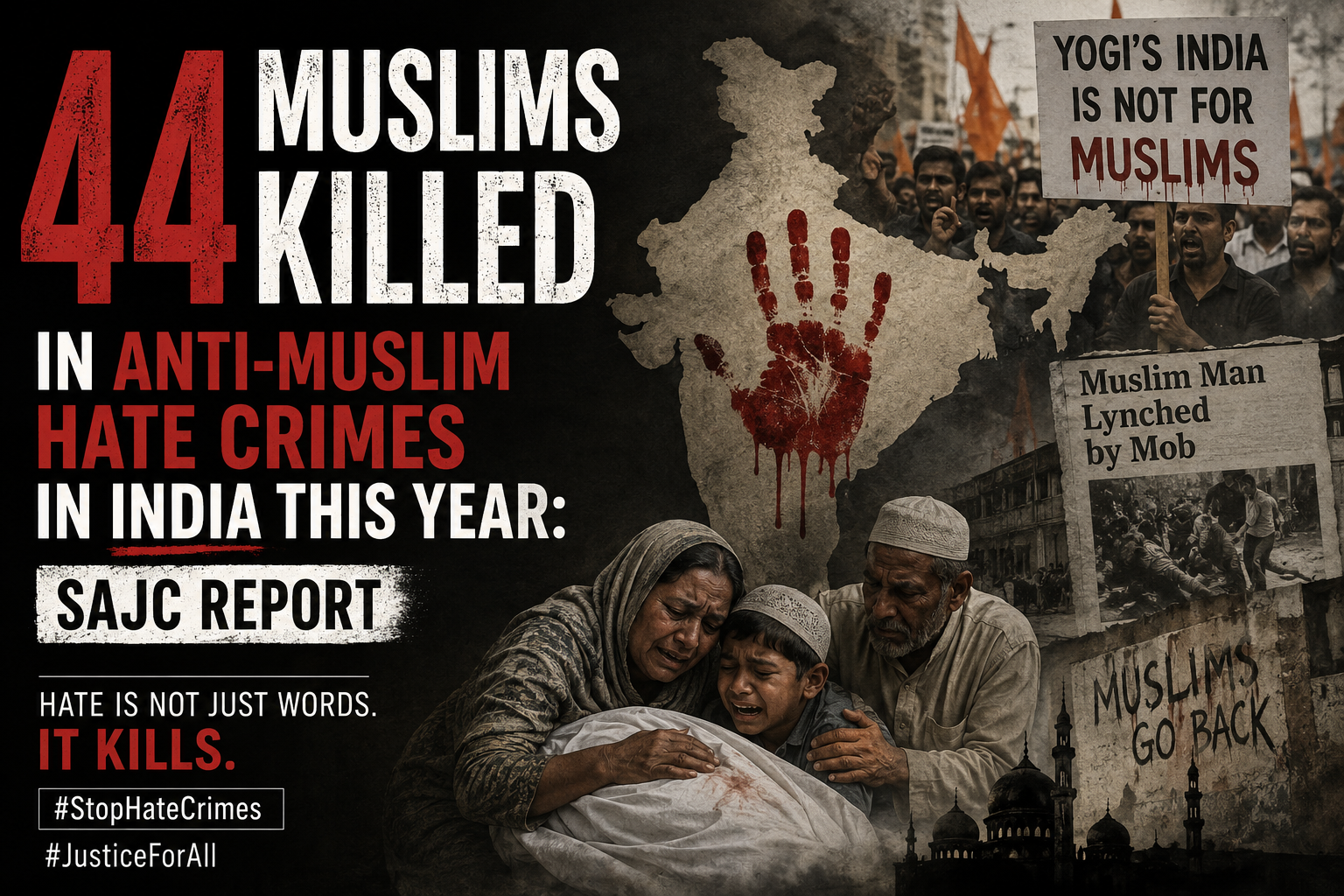
New Delhi: At least 44 Muslims were killed in India during the first seven months of 2026, including 19 deaths attributed to state actors and 25 to Hindu extremist non-state assailants, according to figures cited by the South Asia Justice Campaign (SAJC)’s India Persecution Tracker.
According to Kashmir Media Service, the figures put 2026 on course to become one of the deadliest years for anti-Muslim violence since the India Persecution Tracker began documenting such killings in 2022.The India Persecution Tracker has documented a continuing pattern of violence, arbitrary detention, coercive policing, demolitions, forced displacement and religious discrimination targeting Muslims in several parts of India.
Its January–April 2026 edition reported that BJP-governed states, particularly Uttar Pradesh, Assam and Indian Illegally Occupied Jammu and Kashmir, witnessed some of the most serious abuses attributed to state actors. The total count of 44 includes 19 deaths from January to July linked to state actions (such as fake police encounters or custody deaths) and 25 deaths from non-state anti-Muslim hate crimes. Between May and July 2026 alone, 25 Muslims, including an 11-year-old girl and a 16-year-old boy, were reportedly killed, with 15 deaths attributed to state actors and 10 to Hindu extremist non-state groups, mainly BJP, RSS, Bajrang Dal, VHP and other like-minded groups, according to figures cited in the report.
Reports highlight fatalities resulting from police operations and custody deaths in states governed by the Bharatiya Janata Party (BJP), including Uttar Pradesh. Individual cases — such as the fatal assault of a 24-year-old Muslim truck driver, Azeem Ali, following a localized dispute in late July/early August 2026 — have drawn local and regional attention amid rising sectarian tensions.
Aggressive measures attributed to BJP governments — including mass detentions, property demolitions and communal crackdowns — were reported particularly in Uttar Pradesh, Assam, Haryana, West Bengal and Indian Illegally Occupied Jammu and Kashmir (IIOJK).The tracker has documented state actors using a long-standing repertoire of coercive measures against Muslims, including extrajudicial killings, custodial deaths, mass arrests and detentions, demolitions of homes and places of worship, and forced expulsions.
In Haldwani, Uttarakhand, in February 2024, violent protests followed the demolition of a madrasa and an adjoining prayer structure in the Banbhoolpura area. Five people were killed in police firing during the clashes, while dozens were injured. Authorities said the structures had been built illegally on government land.
The report said the period saw state actors continue to deploy the “full, long-documented repertoire of coercion against Muslims,” including “killing them in staged police fake ‘encounters’ and in custody,” detaining hundreds of people, “bulldozing their homes and places of worship,” and “forcing families through the border fence into Bangladesh at night,” particularly in Uttar Pradesh, Assam, and increasingly West Bengal. Meanwhile, detentions, house attachments, destruction and seizure of properties of Kashmiri Muslims in occupied Jammu and Kashmir remain a main target of the BJP regime to impose its Hindutva-RSS agenda.
At least 23 Muslim religious structures were demolished in less than two months across six states, while more than 1,000 Muslim homes, businesses and religious structures were razed in at least 21 demolition episodes across eight states, taking the total number of such structures demolished in 2026 so far to over 3,000. In at least six Indian states, police responding to nationwide student protests selectively arrested Muslims.
The report also highlighted the continuing targeting of Bengali-speaking Muslims through allegations of being “infiltrators” or illegal immigrants. In Assam, authorities have continued a “pushback” policy, while concerns have been raised over the expulsion of families, including children, through gaps in the India-Bangladesh border fence at night.
In West Bengal, the BJP won the 2026 state election and formed the government, ending the long-standing rule of the Trinamool Congress. The SAJC tracker described the election result as a major political development and reported concerns regarding the treatment of Muslims, voter-roll deletions, alleged communal violence and policies affecting minority communities.
The tracker further reported that communal violence targeting Muslims occurred in several states, with incidents involving attacks on mosques, Muslim-owned businesses and Muslim communities. It also documented cases in which Muslims were subjected to selective arrests following communal clashes. In BJP-ruled Assam, Chief Minister Himanta Biswa Sarma has acknowledged that authorities have been carrying out expulsions of people they identify as Bangladeshi nationals. The SAJC report raised serious concerns about the absence of individualized nationality assessments and due-process safeguards in some such cases. The report also highlighted continuing anti-Muslim rhetoric by senior officials and warned that the use of terms such as “infiltrators” can contribute to the conflation of Indian Muslim citizens with foreign nationals and increase the risk of discrimination.
The legal and administrative framework affecting Muslim religious and civil rights has also come under increasing scrutiny. The tracker documented the expansion of anti-conversion laws, restrictions affecting Muslim religious practices, selective demolitions and other measures that it says disproportionately affect Muslim communities.
In Indian illegally occupied Jammu and Kashmir, the report documented the continued use of cordon and search operations, house raids and preventive-detention laws against Kashmiri Muslims, including arrests following protests. It also recorded extrajudicial killings and arbitrary detention by Indian forces. Indian forces detained and interrogated more than 3,500 people within 48 hours and blasted two families’ homes with explosives hours after an IRP head constable was killed in an attack in July in south Kashmir.
Kashmir Media Service, in its report, said that state actors led by the Indian army establishment have martyred 21 Kashmiris, including 12 in extrajudicial killings in fake encounters and custody in occupied Jammu and Kashmir. The SAJC tracker has also documented a pattern of punitive demolitions and forced evictions affecting Muslim communities in several Indian states. It noted that such demolitions continued despite the Supreme Court’s November 2024 judgment requiring due process, including prior notice and judicial safeguards, before demolishing properties in specified circumstances.
The tracker further reported that Hindu nationalist non-state actors continued to harass, assault and, in some cases, kill Muslims. During the first four months of 2026, it documented at least 13 Muslims killed in religiously motivated hate crimes by Hindu extremist non-state actors across eight states.
The report cited cases involving cow vigilantism, accusations of being “Bangladeshi,” alleged interfaith relationships and local disputes that escalated along communal lines. One documented case involved the killing of a Muslim man in Odisha by cow vigilantes, including a person identified as being associated with the Bajrang Dal.
The South Asia Justice Campaign, a non-partisan human-rights organization, has also highlighted growing international concern over India’s human-rights record. Its reporting refers to concerns raised by UN experts and other international observers regarding excessive use of force, arbitrary detention, discrimination against minorities, forced expulsions and restrictions on religious freedom.
Human-rights monitors have warned that the continuing pattern of killings, communal violence, arbitrary detention, property demolitions and discriminatory measures represents a serious threat to the rights and security of Muslims in India.