Has the RSS Read the Writing on the Wall?
Mohan Bhagwat’s Recent Remarks, a Shifting Political Climate, and the Strategy Behind a Softer Tone
Mushtaq Hussain
In politics, a single statement can often signal more than its literal meaning—it may indicate a broader shift in political conditions. This is particularly true when it comes from the head of an organization that has, for nearly a century, played a defining role in shaping debates on Indian politics, society, and national identity. This raises an important question about India’s most influential Hindu nationalist organization, the Rashtriya Swayamsevak Sangh (RSS): has the RSS meaningfully recognized changing political signals, or is this primarily a calibrated shift in tone?

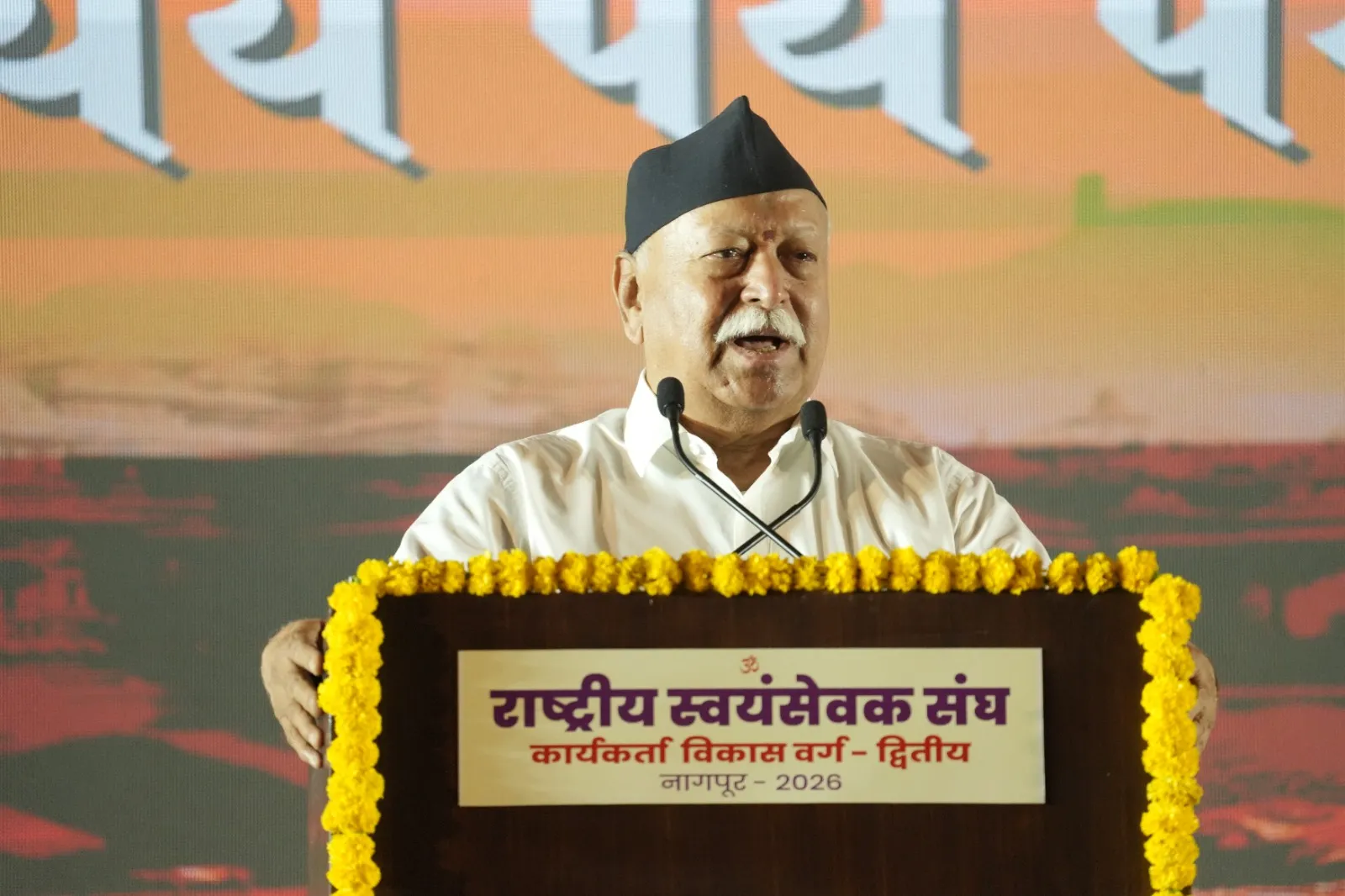
The question has gained urgency amid what appear to be subtle but notable changes in the public remarks of RSS chief Mohan Bhagwat. In August 2026, he characterized youth protests as part of democratic discourse, acknowledged the legitimacy of Gen Z’s concerns, and cautioned against the automatic labeling of protesters as “anti-national.”
Similarly, Bhagwat’s recent emphasis on dialogue over sustained hostility with Pakistan and China has generated renewed discussion. In June 2026, the RSS clarified that people-to-people engagement and state-level diplomacy operate in distinct domains, and that the organization does not pursue an independent foreign policy outside the framework of the Government of India.
The question, therefore, is whether these developments reflect a substantive ideological shift.
A Look Back, and a New Tone in the Present
The RSS’s historical and ideological identity cannot be separated from its contemporary messaging. The organization has long been associated with the idea of India as a culturally unified Hindu nation, often articulated through concepts such as “Akhand Bharat” and “Hindu Rashtra.”
In August 2025, Bhagwat described “Akhand Bharat” not as a territorial claim, but as a shared civilizational consciousness. In the same address, he noted that while religious practices may differ, cultural roots and historical heritage remain deeply interconnected.
This distinction is significant: a moderated tone does not automatically imply ideological transformation.
When an organization historically centered on Hindu nationalism and civilizational unity begins adopting the language of dialogue, tolerance, and democratic rights, the shift cannot be dismissed as purely cosmetic, nor can it be immediately interpreted as a fundamental reorientation. The key question is whether rhetorical changes are being reflected in organizational conduct and policy influence.
A New Approach to Protest: Necessity or Strategy?
Bhagwat’s framing of protest as a legitimate democratic instrument comes at a time when youth-led movements are increasingly shaping India’s political discourse.
The challenge for the RSS is not merely dissent, but the evolving expectations of a younger demographic. Today’s youth are less responsive to religious or nationalist narratives alone; they are increasingly focused on employment, education, transparency, meritocracy, freedom of expression, and tangible economic opportunity.
It is therefore plausible that the RSS recognizes that a rigid nationalist framework may no longer be sufficient to sustain long-term relevance among younger Indians. In this interpretation, a more inclusive and dialogic tone may represent a pragmatic political recalibration.
However, an alternative explanation is that the RSS is actively repositioning itself for a changing political environment.
Pakistan and China: From Hostility to Dialogue?
Bhagwat’s recent remarks on Pakistan and China further complicate the analysis. The RSS has indicated that public engagement and state relations should not be conflated, and that sustained hostility is not a viable long-term framework.
This raises a natural question: why would an organization that has historically framed Pakistan as a principal adversary now emphasize the limitations of permanent enmity?
One explanation lies in India’s evolving geopolitical context. China is a major economic and military power, Pakistan remains central to South Asia’s security dynamics, and India is simultaneously expanding its global partnerships. In such a scenario, prolonged confrontation across multiple fronts can become strategically constraining.
This also intersects with a broader geopolitical discussion: the deepening strategic convergence between India, Israel, and the United States. In recent years, India’s relationship with Israel has expanded significantly in defense, cybersecurity, and intelligence cooperation, while its partnership with the United States has strengthened across defense and advanced technology domains. Some analysts describe this as an emerging “triangular alignment” aimed at balancing China’s influence in Asia.
While this concept has not evolved into a formal alliance, geopolitical observers note that intensifying great-power competition could further encourage such alignments. In that context, domestic ideological organizations like the RSS may face incentives to align their messaging with broader state strategy.
From this perspective, a framework of “managed competition and limited engagement” may gradually replace older narratives of sustained hostility.
Israel: A Key but Separate Dimension
India’s expanding relationship with Israel is an important but distinct element in this broader discussion. In February 2026, the two countries elevated their ties to a “special strategic partnership” encompassing defense, security, cyber technology, trade, and research.
In June 2026, Israel’s defense establishment indicated further expansion of defense-industrial cooperation, followed by additional joint technology initiatives announced in July.
These developments raise a broader question: is India pursuing a multi-aligned foreign policy across different geopolitical theaters?
However, caution is warranted. There is no concrete evidence to suggest that India’s relationship with Israel is directly influencing its posture toward Pakistan or China. Nevertheless, in geopolitical analysis, it is reasonable to consider that major powers often adopt calibrated, multi-vector strategies that require nuanced messaging across different relationships.
Has the Writing on the Wall Been Read?
This is the central question.
The RSS and its broader ideological ecosystem face multiple pressures: a politically active youth population, rising economic expectations, employment challenges, internal social divisions, and the long-term implications of hardline rhetoric.
Reports of violence linked to cow protection groups have also raised serious concerns regarding minority safety and the rule of law in India. According to Human Rights Watch, multiple incidents between 2015 and 2018 resulted in dozens of deaths, many involving Muslim victims.
In this context, statements advocating restraint in labeling protesters as “anti-national” and emphasizing dialogue with neighboring countries cannot be dismissed as inconsequential. At the same time, it would be premature to interpret them as evidence of a comprehensive ideological transformation.
What Could Be the Strategic Objectives?
If this shift is strategic, it may serve at least three potential objectives.
First, enhancing engagement with younger voters. The RSS may recognize that future political influence will depend significantly on youth outreach, requiring a more inclusive rhetorical approach.
Second, managing domestic perception. A moderated tone may help address perceptions of ideological rigidity and broaden the organization’s appeal.
Third, increasing geopolitical flexibility. Limited engagement with Pakistan and China could reduce regional pressure, while closer alignment with the United States and Israel may strengthen India’s position in an evolving global order. Some analysts even speculate about a long-term triangular strategic convergence, though this remains a theoretical construct rather than an established framework.
These remain analytical possibilities rather than definitive conclusions.
The Real Test Is Not Words, but Action
Ultimately, the significance of the RSS’s recent statements will be determined not by rhetoric, but by future conduct.
Will its approach toward minorities change in practice?
Will violence associated with vigilante groups be explicitly condemned and addressed?
Will the right to dissent be consistently protected?
Will engagement with Pakistan and China translate into sustained diplomatic dialogue?
And most importantly, will core ideological constructs such as “Hindu Rashtra” and “Akhand Bharat” be meaningfully reinterpreted?
The answers to these questions will determine whether the current moment represents ideological evolution or strategic repositioning.
Final Reflection: Signals May Have Been Noted, but the Response Remains Unclear
History demonstrates that political organizations do not always change only when ideologies collapse; often, they adapt when they recognize that the surrounding environment has shifted.
Mohan Bhagwat’s recent remarks suggest such a possibility. Framing protest as democratic engagement, acknowledging youth concerns, and emphasizing dialogue over hostility with neighboring countries all indicate a discernible shift in tone.
However, the central question remains: is this ideological reform, or strategic recalibration?
It is possible that the RSS has recognized changing political signals—that a new generation, evolving economic expectations, regional instability, and a shifting global order require a revised political language.
But recognizing signals is not equivalent to changing direction.
The coming years will determine whether these statements represent a genuine transformation or a tactical adjustment to a changing political landscape.
The real question is not whether the RSS has read the writing on the wall—but what it chooses to do after reading it.