Remembering Shaikh Abdul Aziz
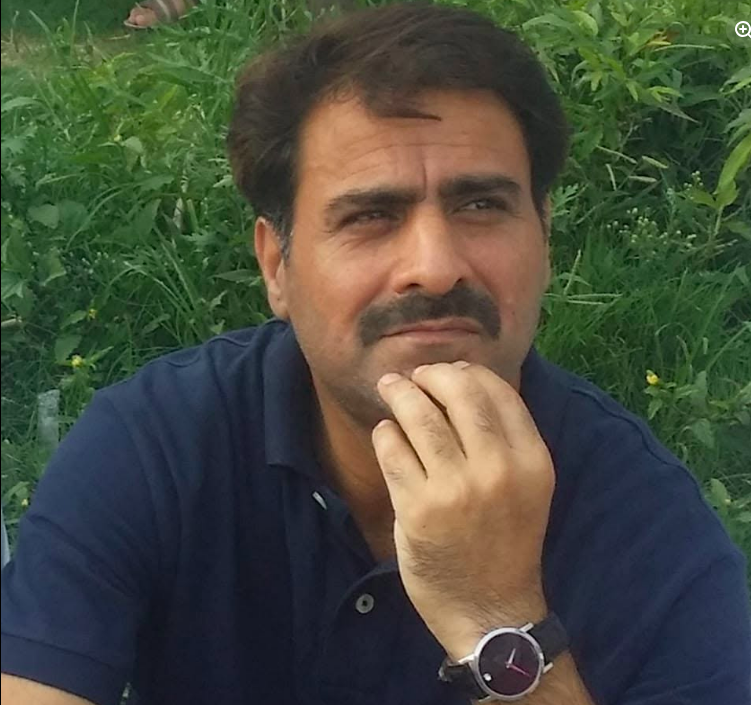 Political Beliefs & Advocacy
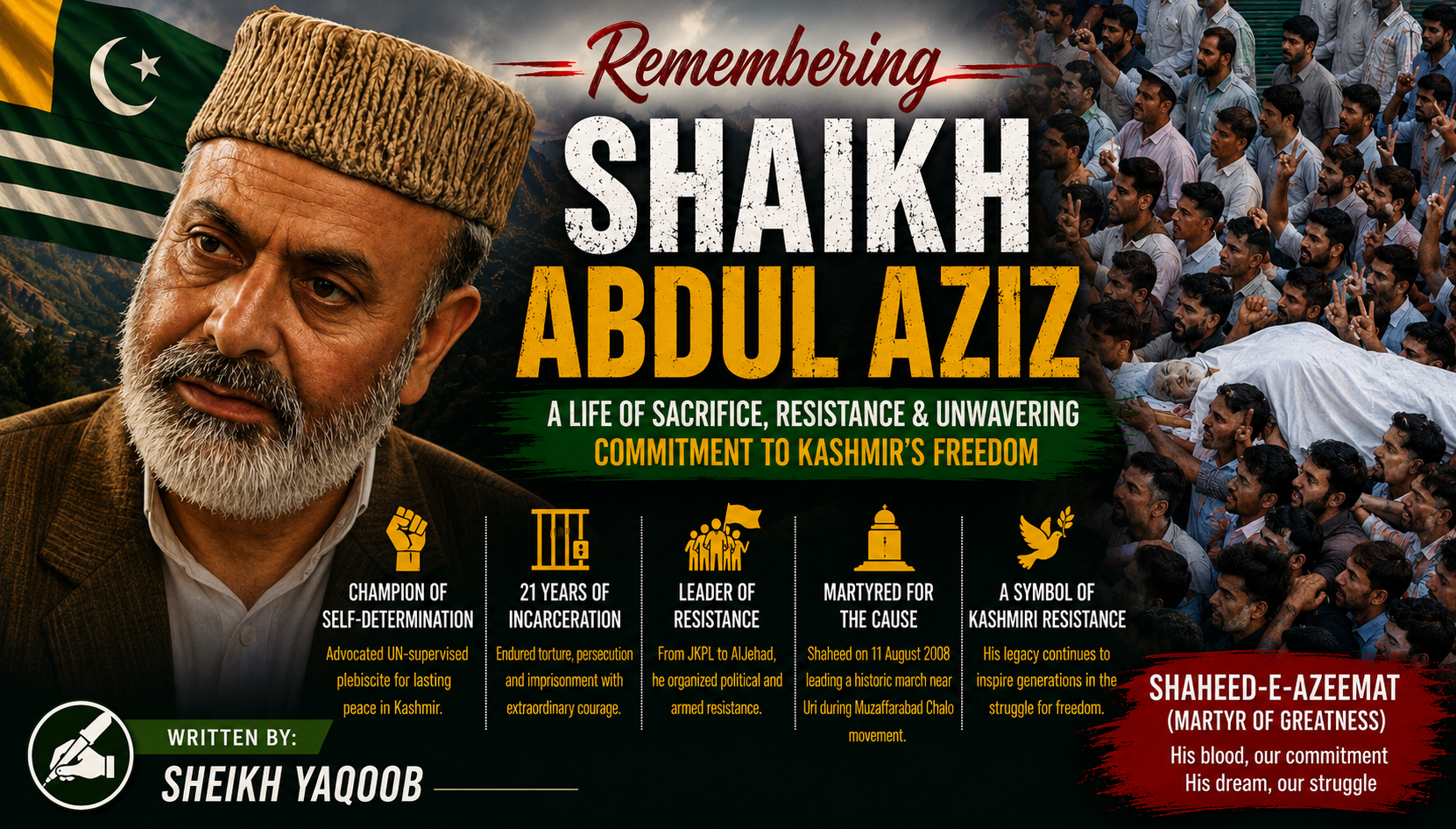
A staunch proponent of Kashmir’s right to self-determination, Shaikh Abdul Aziz, firmly advocated for a UN-supervised plebiscite as a means to lasting peace in the region. He remained committed to his dream and faced all the hardships, torture, persecution, and detentions with an exemplary grace and fortitude – he was unwavering and indomitable. He toiled hard, day night organising the political and the armed resistance against the illegal Indian occupation of his motherland till his last breath. Proving his commitment and loyalty to the pro-Pak noble national resistance,he made his legacy immortal by spilling his blood for it on August 11, 2008.
Early Life & Background
Born in 1952, in Namblabal, Pampore (near Srinagar) into a respectable and financially well established Shaikh family, he completed his educational career locally before joining his family’s saffron-growing agricultural business—saffron being a hallmark of Pampore. Influenced by the all pervading love for freedom and Pakistan , he openly supported Pakistan as it launched war for the freedom of his motherland from the Indian occupation in 1965 who challenged him in a local police lock up at the tender age of mere 13, however, this brief detention of a few days only reinforced his faith and changed his thinking for ever. It proved a turning point in his life, and freedom became its overriding dream with all worldly attractions losing their meaning to him, and so began his new and epic journey of freedom.
Political Association:
He began his activism in the Young Men’s League in the early 1970s, which was later merged into the Jammu Kashmir Peoples’ League in 1974. Sheikh Abdul Aziz became its District President (Pulwama) in 1979. He, because of his passion for resistance and remarkable services, rose to become the party General Secretary in 1983 and worked single mindedly to organise the pro-Pak resistance across the occupied IIOJK under its banner till1987 .
In the early 1990, he crossed into Azad Kashmir, where he led a military wing of JKPL—the Jehad Force—and in 1992 a merger of Jehad Force and Muslim Janbaz Force to form Jammu Kashmir AlJehad, leading it until his arrest in May 1993 .
Long Incarceration
Sheikh Abdul Aziz spent almost 21 years in incarceration, notably from 1979, 1983 to 1999, then again from 2001 until his release in August 2008. He was lodged in multiple prisons, including those in the infamous Tihar, Delhi, and Jodhpur, Kot Bhalwal, and different torture centres in Srinagar amid harsh conditions .
Pakistan Visit & Public Reception
In 2000, he came to Pakistan (Rawalpindi/Lahore) to attend his youngest brother’s (myself) wedding.
Upon arrival at Lahore airport, he performed a prostration (sajda), a highly symbolic act, before being received as a state guest for about a month and was given guard of honour —covered widely in Pakistani media, provoking strong Indian resentment.
On his return to the occupied valley, he was immediately arrested again by Indian authorities, ending his brief freedom until his release in early August 2008. By this time, he had gained an aura and popularity across the land.
Martyrdom in the 2008 Uprising
In 2008, following the Amarnath land transfer controversy and the shrine board impasse, BJP-RSS–aligned groups imposed an economic blockade of the Srinagar-Jammu highway, seeking to starve the Valley into submission.
In response, Kashmiris launched the Muzaffarabad Chalo (Rawalpindi Chalo) movement, demanding the opening of the historic Srinagar-Rawalpindi road and staging a protest march to Uri, including a strike and mass mobilization.
Sheikh Aziz led a half-million strong procession, which was fired upon by Indian paramilitary forces near Uri. On 11 August 2008, during the Muzaffarabad Chalo march protesting the economic blockade of the Kashmir Valley by Hindutva-aligned groups, Shaikh Abdul Aziz was martyred by Indian paramilitary forces near Uri while leading a demonstration of millions Kashmiris. He succumbed to injuries at SMHS Hospital in Srinagar and was buried at Martys’ Graveyard, Eidgah, the following day.
Symbol of Resistance
Shaheed-e-Azeemat (Martyr of Greatness) for Kashmir—his passing – intensified the movement for self-determination.
Sheikh Abdul Aziz remains a central figure in the Kashmiri freedom movement, remembered for his unshakable belief in selfdetermination his willingness to sacrifice his life for the cause, and his impact as a founding APHC leader. His life and martyrdom are deeply embedded in the collective memory of those continuing the struggle for Kashmir’s political future.
His legacy is commemorated annually by APHC and JKPL, seen as a guiding light for the struggle for Kashmiri freedom .
(The author is a leader of All Parties Hurriyat Conference Azad Jammu and Kashmir.)