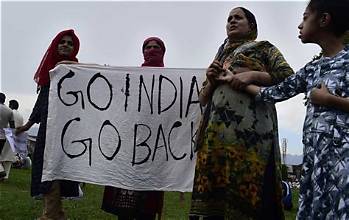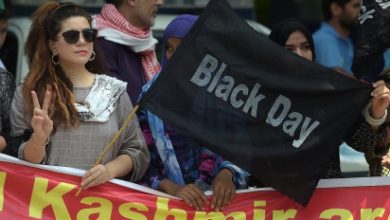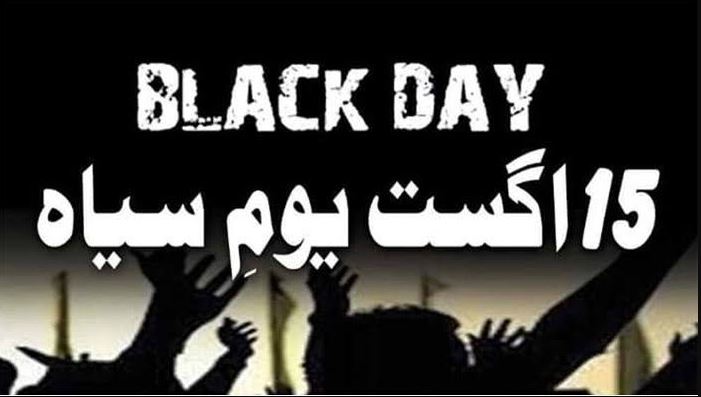
As India celebrates its 79th Independence Day on August 15, the date carries a profoundly different meaning in Kashmir. For the people of Indian illegally occupied Jammu and Kashmir (IIOJK), the day is observed as a Black Day, not as a rejection of freedom itself, but as a protest against what they regard as the denial of their right to determine their own political future.
Kashmiris on both sides of the Line of Control and across the world observe the day to convey to the international community their rejection of what they describe as India’s illegal occupation of their homeland. The observance is also intended to send a message to New Delhi that, in their view, India has no right to celebrate its independence in Jammu and Kashmir while the territory remains the subject of an internationally recognised dispute.
The symbolism is striking. A country celebrating its liberation from colonial rule is confronted by a people who argue that their own political future was never finally determined by their consent.
That claim cannot be understood without returning to the extraordinary political commitments made in the aftermath of Partition.
When British India was partitioned in 1947, Jammu and Kashmir was a princely state whose ruler, Maharaja Hari Singh, had not initially decided whether to accede to India or Pakistan. India sent troops into the state on October 27, 1947, following the reported signing of a so-called Instrument of Accession by the Maharaja. An indigenous armed struggle against India’s hegemony had already broken out in parts of the territory. The subsequent armed conflict transformed the question into an international dispute. India took the Kashmir issue to the United Nations, and the Security Council began considering it in January 1948.
What followed was not simply an exchange of diplomatic claims. It was an international process in which the future of Jammu and Kashmir was repeatedly linked to the will of its people.
Security Council Resolution 39 of January 20, 1948, established the United Nations Commission for India and Pakistan (UNCIP). Resolution 47 of April 21 called for measures to restore peace and order and addressed the holding of a plebiscite in Jammu and Kashmir. The UN’s own record describes Resolution 47 as concerning both restoration of peace and the plebiscite in the state.
The distinction is important. The UN framework did not simply envisage an indefinite bilateral negotiation between India and Pakistan. It linked the settlement process to demilitarisation and a free and impartial plebiscite under UN auspices.
That principle was subsequently reinforced. Resolution 80 of March 14, 1950, appointed a UN Representative and continued efforts towards demilitarisation. Resolution 91 of March 30, 1951, followed the report of UN Representative Sir Owen Dixon and addressed, among other matters, the continuing UN role in the India-Pakistan dispute and the question of a constituent assembly in Srinagar. The resolution recorded assurances from India’s representative that any such assembly would not prejudice matters before the Security Council.
Resolution 96 of November 1951 dealt with demilitarisation, while Resolution 98 of December 1952 recalled the earlier UN framework and the parties’ commitments concerning the Kashmir question.
Even as political circumstances changed, the UN framework did not simply disappear. Resolution 122 of January 1957 rejected unilateral action by a constituent assembly as a means of determining the final disposition of Jammu and Kashmir. Resolution 126 of December that year again addressed the unresolved India-Pakistan dispute and the lack of progress towards implementing the earlier framework.
The historical record therefore contains an important continuity: the plebiscite was not a concept introduced into the Kashmir dispute years later. It was embedded in the international process that began in 1948 and remained part of the diplomatic record for years afterwards.
Perhaps more politically consequential is the fact that the principle of popular consent was not confined to UN resolutions. It was also repeatedly acknowledged by Indian leaders and representatives.
Jawaharlal Nehru, India’s first prime minister, stated in the early months of the dispute that the people of Kashmir would ultimately determine the question of accession.
In a telegram of October 27, 1947, Nehru stated that India’s assistance to Kashmir was not intended to influence accession and that, in a disputed territory, accession should be decided according to the wishes of the people. The following day, he wrote that accession was subject to reference to the people and their decision. On October 31, he declared that India’s assurance to withdraw its troops once peace and order had been restored and leave the decision about the state’s future to its people was a commitment not merely to Pakistan but to the people of Kashmir and to the world.
The principle did not end with Nehru’s early assurances. It was subsequently articulated before the United Nations by India’s own representatives.
On January 15, 1948, India’s representative at the Security Council, Sir Gopalaswami Ayyangar, stated that when the Indian Independence Act came into force, Jammu and Kashmir, like the other princely states, became free to decide whether to accede to India, Pakistan or remain independent.
More than three years later, on March 1, 1951, Sir Benegal Rama Rau, Indian representative told the Security Council that the people of Kashmir were not mere objects to be disposed of according to a predetermined formula and that their future had to be determined in accordance with their own interests and desires.
And on January 31, 1952, during the Security Council’s 572nd meeting, another Indian representative, Mr Setalvad, stated that he had been among those who had first declared that the people of Jammu and Kashmir should freely decide their own future.
Taken together, these statements are significant. They show that the principle of popular choice was not merely imposed upon India through international diplomacy; it was also articulated by Indian representatives during the early years of the dispute.
They should not therefore be dismissed simply as relics of another era. They raise a question that remains central to Kashmir today: if the people of Kashmir were once recognised as having a legitimate interest in determining their political future, on what basis was that interest subsequently considered permanently settled?
The United States, too, has a substantial historical record of supporting the principle that Kashmir could not be settled unilaterally.
On February 15, 1957, US Ambassador Henry Cabot Lodge Jr reminded the Security Council that the resolutions of August 13, 1948, provided for a ceasefire, a truce and ultimately the determination of the future status of Jammu and Kashmir “in accordance with the will of the people.”
Five years later, on June 15, 1962, US Ambassador Adlai Stevenson similarly argued that the larger interests of South Asian peace and security required a settlement of Kashmir and that the dispute could not be resolved unilaterally by either India or Pakistan. A settlement, he said, required agreement and compromise while taking into account the freely expressed will of the people concerned.
The significance of these statements lies not simply in their age but in the principle they embody. In the formative years of the Kashmir dispute, India’s representatives and major international powers discussed the question in terms of the wishes, interests and freely expressed will of its people.
The vocabulary of diplomacy may have changed, but the fundamental question has not: what happened to the principle of popular consent?
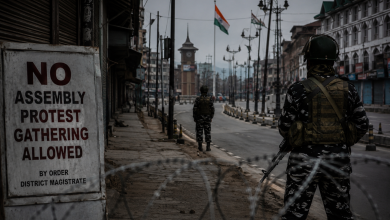
Nearly eight decades have produced generations of Kashmiris for whom the dispute is not a chapter in a history book but a lived political reality. The region has experienced wars, insurgency, militarisation, displacement, political repression, terrorism and repeated crises between two nuclear-armed states.
The constitutional changes of August 2019 added another profound layer to the dispute. India’s revocation of Jammu and Kashmir’s special constitutional status and its reorganisation of the former state into Union Territories represented, to people of Kashmir, a unilateral alteration of the political and constitutional status of a disputed territory.
But changing the administrative architecture of a disputed territory cannot, by itself, resolve the political question surrounding it. A durable settlement requires addressing the aspirations of the people concerned as well as the positions of the principal parties.
That is what makes August 15 such a powerful symbol in Kashmir.
On the very day India celebrates the principle of national freedom, Kashmiris are reminding the international community that, in their view, their own political future remains unsettled.
For them, India’s Independence Day is therefore not a day of celebration. It is a day of protest and mourning, symbolising their rejection of Indian rule and their continued demand for the right to determine their political future. Through rallies, demonstrations and other forms of peaceful expression, Kashmiris seek to draw international attention to what they describe as India’s illegal occupation and the denial of their fundamental political rights.
The Black Day observance is consequently more than an annual protest against August 15. It is a reminder of a political question that has survived successive wars, diplomatic initiatives, constitutional changes and generations of changing leadership: whether the people of Jammu and Kashmir should have a decisive voice in determining their own future.
The historical record makes it difficult to dismiss that demand simply as contemporary rhetoric. In the early years of the dispute, India publicly spoke of the people’s wishes, while the United Nations established and repeatedly revisited an international framework centred on determining the future of Jammu and Kashmir.
Nearly eight decades later, the contradiction remains at the heart of Kashmir.
And so, while India celebrates its independence on August 15, Kashmiris observe the day as a Black Day, not because they reject freedom, but because they argue that their own freedom to determine their political destiny remains unfinished.
The Black Day observance thus represents both a rejection of Indian rule and a renewed call for international attention to a dispute whose central question has remained remarkably consistent since 1947: who should decide the political future of IIOJK, the government that claims the territory, or the people whose future is at stake?