Pakistan rejects Yasin Malik’s case, sentence as politically motivated and contrary to justice
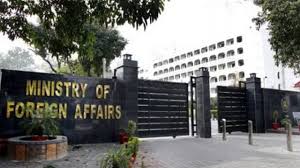 Islamabad: Pakistan has completely rejected the case and sentence handed down by India against Jammu and Kashmir Liberation Front (JKLF) Chairman Mohammad Yasin Malik, describing the proceedings against him as politically motivated and contrary to the fundamental requirements of justice.
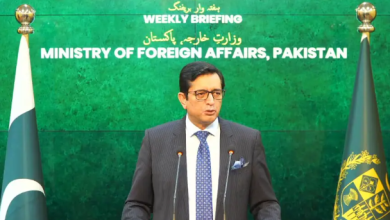
According to Kashmir Media Service, during his weekly press briefing, Foreign Office Spokesperson Tahir Hussain Andrabi said Pakistan would continue to raise the case of Yasin Malik at international and multilateral forums. He urged the international community to take notice of the matter and said Pakistan prayed for Yasin Malik’s health and long life.
On the Indus Waters Treaty (IWT), Andrabi said the Permanent Court of Arbitration at The Hague had reaffirmed that the treaty remained fully enforced and binding, rejecting India’s unilateral attempt to place it in so-called abeyance. He said the unanimous award of the Court of Arbitration constituted an important reaffirmation of the sanctity of the IWT and the rule of international law.
The court had confirmed that India’s purported decision to place the treaty in abeyance did not relieve it of its obligations under the agreement, while the treaty’s dispute-settlement mechanism remained operative, the spokesperson said.
Andrabi said an interim measure concerning the Ratle Hydroelectric Power Project further affirmed that rights and obligations under the treaty could not be altered or displaced through unilateral action. “Pakistan welcomes these clear and authoritative pronouncements,” he said, adding that they validated Islamabad’s consistent position that differences concerning the IWT must be addressed strictly within the framework of the treaty and in accordance with international law.
Regarding the US-Iran conflict, Tahir Hussain Andrabi described the latest escalation between the United States and Iran as “concerning and undesirable”, while reaffirming its commitment to pursuing dialogue and diplomacy to promote peace. “Despite recent escalations, we remain hopeful, and we will continue to strive for dialogue and diplomacy,” he said.
Andrabi said both sides had carried out armed attacks and retaliatory strikes in the US-Iran conflict, while Islamabad was closely monitoring the situation. Describing the current escalation as “concerning and undesirable”, he said Pakistan had not lost hope in the peace process.
The spokesperson said the latest US-Iran escalation could not be characterised as a failure of Islamabad’s diplomatic efforts, adding that the country was engaging in the peace process with complete sincerity to help resolve the US-Iran conflict.
Andrabi said Pakistan’s diplomatic efforts would continue and expressed hope that the two sides would eventually return to the negotiating table once the current escalation subsided. He said the Islamabad Memorandum of Understanding (MoU) provided a framework for bringing the parties back to negotiations and could be used if they were willing to resume talks.