India’s IWT move puts millions at risk, Geneva event warns
Experts call for dialogue and legal frameworks to protect downstream communities
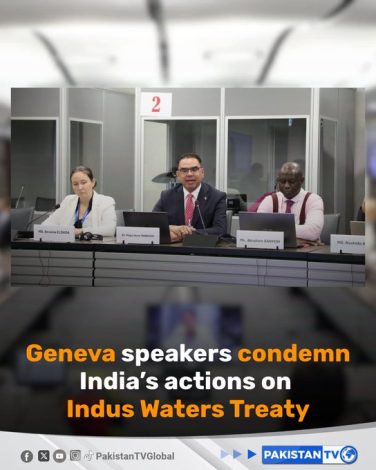
Geneva: India’s decision to place the Indus Waters Treaty (IWT) in abeyance has heightened concerns over water security, agriculture and livelihoods of millions of people dependent on the Indus Basin, as the six-decade-old agreement faces a major challenge amid continued tensions between India and Pakistan.
The concerns were raised at a side event held in Geneva on the margins of the 63rd session of the UN Human Rights Council.
Titled “Water Justice and Climate Resilience: Advancing Transboundary Cooperation in South Asia and the Middle East,” the event brought together legal experts, researchers, diplomats, practitioners and civil society representatives to discuss international water law, human rights, climate resilience, environmental justice and management of shared rivers.


“Trans-boundary Water Challenges in South Asia” was among the principal themes, with particular attention to the Indus River system and the legal and institutional framework governing shared waters.
Speakers at a side event during the UN Human Rights Council session in Geneva condemned India’s unilateral suspension of the Indus Waters Treaty and urged respect for Pakistan’s water rights. They called for international action to uphold treaty obligations, stressing the… pic.twitter.com/c9OOjIrFqr
— Pakistan TV (@PakTVGlobal) October 2, 2026
The Permanent Court of Arbitration (PCA), which administers the proceedings over the IWT, has determined that the treaty remains in force despite India’s decision to place it in abeyance. India has rejected the arbitration process, while Pakistan has cited the court’s order as supporting its position that the agreement remains effective.
Rashida Abbas, founder of the Hydro-Justice Student Research & Policy Fellowship and a PhD candidate at the University of Geneva, addressed the South Asian dimension of the discussion, focusing particularly on the Indus system.
Abbas said rivers should not be viewed solely as matters between states because their consequences are experienced directly by people and communities. “Rivers are not experienced only by states,” she said. “They are experienced by people.” She linked water governance with human rights, noting that decisions concerning rivers can affect drinking water, agriculture, livelihoods, communities and health.
Abbas argued that the future management of South Asia’s shared waters should be based on law, dialogue, science, functioning institutions and justice. She also stressed that trans-boundary agreements should not become optional when relations between states deteriorate.
The discussion addressed concerns about using shared water resources as instruments of political pressure. Abbas highlighted the interests of downstream communities and the need for legal frameworks to protect their water security and human rights.
Other speakers placed the Indus dispute within a broader discussion of trans-boundary water challenges.
Majid Hawi Alwan addressed geopolitical pressures surrounding shared water systems in arid regions, including the Gulf and wider Middle East. His contribution focused on regional approaches in which water security is treated as a shared necessity rather than an instrument of unilateral leverage.
Seraina Eldada brought a mediation and diplomacy perspective, examining the institutional design of transboundary water arrangements and the role of third-party mediation and permanent mechanisms in resolving disputes.
Harmayn Mujahid, a legal scholar and fellowship coordination officer, linked water insecurity with human rights concerns. The discussion considered how changing river patterns and climate-related stress can affect vulnerable communities and why questions of equity need to be considered alongside state sovereignty in international water law.
Tahir Mahmood addressed the relationship between resource scarcity and security, including risks associated with water-related tensions in regions already affected by political and territorial disputes. He also discussed prevention and resilience in the context of what he described as “hydro-terrorism.”
The Geneva discussion placed the current India-Pakistan dispute within a wider question of whether institutions governing shared rivers can continue to function during periods of political tension.
The meeting underscored the importance of maintaining established mechanisms for dialogue and dispute resolution as countries sharing vital water resources confront both political tensions and growing environmental pressures.