New report describes India’s rule in Kashmir as ‘settler-colonial project’
Istanbul-based lawyers’ body cites demographic engineering, military control and political repression
 Report argues violations amount to war crimes, calls for international accountability
Istanbul: A new report by an international association of lawyers has described India’s rule over Jammu and Kashmir as having evolved from prolonged military occupation into a “structural settler-colonial project”, citing demographic engineering, military control, political repression and restrictions on fundamental freedoms, particularly since the revocation of the territory’s special constitutional status in 2019.
The report, titled “Longest Siege: Settler Colonialism and Structural Violence in Indian Occupied Jammu Kashmir,” was published by the Worldwide Lawyers Association (WOLAS), a human rights body comprising legal professionals and academics headquartered in Istanbul. Examining developments from August 2019 through 2026, it argues that India’s policies have extended beyond military control to changes that threaten the political identity, land rights and future of the Kashmiri people.
According to the report, the revocation of Jammu and Kashmir’s special constitutional status in August 2019 marked a decisive turning point, paving the way for legal and administrative changes that weakened protections for the local population.
Human toll and accountability

Drawing on figures from Kashmir Media Service (KMS) and the Jammu Kashmir Coalition of Civil Society (JKCCS), the report puts the cumulative human toll between January 1989 and August 2026 at 96,502 people killed, more than 184,000 civilians arrested, over 110,000 homes and other structures destroyed or damaged, and nearly 23,000 women widowed. It also records more than 8,000 enforced disappearances and over 11,000 incidents of sexual violence.
The report refers to a 2011 inquiry into unmarked graves that documented 2,730 bodies across 38 sites in north Kashmir, including 2,156 that remained unidentified.
It argues that accountability for abuses has been obstructed by the Armed Forces (Jammu and Kashmir) Special Powers Act (AFSPA), which requires prior sanction from the central government before members of the armed forces can be prosecuted in civilian courts. Citing United Nations findings, the report says the Indian government had not sanctioned a single such prosecution in nearly three decades.
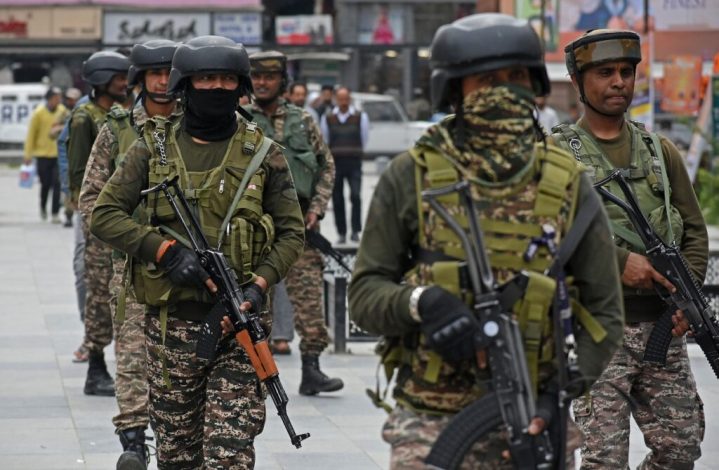
The report also describes the Indian military presence in Jammu and Kashmir as among the highest globally relative to the population, highlighting the scale of security deployment in the territory.
Demographic changes and cultural restrictions
A central argument of the report is that the post-2019 system represents a colonial project rather than repression alone. It points to changes in domicile laws that allow non-residents to obtain residency rights and acquire land, an eviction campaign in 2023, and the renaming of institutions and places.
The report also highlights changes to the territory’s linguistic and educational landscape, including the removal of Urdu’s status as the sole official language and the expansion of schools run by groups affiliated with the Hindu nationalist Rashtriya Swayamsevak Sangh (RSS).
It further documents restrictions on religious activities, including the repeated denial of Eid prayers at Srinagar’s Jamia Masjid and Eidgah over several consecutive years, as well as the repeated house arrest of Kashmir’s chief cleric and senior All Parties Hurriyat Conference leader Mirwaiz Umar Farooq.
Assessing these policies under international humanitarian law, the report invokes Article 49(6) of the Fourth Geneva Convention, which prohibits an occupying power from transferring parts of its own civilian population into the territory it occupies.
Detentions, political leaders and legal proceedings
A substantial section examines the detention and death of Kashmiri political figures. It documents the deaths in custody of four senior political leaders since 2019 and the proscription of 10 local organisations under India’s Unlawful Activities (Prevention) Act (UAPA).
The report records that veteran pro-freedom leader Syed Ali Gilani died in 2021 after years under house arrest, while senior Hurriyat leaders Muhammad Ashraf Sehrai and Altaf Ahmad Shah died in custody. It also notes that India’s National Investigation Agency has pursued the death penalty against Jammu and Kashmir Liberation Front chief Mohammad Yasin Malik, who is already serving a life sentence.
Citing an Indian Supreme Court case from May 2026, the report says the conviction rate under the UAPA in occupied Jammu and Kashmir was below one per cent and had reached zero in 2019. It argues that prolonged pre-trial detention has, in practice, amounted to punishment before conviction.
The report also tracks preventive detentions under the Public Safety Act (PSA) and UAPA. Drawing on data compiled by the Legal Forum for Kashmir and, from mid-2024, the Kashmir Law and Justice Project, it records 26,129 arrests under the two laws between 2019 and 2026.
According to the report, the largest spike occurred in 2019, the year India revoked the territory’s special status, while the figures rose again from 2024. It links part of the latter increase to the detention of approximately 2,800 civilians following the April 2025 attack in Pahalgam.
The report also highlights the cases of women detained or sentenced under the law. It notes that in March 2026, Dukhtaran-e-Millat chief Asiya Andrabi received a life sentence, while two associates were sentenced to 30 years each. The report characterises the sentences as punishment for political expression rather than for any documented violent act.
Among those it identifies as long-term prisoners is Ashiq Hussain Faktoo, who has been detained since 1993. The report says he was made to sign a blank paper that was subsequently used as his confession, that a recommendation for his release in 2008 was rejected, and that he now suffers from untreated glaucoma and partial blindness. It also notes that he completed a doctorate and wrote more than 20 books while in prison.
Surveillance and restrictions on intellectual life
The report raises concerns over what it describes as an expanding surveillance infrastructure, including household-level biometric registration. It also states that 4,249 books had been withdrawn from circulation by 2026.
It presents these measures as part of a broader pattern of control extending beyond security operations into cultural, intellectual and social life. The report further examines the use of tourism, cinema and staged international events to project an image of normality in the territory, arguing that such displays risk obscuring unresolved concerns over political rights, freedom of expression and local autonomy.
It stresses the need to protect Kashmir’s cultural heritage and ensure that the voices and aspirations of its people are not overshadowed by official narratives.
Pressure on rights defenders, journalists and lawyers
The report documents the prosecution of prominent Kashmiri human rights defenders and what it describes as the institutional displacement of the region’s Bar Association.
It also alleges systematic passport denials affecting journalists, lawyers and academics, arguing that such restrictions limit their ability to travel, communicate their findings and engage with international institutions.
According to the report, pressure on these groups undermines independent scrutiny and makes it more difficult to document human rights violations and bring them before international bodies. It warns that the weakening of independent legal and journalistic institutions leaves affected communities with fewer avenues to challenge abuses, seek remedies and defend their rights.
The report calls for sustained international attention to the situation of Kashmiri civil society and stronger mechanisms to support those documenting alleged violations.
India-Israel nexus
Another chapter examines what the report describes as an India-Israel nexus underpinning the security architecture in Kashmir. It cites Israeli-supplied Heron drones, Tavor rifles and guided munitions, and estimates that India’s annual defence spending with Israel has reached approximately $1 billion, double its 2014 level.
The report also references testimony collected by London-based firm Stoke White Investigations alleging the presence of Israeli intelligence operatives during interrogations. It cites journalist Azad Essa’s analysis of what he sees as structural similarities between Hindutva and Zionism as exclusionary, homeland-based ideologies.
War crimes allegations and recommendations
In its legal assessment, the report argues that documented practices, including torture, arbitrary detention, home demolitions and population transfers, may constitute grave breaches of the Fourth Geneva Convention, war crimes and crimes against humanity under the Rome Statute.
It further argues that prohibitions on torture and crimes against humanity impose obligations on states regardless of their ratification of particular treaties. Noting that India is not a party to the Rome Statute, the report identifies what it calls an accountability gap.
To address this, WOLAS recommends sustained UN engagement, the establishment of a commission of inquiry, universal-jurisdiction proceedings against named commanders in third countries, targeted sanctions and a request by the UN General Assembly for an advisory opinion from the International Court of Justice on the legality of the 2019 revocation.
The report’s title refers not only to the physical restrictions imposed on the territory but also to what its authors describe as an information siege — the longest of its kind — that has made the scale of developments in Kashmir increasingly difficult to assess.
It concludes that the changes documented since 2019 demand sustained international engagement, independent monitoring and coordinated legal action. It urges international institutions, governments, legal organisations and human rights advocates to examine its findings and pursue appropriate accountability mechanisms.
At the centre of the report is the concern that changes to land laws, residency rules, political representation and civil liberties could have lasting consequences for Kashmir’s demographic composition, cultural identity and political future.
The report maintains that the civil liberties, cultural identity, land rights and political representation of the Kashmiri people must remain central to international discussions on the disputed territory. It calls for efforts to move beyond expressions of concern towards sustained documentation of violations, protection of affected communities and enforcement of international legal obligations.