408% increase in violence against Christians since Modi came to power: Report
Report titled ‘Fear and Expulsion: The Price of Being Christian in India’ released
New Delhi: Incidents of violence and persecution against Christians in India have increased significantly since the Narendra Modi-led government came to power in 2014, with reported incidents rising from 147 in 2014 to 747 verified cases in 2025, according to data compiled by the Evangelical Fellowship of India’s Religious Liberty Commission (EFIRLC).
The figures represent an increase of approximately 408 per cent over the period. The 2025 figure was verified from more than 915 reports received during the year.
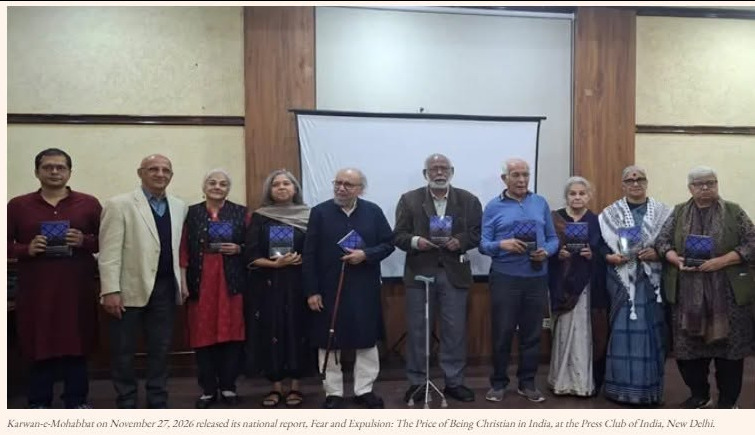
The findings were highlighted in a national report titled Fear and Expulsion: The Price of Being Christian in India, released by Karwan-e-Mohabbat at the Press Club of India in New Delhi.
The report documents nearly 900 testimonies of persecution, forced displacement, social boycotts and institutional complicity across 20 districts in Chhattisgarh, Odisha, West Bengal and Madhya Pradesh. It examines growing patterns of violence, discrimination and persecution against Christian communities, particularly Adivasi and Dalit Christians.
The report documents how the exercise of constitutionally guaranteed religious freedom is increasingly being met with intimidation, violence, criminalisation and social exclusion. Across villages, churches, homes and burial grounds, Christian communities are reportedly facing restrictions on their rights to worship, practise their faith, sustain their livelihoods and live in their ancestral villages without fear.
The documentation includes nearly 500 testimonies from Chhattisgarh, around 300 from Odisha, interactions with approximately 25 victims across five districts of Madhya Pradesh, and accounts concerning 48 cases heard at the People’s Tribunal convened by Karwan-e-Mohabbat in 2026. The report draws on these testimonies alongside independent investigations, institutional reports, secondary research and legal analysis.
Violence, expulsion and social boycotts
The findings reveal recurring patterns of persecution extending beyond individual acts of violence. Pastors, priests and other religious leaders have reportedly faced physical assaults, threats, intimidation and criminal proceedings, often following reports of forced religious conversions.
Churches, chapels and house churches have reportedly been vandalised, prayer meetings disrupted and congregations intimidated. Christian families have faced social boycotts, expulsion from villages, economic exclusion and punitive fines for refusing to renounce their faith.
One of the particularly disturbing findings concerns the denial of burial rights. Families have reportedly been prevented from burying deceased relatives in village burial grounds and, in some instances, even on their private land. Funeral processions and religious rites have also been obstructed, leaving grieving families to endure further humiliation and coercion.
Testimonies further document physical assaults, public stripping and parading, sexual violence and other forms of degrading treatment.
Institutional complicity
The report raises serious concerns over the role of state institutions in perpetuating or enabling these violations.
Survivors have described police inaction, refusal to register complaints, retaliatory criminal cases against victims, pressure to enter into compromise agreements and, in some instances, police participation in intimidation and violence.
These accounts point to a recurring pattern in which people reporting violence themselves face criminal proceedings, while those accused of committing such acts frequently escape accountability.
Situating these experiences within the wider national context, the report highlights the sharp increase in reported incidents of violence against Christians. According to EFIRLC data, reported incidents rose from 147 in 2014 to 747 verified cases in 2025.
The report also cites data from the United Christian Forum (UCF), whose helpline had recorded 531 incidents by mid-April 2026, indicating a continuing trend of violence and persecution against Christian communities.
It further examines the role of Hindutva mobilisation surrounding forced conversions and the growing use of anti-conversion legislation. According to the report, terms such as “force”, “fraud” and “allurement” remain vaguely defined in these laws, creating an atmosphere of suspicion and hostility towards Christian communities.
The report expresses concern over the alleged misuse of anti-conversion laws, particularly their broad definitions of inducement, advance-notice requirements, reversal of the burden of proof and stringent penalties. These provisions, alongside allegations made by vigilante groups, have reportedly contributed to the criminalisation of peaceful religious gatherings and the exercise of freedom of conscience.
Attendance at report launch
The report’s release was attended by prominent public intellectuals, human rights activists, legal experts, journalists and civil society representatives.
Those who addressed the gathering included Annie Raja, Colin Gonsalves, Githa Hariharan, Harsh Mander, John Dayal, Navsharan Singh, Saket Gokhale, Syeda Hameed, Wajahat Habibullah and Zoya Hasan. The event was moderated by Omair Khan, a researcher at Karwan-e-Mohabbat.
Addressing the gathering, speakers expressed concern over the systematic nature of violence and discrimination against Christian communities and the widening gap between constitutional guarantees and their lived realities.
John Dayal reflected on the history of violence against Christians in India, drawing on his experience as a member of the Christian community and his professional career as a journalist covering communal violence. Recalling the 1998 Christmas Eve attacks in Gujarat and the killing of Graham Staines and his two sons in January 1999, he highlighted the persistence of targeted violence against Christians and stressed the need to address institutional silence and complicity through sustained civil society intervention.
Harsh Mander highlighted that persecution extends beyond attacks on churches to include systematic humiliation, segregation and social and economic exclusion, disproportionately affecting the most disadvantaged communities.
Githa Hariharan described the report as evidence of the human cost of exclusionary politics. She argued that anti-conversion laws reinforce caste hierarchies and are used to criminalise religious choices, depriving Dalit and Adivasi communities of their identity and dignity, often with state complicity.
Syeda Hameed observed that violence against Christians had become a political instrument for Hindutva forces and had intensified since 2014. She said complaints of religious conversion were being used to question the loyalty of Christians and deny them even the dignity of burial.
Navsharan Singh highlighted how Adivasi and Dalit Christians are labelled as “converts” and “infiltrators”, along with other dehumanising terms, reflecting a wider pattern of systematic exclusion and selective targeting.
Annie Raja emphasised the growing marginalisation of these communities and the institutional impunity that enables such persecution, undermining their right to live with dignity and freedom from fear.
Colin Gonsalves criticised the Supreme Court’s indifference towards documented hate crimes against Christians. He also highlighted the selective use of anti-conversion laws against Adivasi Christians and the denial of their rights to worship and burial. He warned that the lack of accountability emboldens perpetrators and called for collective resistance.
Saket Gokhale highlighted religious bias in political discourse, pointing to the hesitation of politicians to extend Christmas greetings despite readily wishing people on Eid. He questioned complaints of forced conversion against Christian institutions despite their contributions to education and public service. He argued that anti-conversion laws in 13 states contradict Article 25 of the Constitution, which guarantees religious freedom, and stressed that the struggle is for equal rights, not minority privilege.
Zoya Hasan highlighted the contributions of Christian communities to education and healthcare while raising concerns over complaints of religious conversion, the denial of Scheduled Caste status to Dalit Christians and regulatory pressure on Christian organisations under the FCRA Amendment Bill, 2026. She emphasised that the issue extends beyond minority rights to the protection of India’s constitutional guarantees and democracy.
Wajahat Habibullah warned that violence against Christians, particularly vulnerable communities and house churches, reflects a deeper societal problem and threatens India’s inclusive civilisational heritage. He called for a united response across faiths to defend the country’s shared identity and protect its most vulnerable communities.
A statement by Sagarika Ghosh, which was read out at the gathering, highlighted the violence, intimidation and social ostracism faced by Christians in rural Bengal, alongside alleged state complicity and police indifference. She also raised concerns over the FCRA Amendment, 2026, warning of its implications for Christian institutions, including schools and hospitals, and the potential seizure of properties without trial. She stressed that the struggle concerns not only Christian rights but also constitutional freedoms and democratic rights.
Recommendations and way forward
The report calls for urgent intervention by state authorities to ensure the protection of Christian communities and accountability for violations.
Its recommendations include independent investigations into complaints of police complicity and institutional failure; protection of clergy, churches and peaceful prayer gatherings; an end to organised social and economic boycotts; protection of burial rights; and the provision of legal, medical, psychosocial and livelihood assistance to survivors and displaced families.
It also urges state governments to ensure that anti-conversion legislation is not used to criminalise peaceful religious practices or individual choices, and that complaints of forced conversion do not become a pretext for vigilante violence or retaliatory criminal proceedings.
At its core, Fear and Expulsion: The Price of Being Christian in India examines the widening gap between India’s constitutional promises and the lived realities of its Christian citizens.
The report argues that religious freedom must not remain a guarantee confined to paper. It must ensure that people can worship without fear, bury their dead with dignity, sustain their livelihoods without discrimination and remain in their homes and communities without being forced to abandon their faith.
The release of the report is an appeal to governments, constitutional institutions, civil society and citizens to confront the growing normalisation of religious discrimination and violence and reaffirm the constitutional guarantees of equality, dignity, liberty and fraternity.
A short video documentary on Karwan-e-Mohabbat’s visit to Madhya Pradesh, prepared by its media team, was also screened during the press conference.