Report urges affirmative action to address deep-rooted Muslim marginalisation in India
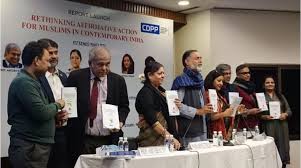 New Delhi: A recent report titled Affirmative Action for Muslims in Contemporary India has sparked debates about the systemic discrimination faced by Muslim communities in the country.
According to Kashmir Media Service, released by the Centre for Development Policy and Practice (CDPP), the report was unveiled at the India International Centre, followed by a panel discussion featuring prominent scholars and public figures.
The report, co-authored by Dr Hilal Ahmad and Dr Mohammad Sanjeer Alam of the Centre for the Study of Developing Societies (CSDS), along with Nazima Parveen, Associate Research Fellow at Policy Perspectives Foundation, highlights the persistent social exclusion and economic marginalisation of Muslims.
“A secular yardstick is needed to measure the relative marginalisation of Muslim communities so that they can be accommodated in the existing reservation system,” said Nazima Parveen during the event.
The panel discussion included Jawaharlal Nehru University (JNU) Professor Amitabh Kundu, Swaraj Abhiyan founder Yogendra Yadav, senior journalist Ghazala Wahab, and Population Foundation of India Executive Director Poonam Muttreja. Drawing on data from the Status of Muslims report, Professor Kundu compared Muslims with Hindus, Scheduled Castes (SC), Scheduled Tribes (ST), and Other Backward Classes (OBC) in terms of education and employment.
“Inequality and equity are two different things, but discrimination is a reality that we have tried to measure in this report,” Kundu said. He explained that discrimination manifests in unequal job opportunities and pay gaps, adding, “When you analyse these factors, it becomes clear that discrimination against Muslims is a bitter reality.”
Kundu also challenged stereotypes about Muslim communities. Addressing the misconception that Muslim families prevent women from receiving an education, he presented data showing that the gender gap in school enrolment is lower among Muslims than Hindus. “For the ‘never enrolled’ category, the female-male gap among Muslims is 4.97 per cent—lower than the 5.83 per cent seen among Hindus,” he said.
Poonam Muttreja debunked another widespread myth—that the Muslim population is growing at an alarming rate. “The Muslim population will, at most, grow by 18 per cent in the next century. In fact, the Muslim population is declining the fastest,” she stated. Muttreja criticised Hindi news channels for perpetuating falsehoods, saying, “The media has played a disruptive and destructive role by repeating this lie repeatedly.”
The report advocates for a “convergence approach” to address the socio-economic challenges faced by Muslims.
Senior journalist Ghazala Wahab highlighted the gap between official statistics and the lived experiences of Indian Muslims.
The panel concluded with a call for targeted affirmative action to address the deep-rooted marginalisation of Muslims. “If we are serious about achieving social equity, we must acknowledge the discrimination faced by Muslims and take concrete steps to dismantle these barriers,” Kundu urged.
The report adds to the growing body of evidence highlighting the urgent need for policy reforms to protect and uplift marginalised Muslim communities in India.