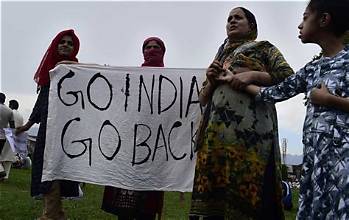
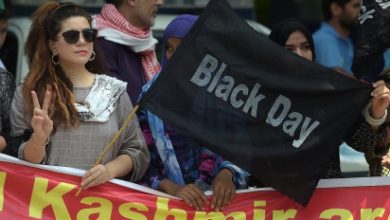
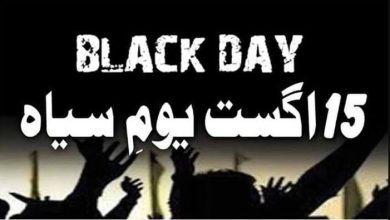
August 5 is observed as Black Day by Kashmiris on both sides of the Line of Control and across the diaspora. This marks the day in 2019 when the Indian government, under Prime Minister Narendra Modi, unilaterally revoked Articles 370 and 35A of the Indian Constitution. These provisions had granted Jammu and Kashmir a degree of autonomy. Their abrogation is widely seen by Kashmiris as an illegal act and a violation of international norms. The move intensified political repression and deepened public resentment across the region.
On 9 August 2019, more than 10,000 people held a peaceful protest in Srinagar against the Indian government’s revocation of Article 370, according to a Reuters report. In response, Indian occupation forces used tear gas and pellet guns to disperse the demonstrators. Al Jazeera, citing reports from Srinagar residents communicated through satellite phones and limited internet access, confirmed ongoing protests and violent clashes. Eyewitness accounts described the use of excessive force, including tear gas shelling and widespread pellet gun attacks. These actions reportedly caused severe injuries and lacerations among civilians.

Before shedding light on the contours of PM Modi game plan, it is pertinent that we understand the significance of Article 35A and 370. Article 35A, referred to as “permanent resident law”, gives Kashmiris the status of “permanent residents” of the geographic territory. Article 370 specifies provisions of the Indian constitution that shall apply to Kashmir allowing them to make their own laws in all matters except defence, foreign affairs and communications. It also prohibits non-Kashmiris from buying land in the territory.
The main objective of PM Modi move was to forcibly incorporate disputed Muslim majority state into Indian Union, suppress the indigenous movement for Kashmiris freedom and to change demography of Indian Illegally Occupied Jammu and Kashmir (IIOJK). In this way, Muslims majority would be reduced to a minority as Israel has done in Palestinian land. This was nothing short of ethnic cleansing and clear violations of India’s bilateral commitments with Pakistan and of the United Nation’s resolutions, which require that the ground realities in IIOJK need not be changed To brush its atrocities under the carpet, the Modi government claimed that revocation of Article 370 brought development, peace, jobs, and investments in IIOJK. However, the ground reality in IIOJK is different from as professed by the Indian government.
The inhumane military siege only became a basis of frustration, anarchy, and disorder for Kashmiris. The Indian government under the leadership of Modi is systematically depriving the Kashmiri Muslims of their basic rights by resorting to economic terrorism in IIOJK. There is not any sector of IIOJK economy that has not suffered losses in the past Six years. According to an estimate, the military siege has caused Kashmiris an economic loss of $3.5 billion. Almost five lac Kashmiris have lost jobs since scrapping of IIOJK’s special status in August 2019. Creation of jobs for non-Kashmiris is a part of India plan to further change the demography of the Kashmir region. Clearly, the Indian government has embarked upon an inhuman and unprecedented path to make the Kashmiri people suffer by suffocating them through coercive economic policies. Besides this, more than one lac Kashmiri citizens have been martyred while thousands of women have been raped. Lethal pellet guns continue to be used indiscriminately, leaving thousands of children and adults blind. In short, India is culpable under the Genocide Convention, War Crimes, Crimes against Humanity and the Conventions on Torture, Involuntary Disappearances, Extra-Judicial Killings and Women’s Rights among a number of others.
The repression has drawn criticism from the International community, including the US Congress, the European Parliament, and the United Nations Human Rights Council (UNHCR). United Nation experts have raised concerns throughout the years in India over a number of issues, including extrajudicial killings, the possible displacement of millions in Assam, the possible displacement of tribal communities and forest dwellers, and the closure of communications in Kashmir.
The Organisation of Islamic Cooperation Permanent Commission on Human Rights has also condemned the violation of Indian human rights in IIOJK. The OIC supports the demand of UN experts to address the dangerous human rights situation in Indian occupied Kashmir. A statement issued by the OIC Permanent Commission on Human Rights said, “We also support the demand of the UN experts that human rights violations, extrajudicial killings, enforced disappearances, and violence be reported in IIOJK.” According to the recent data around 22,939 women became widows and 17855 children became orphans. During this period, Indian troops desecrated 11,246 women and damaged 110,445 residential houses and other buildings. Furthermore, more than 8,000 Kashmiris have been reported missing by Indian troops and police during the period.
Amnesty International responded that the Indian government’s action would “likely to inflame tensions in the area and increase the risk of further human rights violations”. It also mentioned that “use of pellet guns and other weapons are in defiance of international human rights standards”, after the Indian Supreme Court refused to lift restrictions on Jammu and Kashmir
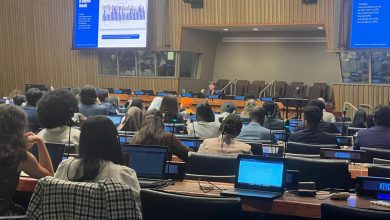
India’s revocation of Article 370 has further strained its already fragile relations with Pakistan, closing the door on meaningful bilateral dialogue. In response to this unilateral move, Kashmiris across the world observe 5 August as Black Day to protest the loss of their autonomy and continued oppression. Pakistan has consistently called for international media and human rights organizations to be granted access to Indian-occupied Kashmir. The authoritarian measures in the region pose a serious threat to peace and stability. There is an urgent need to engage the global community and awaken international conscience. The United Nations must be reminded of its responsibility to resolve the Kashmir dispute and support the Kashmiri people’s right to self-determination.