On 5 August 2019 Indian government abrogated Article 370 of its Constitution, that article had granted Jammu and Kashmir a special status. Article 370 of the Indian Constitution allowed Indian occupied Kashmir to have its own constitution, flag, and control over laws except in defense, foreign affairs, and communications. So the revoking of article 370 wasn’t just a political move done by Indian governmentit alsotriggered a full-scale crackdown on millions of people, cutting off an entire region from the rest of the world. 5 August isjust not onlyremembered in Kashmir as a constitutional reform but also as the day their identity was dismantled and silence was forced upon them.
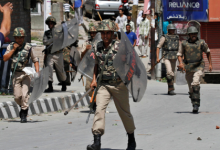
Within hours of the announcementmore than 38,000 additional Indian troops were deployed in Indian illegally occupied Jammu &Kashmir .That deployment made this region one of the most heavily militarized zones in the world. Lockdown was imposed, phone lines were cut, and internet was shut down for 213 days, the longest lockdown ever in any democracy. Around 13,000 Kashmiri boys, some as young as 14, were reportedly detained many without charges according to reports by The Washington Post and BBC. Even the journalists were harassed, local newspapers were blocked from publishing freely, and foreign media was denied access. According to The New York Times it is “the world’s largest military siege of civilians in recent times.”
If we talk about the human cost between August 2019 and 2025 over 1,200 civilians were killed in various incidents such as custodial killing, fake encounters, crossfire, and alleged targeted operations according to human rights documentation by JKCCS and other monitoring groups. More than 24,000 peopleincluding political leaders, students were arrested under the Public Safety Act (PSA) and Unlawful Activities Prevention Act (UAPA). These laws have been widely condemned byinternational organizations such as unitednation and Amnesty Internationalfor enabling imprisonment without trial. About 1,800 houses were reportedly destroyed or severely damaged during cordon-and-search operations (CASOs), with many families left homeless and without compensation.
One of the most alarming outcomes post-2019 is the clear and deliberate demographic shift in Kashmir. After abrogation of article 370 Indian governments has allowednon-residents to acquire land and permanent residency. By recent reports more than 4 million domicile certificates had been issued, with over 600,000 non-Kashmiris settling or applying for government jobs in the region. This demographic shift is not just a fear anymore it is happening. This change is designed to reduce the Muslim-majority status of Kashmir and ensure long-term political and cultural control. This is the major agenda of Hindustva ideology like converting Muslims into Hindu by force and increasing demographic shift in Indian illegally occupied Kashmir.
Students have lost the proper accesses to academics. Students are suffering from different psychological traumas;these traumas have majorlyaffected their ability of learning understanding. Businesses have collapsed apple farmers which is the backbone of Kashmir’s economy saw massive losses due to internet bans and logistical disruptions. According to the Kashmir Chamber of Commerce and Industry, the valleyhas suffered a major economic loss of over 40,000 crore (approximately $5 billion) in just first year after the abrogation.
Despite the Severity of the situation international responses have largely been cautious. The United Nations High Commissioner for Human Rights (UNHCHR) raised concern twice in 2018 and 2019 and asked India to allow an independent investigation. But as always New Delhi dismissed the reports, calling them “false and biased.”
Several media outlets like The Guardian, BBC, and Foreign Policy published detailed accounts of torture, suppression, and arbitrary detentions continuously. But strong global response over India`s act remains missing. Global powers should take binding action against India’s illegal acts in disputed territory but unfortunately nobody is considering it.
Every year since 2019 Pakistan marks 5 August as “Youm-e-Istehsal” the Day of Exploitationto express solidarity with the people of Indian-occupied Jammu and Kashmir. Black flags are raised on government buildings, and the national flag is flown at half-mast in many places. Pakistan highly condemned India’s 5 August actions, calling them illegal and against international law. Prime Minister of Pakistan at the time declared it a “fascist move” and also Pakistan downgraded diplomatic ties with India. Since then, Pakistan has been vocal at the UN General Assembly, OIC, and Human Rights Council.
In Present times on every 5 August the streets of Kashmir may appear quiet not by choice, but by fear. Thisissue isn’t about politics anymore; this is about people, about mothers searching for missing sons. A generation is growing up behind barbed wires and surveillance it’s also about a homeland that is being altered without consent. Kashmir has now become a world’s largest open prison where anything could happen at any time or any point.
As the world talks about human rights, freedom, and justice Kashmir still waits and bleed.
Ifra Bibi student of International relations at National University Of Modern Languages and currently serving as an intern at the Kashmir Institute of International Relations(KIIR).