Kashmir Recolonized: The Settler Colonial Agenda Behind Article 370’s Abrogation
Muhammad Batish

 In a unilateral and contentious step, the Indian government repealed Articles 35A and 370 of the Indian Constitution on August 5, 2019. These constitutional clauses, which acknowledge the area of Indian occupied Jammu and Kashmir’s unique historical, cultural, and political character, have long granted it special status and a certain amount of autonomy. After the abrogation of these constitutional clauses, Jammu and Kashmir lost its semi-autonomous status and was dismembered into two Union Territortories under direct administration, of Bharatiya Janata Party (BJP)-led government in New Delhi. In actuality, this decision is a deliberate attempt to reshape the region’s political landscape and demographics in accordance with a larger settler-colonial and Hindutva-driven agenda. It is hailed in some sections of Indian political discourse as a step toward national integration and development.
Legal Dispossession and Demographic Transformation
The removal of Article 35A, which gave the Jammu and Kashmir local legislature the authority to identify permanent residents and limit their access to state benefits, employment opportunities, and property ownership, was one of the most important outcomes of this strategy. By virtually preventing non-Kashmiris from relocating to the area, this clause maintained the region’s demographic makeup.


There has been a significant change in the area since Article 35A was revoked. The Government of Jammu and Kashmir reported in July 2022 that more than 3.4 million additional residence certificates had been granted to people from outside the area. This number represents about 30% of the entire population, which is a substantial demographic shift considering that there were only about 12 million people living in Jammu and Kashmir before to 2019.
Additionally, the Indian government amended property ownership regulations in October 2020, allowing non-residents to lawfully own urban and agricultural land in Jammu & Kashmir. Previously, only native residents were allowed to own such property under the constitution. Similar to settler-colonial tactics employed in areas such as Palestine, the Western Sahara, and portions of Indigenous North America—where native populations were progressively disempowered and displaced through legal and administrative mechanisms—these new regulations directly aid in the settlement of outsiders.
The ideological trajectories of the BJP and its parent party, the Rashtriya Swayamsevak Sangh (RSS), cannot be separated from the revocation of Jammu and Kashmir’s autonomy. Hindutva, a majoritarian, ethno-religious nationalism that sees India as a Hindu Rashtra (Hindu nation-state), is at the heart of its political philosophy. Within a homogenized Hindu government, this ideological framework aims to absorb or marginalize religious and ethnic minorities, especially Muslims.
This vision takes the form of an effort to use economic, demographic, and legal means to change the Muslim-majority nature of Kashmir. The foundation for long-term structural dominance is laid by the abrupt inflow of non-Kashmiri settlers, state-sponsored infrastructural initiatives, and corporate investments.
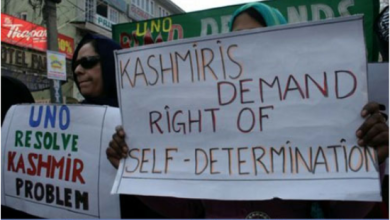
Concerns over these policies’ effects on Kashmiris’ rights, particularly with regard to self-determination, land rights, and cultural preservation, have been voiced by the international community and human rights organizations. However, the Indian political establishment has mostly ignored criticism.
Conclusion
An important turning point in Jammu and Kashmir’s history was the repeal of Articles 370 and 35A. It is a purposeful move in a settler-colonial enterprise with roots in Hindutva ideology, not a neutral act of integration. The Indian government has started a process to eradicate Kashmir’s identity and replace it with a new order characterized by authoritarian nationalism rather than constitutional pluralism by lawfully permitting demographic change, outsider land acquisition, and political marginalization of the native population, which amounts violation of UN resolutions on Jammu & Kashmir, 4th Geneva Conventions and other international norms.
The writer is perusing BS International Relations from National University of Mordern Language (NDU) Islamabad and researcher at Kashmir Institute of International Relations (KIIR)