Seminar in Dhirkot commemorates massacre of 1947Jammu Muslims
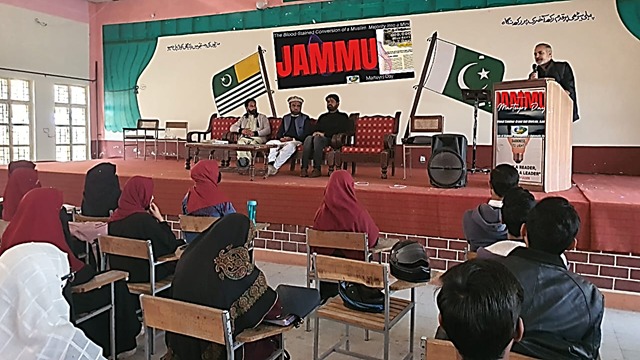 Dhirkot: The Institute of Dialogue, Development and Diplomatic Studies (IDDDs), in collaboration with the Post Graduate Degree College, Dhirkot, organized a seminar to commemorate the massacre of Jammu Muslims in 1947—a dark chapter in history when the Muslim majority of Jammu was slaughtered by the Dogra forces.
According to Kashmir Media Service, the speakers highlighted that the Jammu massacre stands as one of the bloodiest killings of Muslims in South Asian history. They said although every day in Kashmir remains a black day under Indian occupation, this particular episode was deliberately suppressed by design—to conceal what was, in essence, a genocide planned to alter the demography of the Muslim-majority Jammu region of the then princely state of Jammu and Kashmir, ruled by the Hindu Dogra Maharaja.
They said the Dogra regime had distributed lethal weapons among Hindu militias while disarming the Muslims, ordering them to surrender even household tools like axes and knives. This strategic move, they added, ensured that the Muslim population had no means to defend themselves when the orchestrated killings began and as a result, Jammu’s Muslims lost their land, lives, and liberty.
The speakers emphasized that even today, talking about this tragedy remains a challenge under India’s military domination, which continues to deny the people of Jammu and Kashmir their fundamental rights.
They said in Jammu and Kashmir, the minority Dogra ruler subjugated the Muslim majority, depriving them of basic democratic rights. Hence, joining Pakistan, a Muslim-majority state, was seen as the natural and just choice for the people of Jammu and Kashmir. However, this reality was intolerable to the Dogra ruler and his allies, who launched the Jammu massacre to transform the Muslim majority into a minority, they lamented.
The speakers said historical records indicate that the massacre was pre-planned weeks in advance (September–October 1947), around the same time when the people’s uprising liberated Azad Jammu and Kashmir.
Dr Waleed Rasool, Director of IDDDS, addressing the gathering, said: “This tragedy teaches us to remain grateful to the sons of the soil who liberated Azad Jammu and Kashmir from Indian control during those testing times. History cannot be changed, but geography can be reshaped through struggle and unity. The lesson of Jammu is that we must remain steadfast, united, and resolute in pursuing the right to self-determination despite all odds.”