 No ideal region in the world can claim to be the protector of human rights; violations occur everywhere, but accountability for these violations is at least bound by the state and the international system, such as judicial oversight and public representation. In Indian Illegally Occupied Jammu and Kashmir (IIOJK), however, India stands as the violator of human rights. Violations have been happening routinely since 1947, while accountability is systematically absent and civilian voices are neglected. In this region, the survival of Kashmiris has been treated as a negotiable cost of state security, not as a protection of human security.
On Kashmir Solidarity Day, the world is reminded of these ongoing injustices and the urgent need to uphold the rights of Kashmiris. This day is a call to action: to raise awareness, to stand with the oppressed, and to ensure that the struggle of Kashmiris does not remain invisible. Pakistan, along with global civil society, consistently highlights these violations, challenging India’s narrative of “normalcy” and insisting that the occupation’s human cost be acknowledged internationally.
This article examines how state-centric security is prioritized over human rights in IIOJK. The Indian illegally occupied Jammu and Kashmir has displaced, subordinated, and in many cases erased the human security of its populations. The Kashmir conflict persists as an ongoing, profound tension between state-centric security and the human security of civilians. On Kashmir Solidarity Day, we are reminded that solidarity is not symbolic—it is about amplifying voices, demanding accountability, and asserting the rights of those whose lives have been disrupted for decades.
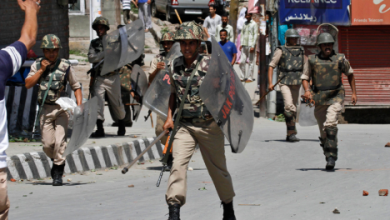
According to the Office of the United Nations High Commissioner for Human Rights (OHCHR, 2019), Indian troops have continuously relied on pellet-firing shotguns for crowd control, despite their sweeping and harmful effects. Records from Srinagar’s Shri Maharaja Hari Singh Hospital indicate that at least 1,253 civilians were affected and permanently blinded due to pellet injuries from mid-2016 to the end of 2018. Indian military search operations, reintroduced in 2017, have been involved in violations including arbitrary detention, property seizures, and collective punishment. Political and public representative organizations such as the Jammu and Kashmir Liberation Front and the Jamaat-e-Islami were banned in early 2019, reflecting the limited civil freedoms on the ground (OHCHR, 2019).
Yet, no single member of Indian troops has been tried in civil courts for torture or human rights violations since the 1990s. The custodial death of schoolteacher Rizwan in March 2019 is one stark example.
In parallel, IIOJK has experienced one of the world’s highest frequencies of internet shutdowns. Nearly half of all internet shutdowns in India in 2018 occurred in Kashmir, and 25 more were imposed in just the first four months of 2019. India imposed an internet shutdown for nearly 18 months, leaving only 30% of the population with access to 2G services, according to the Internet and Mobile Association of India (IAMAI, 2018).
The Indian government, led by the Bharatiya Janata Party, has repeatedly claimed that it is maintaining peace and working on development in Kashmir. However, the reality is starkly different. Since the 1980s, approximately 96,000 Kashmiris have been killed, 23,000 women widowed, nearly 11,000 girls and women sexually abused, and around 100,000 houses and schools destroyed. Since 1989, thousands of innocent civilians have been subjected to enforced disappearances following arrest by Indian troops, with rough estimates exceeding 8,000 cases. Consequently, approximately 1,500 women are “half-widows,” living without certainty about their husbands’ fate (Breakthrough, 2014).
Collectively, these patterns reflect a state security paradigm that systematically displaces human security. On Kashmir Solidarity Day, it becomes vital to remember the human cost of this occupation. It is a day to raise awareness, reaffirm solidarity, and insist that the voices of children, women, and all civilians under occupation are heard globally (Noor, 2025).
Kashmir Solidarity Day also serves as a platform to remind the world that these violations are not abstract statistics—they are human lives shattered by policies of repression. Pakistan’s role in advocating for Kashmiris is continuous, pushing for international attention and holding forums to highlight India’s systematic violations. Civil society, media, and academic institutions also use this day to showcase stories of resilience, courage, and survival despite decades of oppression. The day calls on governments, organizations, and individuals to acknowledge the ongoing struggles and to amplify Kashmiri voices in every discussion on justice, human rights, and self-determination.
Solidarity is more than a statement; it is recognition, advocacy, and action. Every march, seminar, media campaign, and international statement on this day strengthens the demand for accountability. It reminds the world that the fight for Kashmir is inseparable from global human rights concerns and that the people of IIOJK deserve freedom, dignity, and protection under international law.
The writer is a student of BS International Relations at the International Islamic University Islamabad, and is currently intern at Kashmir Institute of International Relations.