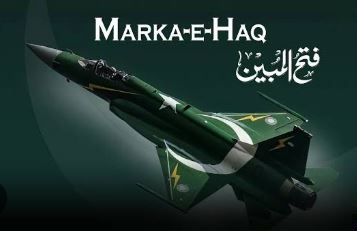
A year has passed since the brief but intense confrontation of May 2025, yet its imprint on Pakistan’s national consciousness remains vivid and deeply felt. What unfolded over those four days has since come to be known as Marka-e-Haq, a phrase that, for many, captures not only a military response but a moral and emotional reckoning. It is remembered not simply as a clash of arms, but as a moment when grief, resolve and national purpose converged in a way that is rarely witnessed in the life of a nation.
The origins of the crisis were abrupt and unsettling. Tensions had sharply escalated following the Pahalgam incident in Indian-occupied Jammu and Kashmir, which India swiftly blamed on Pakistan, though Islamabad denied any involvement and called for an impartial international investigation. In the charged atmosphere that followed, India launched strikes on Pakistani soil in the early hours of 7 May, targeting locations including areas near Bahawalpur and Muridke. The deaths that followed, particularly of young students, struck a profound chord across the country. These were not distant or abstract losses. They were personal, immediate and deeply human. Classrooms that had once been filled with aspiration became sites of mourning, and families across Pakistan saw in those victims a reflection of their own children. It was from this climate of grief, anger and national solidarity that the phrase Marka-e-Haq began to emerge, encapsulating what many viewed as Pakistan’s justified and measured reciprocation.
In those first hours, uncertainty prevailed. There was the familiar fear of escalation that has long defined relations between two nuclear-armed neighbours. Yet there was also a quieter, more determined sentiment taking hold. The question was not simply how Pakistan would respond, but how it would do so without allowing the situation to spiral beyond control. That balance between firmness and restraint would come to define the country’s posture throughout the crisis.
The deliberations in Islamabad during those critical moments were, by all accounts, marked by urgency but also by clarity. Civilian and military leadership appeared aligned in their assessment that a response was necessary, yet equally conscious of the risks inherent in any escalation. What emerged was an approach that sought to reassert deterrence without abandoning the possibility of de-escalation. It was a difficult line to hold, but one that would shape both the conduct of the operation and the narrative that followed.
When Pakistan initiated its counter-operation, later described as Bunyan-un-Marsoos, it did so with an emphasis on precision and proportionality. Official accounts portrayed the strikes as carefully targeted and deliberately limited, designed to signal capability rather than provoke an open-ended conflict. For a domestic audience, this was presented as evidence of a state acting with both strength and discipline. The message was clear. Pakistan would defend its sovereignty, but it would not do so recklessly.
In the days that followed, a powerful narrative began to take shape within the country. Marka-e-Haq came to symbolise not only a successful military response but a reaffirmation of national unity. In a political landscape often characterised by division, the crisis produced a rare moment of cohesion. Citizens from different backgrounds and regions appeared to speak with a shared voice, united by a sense of purpose and, perhaps more importantly, by a shared sense of loss.
This unity was reinforced by the imagery that emerged from those days. The sight of a country on alert, of institutions functioning in concert, of a population rallying around a common cause, created a powerful emotional current. It is this aspect of Marka-e-Haq that has arguably had the most enduring impact. Military engagements, by their nature, are transient. The sense of collective resolve they generate can linger far longer.
At the same time, it is important to recognise that the meaning of Marka-e-Haq is not confined to domestic interpretation. Beyond Pakistan’s borders, the conflict was viewed through a different lens. International observers were less concerned with narratives of victory and more focused on the risks of escalation. Calls for restraint came swiftly, reflecting a broader concern about the stability of a region where even limited confrontations carry significant dangers. The eventual ceasefire was therefore seen not as a triumph of one side over the other, but as a necessary step to prevent a far more dangerous outcome.
This divergence between internal and external perceptions is not unusual. Nations at moments of crisis often construct narratives that speak to their own experiences and needs. For Pakistan, Marka-e-Haq became a story of resilience and measured strength. For the wider world, it was a reminder of the fragility of peace in South Asia. Both perspectives can coexist, though they do not always align.
What, then, has Marka-e-Haq ultimately achieved for Pakistan? In tangible terms, it demonstrated the country’s capacity to respond swiftly and in a coordinated manner to external threats. It reaffirmed the principle of deterrence that has long underpinned the strategic balance in the region. It also showcased a willingness to engage in de-escalation once a certain threshold had been reached. These are not insignificant outcomes.
Yet its more profound impact lies in the realm of perception and identity. Marka-e-Haq has become part of the language through which Pakistan understands itself in moments of crisis. It speaks to a belief in the country’s ability to endure, to respond, and to maintain its dignity under pressure. It is, in this sense, as much about self-definition as it is about external validation.
There is, however, a need for careful reflection as this narrative continues to evolve. The elevation of any conflict into a symbol of national triumph carries with it certain risks. It can simplify complex realities and obscure the human costs that lie at the heart of such events. The lives lost in those four days, particularly those of the young students whose deaths marked the beginning of the crisis, should remain central to any remembrance. Their absence is a reminder that even the most contained conflicts exact a price that cannot be measured in strategic terms alone.
A year on, as commemorations approach, Pakistan finds itself in a position to reflect not only on what happened, but on what it means. Marka-e-Haq can serve as a source of pride, but it can also serve as a moment of introspection. It offers an opportunity to consider how strength and restraint can coexist, how unity can be sustained beyond moments of crisis, and how the pursuit of security can be balanced with the imperative of peace.
In the end, the legacy of Marka-e-Haq will not be determined solely by the events of May 2025, but by how those events are remembered and understood in the years to come. If it encourages a commitment to stability and a recognition of the costs of conflict, it will have served a valuable purpose. If it becomes merely a fixed narrative of victory, its deeper lessons may be overlooked.
For now, it endures as a powerful and complex chapter in Pakistan’s contemporary history. It is a reminder of a time when the country faced a moment of acute challenge and responded with a combination of resolve and caution. It is also a reminder that in a region as sensitive as South Asia, even the briefest of conflicts can leave lasting echoes.