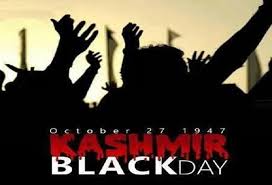
“Injustice anywhere is a threat to justice everywhere.” – Martin Luther King Jr.
 The map of South Asia was redrawn during the partition of 1947 which gave birth to new nations and ignited hopes of freedom for millions. This partition affected the princely states and among the most affected princely states was that of Jammu and Kashmir; a land subjected to competing claims, while the people living there just wanted the basic right to choose their own future. Kashmiris were once promised that they would be given this choice, a promise made by the International Community including United Nations, but history took a darker turn.
Instead of liberty, the shadows of occupation spread heavily. Instead of ballots, bayonets arrived. A decision that was meant to be democratic instead lead to a decades long tale of oppression, loss and resilience. This tale began on a single day; October 27,1947 now remembered as Kashmir’s black day.
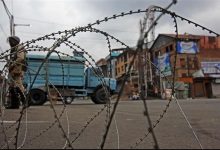

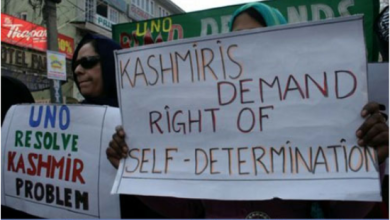
This day October 27, a reminder of broken promises, unending struggles for dignity and shattered dreams, a day etched in the memories of millions. The tale begins in 1947, when the people of Jammu and Kashmir were denied their right to self-determination. What should have been a democratic choice turned into a military occupation. It marks the day Indian forces arrived in Srinagar pretending to offer help, but in reality, they started taking control of the region. What was claimed as a protective action turned into a claim of ownership, sparking a tragedy that has continued for more than seventy years. Black day is not just a historical commemoration, it is a living reality. It stands for 76 years of broken promises and unfulfilled pledges for the people of Kashmir. The United Nations Security Council, through its resolution of 1948 and 1949, made it clear that the Kashmiri people had the right to decide their own future through a fair and unbiased vote. But that promise has never been kept, instead it has been replaced by ongoing violence, enforced disappearances, communication blackouts, mass burial site, extrajudicial killings, and the suppression of basic freedom.
What makes this day even more haunting is the deep contrast between India’s claim of being a democracy and its actions in Jammu and Kashmir. India is proud to be the world’s largest democracy, but in Jammu and Kashmir, it has transformed democracy into a tool of control. People who speak out for justice face charges of sedition, journalists are silenced and even mourning is viewed as rebellion. The abrogation of article 370 and 35A in August 2019 made things worst as it took away the Kashmir’s special status, ending its autonomy and opening the door for policies the change the population under the guise of bringing everyone together. The so called development narrative pushed forward since 2019 rings hollow in the face of ongoing militarization and human rights violation. Months after the removal of these articles, thousands of leaders, activists and ordinary people were detained. Internet shutdowns, random arrests and a complete media blackouts have became the new normal. The silence from the international community has only made the situation worse for the people being oppressed.
Yet, amid the darkness, the people of Jammu and Kashmir remains strong. From young people who keep speaking out even with the risk of being jailed to mothers of the disappeared who march with pictures of their sons; the spirit of resistance never dies. Burhan Wani, a young man, who became a symbol of resistance through social media, shows how the struggle is now seen not just as a political issue, but as a fight for identity and survival. The pain of Kashmir doesn’t stop at its borders, it’s a moral challenge for the world; a reflection of how international institutions have failed to live up to the principles they were built on. The United Nations which once stood for justice, has let this issue become just another bureaucratic matter. Meanwhile, global powers that talk about human rights have chosen their own interests over doing the right thing.
As the world remembers this day, it cant ignore the truth that the people of Jammu and Kashmir keep living under one of the most heavily armed regions in the world. Every curfew, every protest and every silent tear shows a people who won’t give up their right to decide their own future. Kashmir’s black day is not just about remembering past, its about facing the present and demanding the future, where justice replaces oppression and where promises are kept instead of broken. The world has to decide if it will keep ignoring the voices of Kashmiris or finally stand with those who have been unheard for generations. Black day is not just about mourning it is about resistance, memory and the hope that the International community will finally live up to its responsibility.
As we mark October 27, the question still remains; How long will the cries of Kashmir go unheard in the conscience of the world?
The writer is a research intern at the Kashmir Institute of International Relations (KIIR) and serves as the Member of HEAL Pakistan Organization, a youth-driven effort for humanity, education empowerment, awareness and leadership.