Governing Through Trauma: The Mental Health Emergency India Will Not Acknowledge in Kashmir
Muhammad Waleed Akhtar
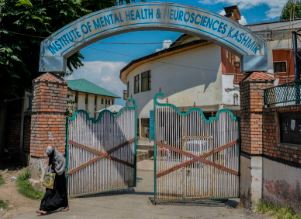
 A woman in the occupied Kashmir Valley has not slept properly in eleven years. She cannot identify the exact night the sleeplessness began. It may have been the raid. It may have been the detention. It may have been the curfew that lasted so long her children forgot what school felt like. She has never seen a psychiatrist. There is no psychiatrist in her district. She carries what cannot be put down and asks no one for help, not because she lacks the will, but because the state that produced her condition has not built the infrastructure to treat it.
The mental health crisis in Indian Illegally Occupied Jammu and Kashmir (IIOJK) is not an unintended consequence of conflict. It is a predictable, measurable and documented outcome of sustained governance practices that have been reported to international bodies, acknowledged by domestic human rights institutions and met with consistent inaction.
The 2015 Médecins Sans Frontières survey across all ten districts of the Kashmir Valley, covering 5,428 households, found that 45 percent of adults showed symptoms of significant psychological distress. The adults surveyed had experienced an average of eight traumatic events each, with 93 percent reporting at least one. Probable depression affected 41 percent, anxiety 26 percent and PTSD 19 percent. The 2017 Housen et al. study published in BMJ Global Health confirmed these figures and established a dose-response relationship: each additional traumatic event measurably increased the severity of all three conditions. The traumatic events most commonly reported were house raids, arbitrary detention, torture and enforced disappearances carried out by Indian forces’ personnel. These are not ambient misfortunes of a conflict zone. They are specific acts with specific perpetrators and measurable consequences for those subjected to them.

Indian authorities maintain that security operations are necessary counter-terrorism measures and that the abrogation of Article 370 in 2019 has improved governance and reduced violence. That position deserves engagement on its own terms. What it cannot explain is a mental health crisis that predates 2019 by decades and continues today. Suicide attempt rates increased by approximately 250 percent between 1994 and 2012, according to the Indian Journal of Psychiatry. By 2022, National Crime Records Bureau data showed IIOJK recording the highest number of suicide attempts among Indian states. A 2025 study found 51.8 percent of Kashmiri adolescents experiencing significant psychological difficulties, while probable depression among Kashmiri women approaches 50 percent, exceeding reported levels in Afghanistan and Palestine. These are indicators of a population in psychological emergency, not normalization.
The crisis is reinforced by severe institutional neglect. Only 41 psychiatrists serve more than 12.5 million people, leaving many districts without a single specialist and creating an 88–90 percent treatment gap. UNODC estimates that around 600,000 residents struggle with substance dependency, widely linked to untreated trauma. The consequences are now intergenerational. Research on epigenetic transmission demonstrates that prolonged maternal trauma can alter stress regulation in offspring. In Kashmir, widespread untreated maternal depression risks embedding the psychological effects of conflict across generations. The legal obligations are specific and binding. Under Article 12 of the International Covenant on Economic, Social and Cultural Rights and General Comment 14, states must ensure the highest attainable standard of mental health and refrain from policies that systematically harm psychological wellbeing. CEDAW General Recommendation 30 requires gender-sensitive services for women affected by conflict and mechanisms clarifying the fate of disappeared persons. The 2018 OHCHR report to the Human Rights Council, document A/HRC/39/47, documented the psychological toll of disappearances in Kashmir and called for accountability and mental health services. UN Special Rapporteurs on Violence Against Women, the Right to Health and Truth, Justice and Reparations have issued communications raising precisely these obligations. Both the Jammu and Kashmir State Human Rights Commission and the National Human Rights Commission have acknowledged the crisis in their reports. The institutional record of acknowledgment is extensive. The record of implementation is not.
A population cannot be systematically exposed to trauma at this scale, denied the means to address it and governed as though it were psychologically intact. The suicide rates refute that fiction. The MSF data refutes it. The adolescent studies and epigenetic research refute it. The women of Indian-Occupied Kashmir, carrying eight traumatic events each on average and nowhere to take them, have already answered whether governance that produces this damage and declines to address it can claim legitimacy over the people it affects. The data simply confirms what they have known for decades.
The author is a graduate in International Relations from the International Islamic University, Islamabad and is currently serving as a researcher at the Kashmir Institute of International Relations, Islamabad.