Modi meets mentor to destabilise Middle East, Muslim world
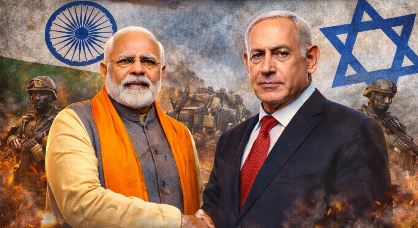
Islamabad: Political observers have warned that the deepening strategic partnership between India and Israel under Indian Prime Minister Narendra Modi could destabilise not only South Asia but also the Middle East, urging the Muslim world to take serious note of the emerging axis.
According to Kashmir Media Service, analysts say what India expects from Israel to assert supremacy in South Asia, Israel similarly expects from India to strengthen its position in the Middle East. They caution that this reciprocal strategic alignment may widen regional fault lines and aggravate existing conflicts.
Observers note that India, as a major supplier of labour and technology professionals to Gulf countries, could facilitate deeper Israeli access to security and technological sectors in parts of the Middle East. They point to the reported arrests of alleged Indian spies in Qatar and the United Arab Emirates in recent years as developments that raise concerns about intelligence penetration and covert cooperation.


Analysts further claim that India is favouring efforts aimed at the emergence of a pro-Israel government in Iran, warning that any such move would directly affect the strategic balance and sovereign interests of Middle Eastern states.
Referring to media reports, including coverage by Al Jazeera, the observers say allegations of coordinated or parallel policies by India and Israel in Gaza and Indian illegally occupied Jammu and Kashmir should be a matter of grave concern for the Muslim Ummah. They stress that the Muslim bloc must view the evolving partnership as a broader strategic challenge.
Political experts maintain that India–Israel relations have intensified significantly during the Modi regime, particularly in defence and internal security domains. They note that cooperation now encompasses advanced surveillance systems, drone technology, missile systems and intelligence sharing mechanisms.
The analysts argue that this growing strategic convergence reflects an ideological alignment between Hindutva and Zionist frameworks, especially in approaches to security doctrines, demographic engineering and governance in conflict regions.
They point to recent developments in Indian illegally occupied Jammu and Kashmir, including the introduction of new domicile laws and demographic changes, as measures that mirror Israeli settler-colonial practices in occupied Palestinian territories.
Concluding, observers maintain that the expanding India–Israel axis raises serious concerns regarding regional stability, human rights and adherence to international law, particularly in Kashmir and Palestine, where both territories continue to witness prolonged occupation and contested political realities.
#ModimeetsMentor/#IndiaIsraelAxis