The Mirage of Normalcy: How India’s ‘Peace’ in Kashmir is Built on Graves and Shackles
Altaf Hussain Wani
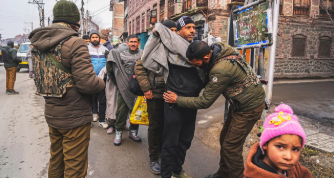
 When Indian government officials and their surrogates in the media wax lyrical about the “return of normalcy” to Indian Illegally Occupied Jammu and Kashmir (IIOJK), they conjure images of bustling markets, blooming tulip gardens, and a population grateful for “development.” It is a seductive narrative, carefully curated for international consumption and domestic political consumption alike. Yet, like all colonial fantasies, it collapses the moment it confronts the granite reality of the ground. The recent report by the Research Section of the Kashmir Media Service (KMS) shreds this propaganda veil with brutal clarity: in the first three months of 2026 alone, Indian forces have martyred ten Kashmiris—eight of them in fake encounters or cold-blooded custody killings—and arrested 933 civilians, including students, women, and political activists. This is not normalcy. This is the calculated pacification of an occupied population through state terrorism.
To claim that IIOJK is “normal” requires a grotesque redefinition of the term. In the lexicon of New Delhi’s public relations machinery, normalcy appears to mean the absence of visible mass protests, achieved not through consent but through the barrel of a gun. The statistics from the KMS report reveal the architecture of this enforced silence. The killing of ten Kashmiris, particularly the eight executed extrajudicially, is not an aberration; it is the continuation of a policy of extermination disguised as “counter-insurgency.” When troops gun down youth in staged encounters or torture detainees to death, they send an unambiguous message: Kashmiri life is expendable in the service of the Indian state’s territorial obsession. This is the “peace” that officials celebrate—a graveyard peace, maintained by the terror of the National Investigation Agency (NIA) and the State Investigation Agency (SIA), which have transformed judicial processes into instruments of collective punishment.
The repression extends far beyond the bullet. The report documents the arrest of 933 individuals and the injuring of 32 peaceful protesters, illustrating that the Indian state is waging a war not just against armed resistance, but against civil society itself. The suspension of nine Kashmiri Muslim employees from government jobs and the attachment of properties belonging to forty-three families in just three months represent a form of legal warfare designed to economically asphyxiate dissent. These are not random administrative actions; they are components of a systematic campaign to criminalize Kashmiri identity. By targeting livelihoods and homes, the Bharatiya Janata Party (BJP) regime and its RSS ideologues aim to render survival contingent upon absolute submission. This is the “integration” promised after the illegal abrogation of Articles 370 and 35A on August 5, 2019: a process where dissent is pathologized as terrorism, and the Muslim-majority character of the territory is assaulted through bureaucratic violence and demographic engineering.
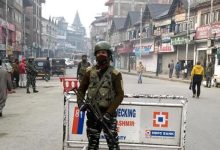
Indeed, to understand the hollowness of the “normalcy” claim, one must locate it within the broader context of the Hindutva settler-colonial project. The revocation of the region’s special status was never about development or governance; it was about dismantling the legal barriers protecting Kashmiri land and identity from external settlement. The subsequent years have witnessed a calculated influx of non-local settlers, the alteration of domicile laws, and the gerrymandering of constituencies—all designed to transform Kashmir from a Muslim-majority region into a Hindu-dominated one. The current wave of killings, arrests, and property seizures serves to terrify the indigenous population into acquiescence as this demographic manipulation unfolds. When officials speak of a “new Kashmir,” they are describing a laboratory for ethnic restructuring, where the original inhabitants are either incarcerated, eliminated, or economically displaced to make room for a compliant settler population.
Moreover, the Indian narrative of normalcy relies on the complete erasure of Kashmiri political agency. The arrest of All Parties Hurriyat Conference (APHC) leaders, human rights defenders, youth activists, and even students under draconian laws reveals a state terrified of dialogue and desperate to monopolize the discourse. In this dystopian “normal,” peaceful protest is met with teargas and bullets, and the expression of political aspiration invites a midnight knock from the NIA. The damage to a single home during cordon-and-search operations, mentioned in the report, symbolizes the broader violation: the invasion of private spaces, the destruction of sanctuary, and the militarization of daily existence. For the thousands of families whose loved ones languish in prisons, for the families of the nearly one hundred thousand martyred during last 36 years, and for the thousands living under the shadow of property confiscation, “normalcy” is a macabre joke.
The international community’s acquiescence to this narrative—driven by geopolitical expediency and Islamophobic indifference—provides the impunity necessary for these crimes to continue. But facts, unlike propaganda, are stubborn. The blood of the tens of thousands of martyrs, the shackles on the over 5000 detainees, and the rubble of demolished homes are the true monuments to India’s rule in Kashmir.
True normalcy cannot be built on the foundations of military occupation. It cannot be measured by tourist footfall or internet speed while a population is gagged and caged. It requires the withdrawal of nearly a million troops, the repeal of black laws like the Armed Forces Special Powers Act (AFSPA), Unlaw Activities Prevention Act (UAPA) Public safety Act (PSA), the restoration of political rights, and, ultimately, the fulfillment of the Kashmiri people’s right to self-determination. Until then, India’s claims of normalcy will remain what they are: a grotesque alibi for an ongoing crime against humanity. The silence in Kashmir is not peace; it is the sound of a scream being strangled.
The writer is chairman Kashmir Institute of International Relations and can be reached @ saleeemwani@hotmail.com and on X @sultan1913