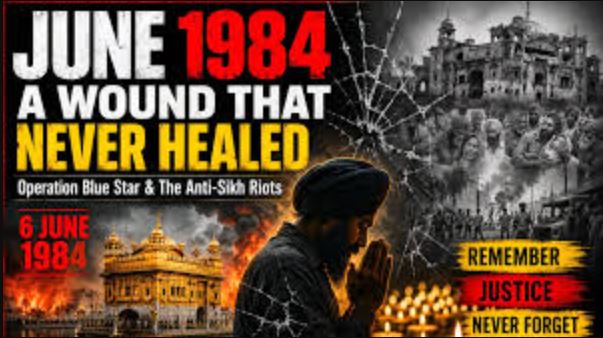
More than four decades have passed since Operation Blue Star, yet its political, religious and emotional consequences continue to reverberate across India and the global Sikh diaspora. Conducted in June 1984 by the Indian Army under the orders of Prime Minister Indira Gandhi, the operation was officially presented as a military action aimed at removing armed pro-Khalistan militants from the Golden Temple complex in Amritsar. However, for millions of Sikhs, it became a symbol of state oppression, religious desecration and political betrayal.
Launched on June 1, 1984 and culminating in a full-scale military assault between June 3 and June 6, Operation Blue Star remains one of the most controversial chapters in India’s post-independence history. What New Delhi described as a security operation against armed pro-Khalistan militants was viewed by many Sikhs as an unprecedented intrusion into the Sikh faith’s holiest shrine, leaving wounds that continue to shape Sikh political consciousness across the world.


The operation did not merely target militants. It entered the holiest shrine of Sikhism, causing extensive damage to the Akal Takht and resulting in significant loss of life. Regardless of differing estimates and interpretations, one fact remains undisputed: the events of June 1984 fundamentally altered the relationship between the Sikh community and the Indian state.
The Roots of Sikh Discontent
The bitterness that culminated in Operation Blue Star did not emerge overnight. Following India’s independence in 1947, many Sikhs felt that their political aspirations and cultural concerns were gradually sidelined. Demands for greater provincial autonomy, protection of linguistic identity and a fair share of Punjab’s resources often became sources of tension between Sikh political groups and New Delhi.
The Anandpur Sahib Resolution of 1973 reflected many of these concerns. Although largely focused on federal autonomy, it was frequently portrayed by critics as separatist in nature. This perception deepened mistrust between Sikh political leaders and the Indian government.
By the late 1970s and early 1980s, Punjab had become increasingly volatile. Rising militancy, political rivalries and heavy-handed state responses created an atmosphere in which compromise became increasingly difficult.
The Transformation of General Shabeg Singh
Among the most consequential figures associated with Operation Blue Star was Major General Shabeg Singh, a highly decorated officer of the Indian Army whose life reflected the growing estrangement between many Sikhs and the Indian state. Singh had served India with distinction and played a pivotal role in training the Mukti Bahini during the 1971 war that led to the creation of Bangladesh. He was widely regarded as a capable military strategist and a loyal soldier.
Yet his relationship with New Delhi deteriorated sharply after corruption allegations surfaced shortly before his retirement. Although the charges were later viewed by many of his supporters as politically motivated, the episode left him deeply embittered. More importantly, Singh increasingly came to believe that Sikhs were being subjected to discrimination and political marginalisation within India. The growing unrest in Punjab and what he perceived as the state’s insensitivity towards Sikh concerns further reinforced this conviction.
Disillusioned with the establishment he had once served, Shabeg Singh eventually aligned himself with Jarnail Singh Bhindranwale and other pro-Khalistan elements. He became the principal military adviser inside the Golden Temple complex, using his professional expertise to organise defences against a potential military assault. His journey from one of India’s most decorated military officers to a leading figure among those resisting the Indian state remains one of the most striking and symbolic chapters of the Punjab conflict. For many Sikhs, his transformation represented not merely personal resentment but a broader sense of alienation felt by a section of the community.
Chanakya Strategy — Sikhs Against Sikhs
One of the most tragic dimensions of Operation Blue Star was that it effectively turned Sikhs against Sikhs. While the operation targeted armed militants and pro-Khalistan activists entrenched within the Golden Temple complex, many of the soldiers ordered to carry out the assault were themselves Sikhs serving in the Indian Army. The result was a deeply painful spectacle in which members of the same faith found themselves on opposite sides of a battlefield.
Critics of the operation have often argued that this reflected a long-standing political tactic described in South Asian political thought as a variation of the divide-and-rule principle, often associated with interpretations of Chanakya’s statecraft. According to this view, governments have historically sought to weaken dissenting groups by fostering internal divisions rather than confronting them as a united force. Whether one accepts this interpretation or not, the perception became deeply embedded within sections of Sikh opinion after 1984.
For many Sikhs, the operation was not simply a confrontation between the state and militants. It was seen as a conflict in which Sikhs were compelled to fight fellow Sikhs, deepening communal wounds and creating divisions that would endure for generations. The psychological impact of this reality extended far beyond the battlefield and contributed significantly to the enduring resentment that followed.
These sentiments were intensified by the anti-Sikh riots that erupted later in 1984 following the assassination of Indira Gandhi. Together, the military operation and the subsequent violence convinced many Sikhs that the crisis was not merely about security or separatism but about the place of their community within the Indian state itself.
The Globalisation of the Khalistan Cause
Perhaps the greatest irony of Operation Blue Star is that while it was intended to suppress pro-Khalistan elements, the idea itself survived and expanded beyond India’s borders.
Large Sikh communities in Canada, the United States, the United Kingdom and Australia have kept memories of 1984 alive through commemorations, political activism and public campaigns. In cities such as Vancouver, Toronto, Calgary, San Francisco and New York, rallies highlighting Sikh grievances continue to attract attention.
For many participants, these gatherings are not simply about supporting Khalistan. They are also expressions of historical memory, demands for accountability and reminders of what they view as unresolved injustices.
India has consistently argued that separatist activism abroad represents a security concern and often accuses foreign-based groups of promoting extremism. However, the persistence of these movements demonstrates that military operations can suppress armed resistance, but they rarely erase political narratives rooted in collective memory.
Lessons from History
Operation Blue Star remains one of the most controversial episodes in modern Indian history because it raises questions that extend beyond Punjab. It highlights the risks of addressing political grievances primarily through force and the long-term consequences of allowing mistrust to harden into alienation.
For many Indians, the operation was a difficult but necessary response to militancy. For many Sikhs, it was a traumatic violation of a sacred space and a turning point that shattered confidence in the state.
History suggests that neither interpretation can be fully understood in isolation. The legacy of 1984 lies not only in what happened inside the Golden Temple but also in the decades of resentment, activism and debate that followed.
More than forty years later, Operation Blue Star continues to serve as a reminder that while governments may win battles through military power, genuine reconciliation requires political wisdom, justice and an honest engagement with historical grievances. Until those issues are fully addressed, the echoes of June 1984 will continue to resonate far beyond the borders of Punjab.