IWT cannot be revoked unilaterally as Pakistan plans legal, technical briefing for experts on treaty: Tarar
 Islamabad: Federal Information Minister of Pakistan Attaullah Tarar has said that the Indus Waters Treaty (IWT) cannot be revoked unilaterally as Pakistan prepared to present the treaty’s legal and technical aspects to experts at the IWT 2026 seminar, scheduled to be held in Islamabad tomorrow.
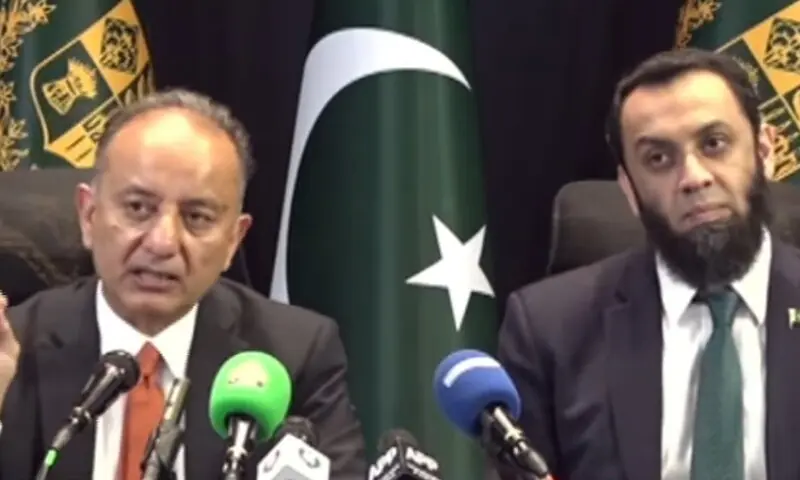
According to Kashmir Media Service, Attaullah Tarar, during a joint press conference with Minister for Climate Change Dr Musadik Malik, in Islamabad said, “Water security is important to Pakistan,” adding the country retains legal and environmental rights over the contractually bound waterway shared with the eastern neighbour.
He said for over six decades, India and Pakistan amicably managed the Indus River system through the IWT transboundary water-sharing agreement signed on September 19, 1960. Last year in April, India suspended the treaty in the wake of the Pahalgam attack.
Tarar highlighted that the World Bank-brokered treaty included a detailed framework for resolving any outstanding issues.
He reminded the Modi-led government that water was not just the country’s lifeline; it was also the country’s “red line”.

The minister said the government invited a host of water and legal experts from around the world to inculcate awareness about the rights of Pakistan over the Indus River against the backdrop of the agreement, saying a conference has been organised on Tuesday to supplement the cause.
Everyone recognises the narrative of Pakistan, the information minister outlined.
Speaking on the occasion, Federal Minister for Climate Change and Environmental Coordination Dr Musadik Malik said the issue of unilateral suspension had been raised on several international forums, including the United Nations.
“Pakistan’s standpoint was upheld by the International Arbitration Courts,” Malik underscored during the presser.
He said the current water crisis suffered by the 240 million people of Pakistan can be explained metaphorically through the widely reported case of Iqbal Solangi – a farming resident of the Sindh-Balochistan border who suffered in the deluges of 2010, 2012 and 2022 while he constantly tried to build his life around the catastrophes.
He explained that agricultural land across Pakistan continuously suffered due to either floods or droughts, “Either the land sinks under several feet of floodwater or is left cracked due to immense shortfall.”
“Climate change is not the only element to blame; the Indian prime minister is equally responsible,” he added.
The federal minister highlighted that PM Modi, with “his hand on the tap”, threatens to deprive Pakistan of every drop of water.
He further stated that India’s water war adversely affects around 40-50% people of Pakistan who depend on agriculture and, in the long term, shrinks the country’s 25% economy relying on the sector.
Hinting at Pakistan’s latest diplomatic coup, the minister said Pakistan managed to garner immense support from the European Union and NATO during a recent seminar held in Brussels.
“No one in the history of the world ever planned to stop rivers from flowing downstream, or the wind from crossing the border,” the minister took exception to India.
He warned that Pakistan had already declared that anyone trying to deprive it of its water would face severe consequences.
“Elsewhere in the world, water flows downstream unbothered even in the absence of a treaty, governed only by a convention… We have a treaty. How can the water be stopped then?”, the climate change minister asserted the case he said was bound by justice.
Concluding on the Indian policy of undermining the treaty with Pakistan, Malik said, it matched the defiant and genocidal policies of Israel, which overlooks all international treaties.