Bollywood’s film Chauhaan faces backlash in IIOJK for downplaying pellet victims’ agony
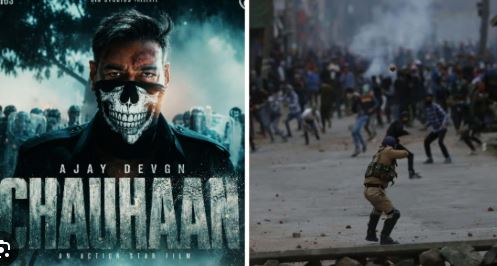
Srinagar : Bollywood star Ajay Devgn’s upcoming film Chauhaan, slated for release in October 2027, has sparked widespread outrage in Indian illegaly occupied Jammu and Kashmir (IIOJK), with political leaders, rights activists and civil society members stating that its makers have trivialised the suffering of thousands of Kashmiris blinded and injured by Indian forces’ use of pellet shotguns.
According to Kashmir Media Service, the recently released teaser shows a youth struck in the eyes by pellet fire, with Devgn’s character dismissing the injuries as “limited damage”, a portrayal that has drawn sharp criticism from Kashmiris, who say it mocks one of the territory’s most painful human rights tragedies.
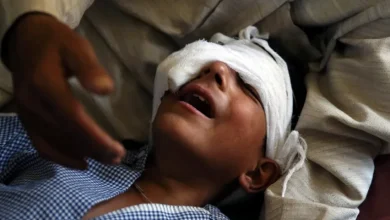
Pellet shotguns, introduced by Indian forces in 2010 as a so-called “non-lethal” crowd-control weapon, have killed, blinded and permanently disabled thousands of Kashmiris, leaving many with lifelong physical and psychological trauma.

Amnesty International has described pellet shotguns as “cruel”, “dangerous”, “inaccurate” and “indiscriminate”, stating that they cannot be used for crowd control in accordance with international human rights standards. The UN Commission on Human Rights has called them “one of the most dangerous weapons used against protesters.” Yet, the makers of Chauhaan portray pellet injuries as “limited damage”.
A study conducted by Soura Institute of Medical Sciences in Srinagar found that during the first four months of pellet gun use in 2010, at least six people were killed and 198 injured, including five who permanently lost their eyesight.
According to an RTI application filed by lawyer Abdul Manan Bukhari, 91 patients with pellet injuries were admitted to hospitals between March 2010 and October 2013. Of these, 36 suffered serious eye injuries, with many assessed as having no possibility of regaining vision.
A 2014 study published in the Journal of Evolution of Medical and Dental Sciences reviewed 20 pellet victims admitted to Soura Medical College, Srinagar, and found that one-third of them never regained their eyesight.
The killing of popular commander Burhan Wani on July 8, 2016, triggered months of widespread protests across Kashmir, during which Indian forces extensively used pellet guns. The period came to be known as the “dead eye epidemic.”
Official figures show that 17 people were killed by pellet injuries between July 2016 and August 2017. Data from the now-defunct IIOJK State Human Rights Commission recorded 1,726 pellet injuries in 2016 alone. In January 2018, then chief minister Mehbooba Mufti informed the Assembly that 6,221 people had been injured by pellet guns between July 8, 2016, and February 27, 2017, including 728 with eye injuries.
Indian paramilitary Centre Reserve Police Force (CRPF) informed the IIOJK High Court in 2016 that it had fired approximately 1.3 million pellets in just 32 days.
A 2022 study published in the Indian Journal of Ophthalmology, based on 777 patients admitted to a tertiary hospital in Srinagar, concluded that pellet-related eye injuries caused severe ocular damage requiring multiple surgeries, while the visual prognosis remained poor for most victims. The study noted that the actual number of victims was likely much higher as it excluded patients at other facilities and those without access to medical care.
By 2017, more than 1,200 victims had formed the Pellet Victims Welfare Trust, with nearly 100 members completely or partially blinded in both eyes.
According to The Polis Project, between July 2016 and February 2019, pellet firing injured 2,942 Kashmiris, killed 18 people, caused 1,459 eye injuries and left 139 victims blind.
In August 2020, Indian forces again used pellet guns and tear gas against Shia mourners during a Muharram procession in Srinagar’s Bemina area, injuring at least 40 people.
Among the youngest victims was 19-month-old Hiba Jan, who suffered a pellet injury to her right eye in November 2018 after Indian forces fired outside her home in Shopian. Her injury became a symbol of the devastating impact of pellet guns on Kashmiri children.
As part of a study named Psychiatric Morbidity in Pellet Injury Victims of Kashmir Valley, researchers at the department of psychiatry at Government Medical College, Srinagar, examined 380 pellet and pellet-plus-firearm injury patients from August 2016 to August 2018. They found 85% of pellet victims had developed psychiatric disorders and 79% were diagnosed with major depressive disorder.
In 2025, another study published in the journal Traumatology interviewed ten direct pellet gun victims and found severe and lasting psychological consequences, including symptoms consistent with complex trauma.
It is this lived experience that has triggered a widespread backlash against the teaser, with many Kashmiris saying it trivialises years of documented suffering.
National Conference leader and Indian parliament member from Srinagar Agha Syed Ruhullah Mehdi said the teaser was deeply disturbing for every Kashmiri who had witnessed pellet guns become a symbol of pain and irreversible loss, adding that the film reduced thousands of shattered lives to “limited damage.”
National Conference spokesperson Imran Nabi Dar described the teaser as “propaganda that has put Goebbels propaganda to shame,” saying it mocked children and young people who lost their eyesight and reopened old wounds of their families. He urged the filmmakers to withdraw the teaser, declaring, “Take it down.”
Rights activist Wajahat Farooq Bhat said cinema must stop reducing Kashmir to a perpetual battlefield and Kashmiris to props in stories of violence. He said decades of bomb blasts, gunfire, curfews and conflict had destroyed families, stolen childhoods and held an entire generation hostage, urging filmmakers to stop glorifying violence through fictional heroes.
Student activist Sahil Parray also condemned the teaser. He expressed concern over hate being spread through films and “vilification of Kashmiris and laughing at pellet victims would sell tickets.” “How much more hatred are you gonna spread? Shame on you,” he posted on X.