When Crime Crosses Borders from India
U.S. Department of Justice's findings reveal how criminal syndicates operating from India have evolved into transnational networks, raising difficult questions about governance, institutional resilience and global security
Humayun Aziz Sandeela
Organised crime has long ceased to be a local law-and-order challenge. In the twenty-first century, criminal enterprises have evolved into multinational networks of violence, exploiting porous borders, encrypted communications, illicit financial systems and global migration to expand their reach. Governments increasingly confront criminal organisations whose influence extends far beyond the territories in which they originated, making transnational organised crime one of the defining security challenges of the modern era.

The most significant revelation contained in the recent indictments unsealed by the U.S. Department of Justice is not merely that criminal syndicates operating from India have expanded overseas. Rather, it is that American prosecutors now describe them as “India-based transnational organized crime groups”, a formulation that marks an important shift in how these networks are understood. According to the indictments, they are no longer viewed simply as domestic gangs with overseas associates, but as sophisticated criminal enterprises capable of coordinating extortion, narcotics trafficking, contract killings, witness intimidation and organised violence across multiple continents. That distinction elevates what was once regarded primarily as a national law-enforcement problem into an issue of international security, diplomatic concern and multilateral criminal justice cooperation.
It is against this backdrop that Operation Hard Ball assumes exceptional importance. The investigation, coordinated by the U.S. Department of Justice alongside law-enforcement agencies in Canada and Europe, represents one of the largest international crackdowns on organised crime networks that have originated in India. According to federal prosecutors, 37 defendants were charged in three indictments, 24 individuals were arrested across multiple jurisdictions and 10 fugitives remain at large. Such figures illustrate the scale of organisations that, according to prosecutors, have developed command structures capable of directing extortion, narcotics trafficking, targeted violence and money laundering across several continents.
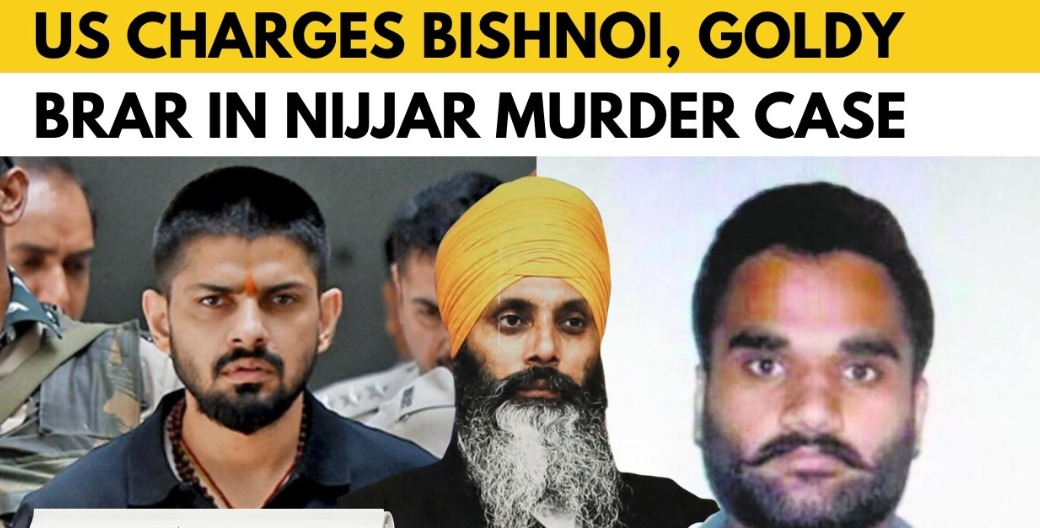
One indictment identifies Lawrence Bishnoi (33) as the leader of a criminal enterprise that prosecutors claim directed operations from India while maintaining networks in Canada, the United States and Europe. Also named are Satinderjeet Singh, alias Goldy Brar (32), Rohit Godara (37) and Sukhraj Singh Kang (58), whom prosecutors describe as senior members of the same organisation. The indictment alleges that the enterprise relied upon decentralised command structures, enabling associates in multiple jurisdictions to execute criminal activities while senior leadership remained outside the immediate reach of foreign law enforcement.
Perhaps the most revealing aspect of the indictment is its description of how the Bishnoi enterprise allegedly transformed violence into a calculated instrument of psychological control.
According to the Department of Justice, the organisation routinely targeted prominent religious, social and political figures, using high-profile attacks not only to eliminate perceived adversaries but also to cultivate fear among communities both within India and across the Indian diaspora. Prosecutors cite the June 2023 assassination of Hardeep Singh Nijjar a prominent Canadian Sikh leader in Surrey, British Columbia and further allege that, in November 2023, Bishnoi publicly claimed responsibility for a separate shooting at the Vancouver residence of a prominent Indian actor and singer. The indictment states that this claim was accompanied by a Facebook post in Punjabi warning, “no one can save you from us.” Far from being an isolated threat, prosecutors contend that the organisation deliberately amplified such acts through social media, online videos and internet posts to magnify its reputation, intimidate potential targets and strengthen its extortion network. In this respect, the indictment portrays an organisation that allegedly understood the strategic value of digital communication as well as any modern terrorist or organised criminal enterprise: violence achieved its greatest effect not merely through the act itself, but through its instantaneous dissemination across digital platforms, where fear could travel faster than bullets and transcend national borders.
Perhaps the most disturbing feature of the indictments is not merely the geographical reach of these criminal enterprises but the allegations regarding their ability to operate despite the incarceration of their principal leaders. Federal prosecutors allege that Lawrence Bishnoi continued directing operations from an Indian prison using illicit mobile telephones, encrypted internet communications and trusted intermediaries. The indictments further allege that the organisation maintained an international hierarchy in which Goldy Brar coordinated North American operations while Rohit Godara oversaw activities extending into Europe. If these allegations are ultimately substantiated in court, they raise uncomfortable questions not simply about organised crime, but about institutional resilience in India. If substantiated, these allegations suggest that weaknesses in prison administration, law enforcement or broader governance in India may have enabled domestic criminal syndicates to evolve into enterprises with a global operational footprint.
The international ramifications of these indictments extend well beyond conventional organised crime. They intersect with one of the most serious diplomatic disputes between India and a Western democracy in recent decades. In September 2023, then Canadian Prime Minister Justin Trudeau told Parliament that Canadian security agencies were pursuing “credible allegations” linking agents of the Government of India to the killing of Canadian Sikh leader Hardeep Singh Nijjar in Surrey, British Columbia. India categorically rejected the accusation as “absurd” and “motivated”, triggering an unprecedented deterioration in bilateral relations, including reciprocal diplomatic expulsions. In October 2024, the Royal Canadian Mounted Police (RCMP) publicly alleged that violent criminal networks, including the Lawrence Bishnoi group, had been used as proxies in campaigns involving intimidation, extortion and violence targeting members of the South Asian community in Canada. The RCMP stressed that these allegations formed part of ongoing criminal investigations and did not constitute judicial findings. Nevertheless, the convergence of Canadian investigations and the U.S. Department of Justice’s description of “India-based transnational organized crime groups” suggests that concerns surrounding such networks have evolved beyond ordinary criminality into matters of international diplomacy, national security and transnational law enforcement. Whatever the eventual outcomes of criminal proceedings, the episode demonstrates how organised crime, when alleged to intersect with geopolitics and diaspora politics, can profoundly reshape relations between democratic states.
A separate indictment focuses on Jaggu Bhagwanpuria (38), whom prosecutors claim heads another India-based transnational organised crime group with an estimated 1,000 members worldwide, including more than 100 members operating in the United States. According to the indictment, the organisation maintained networks extending across Canada, Europe, Australia and New Zealand, illustrating the extent to which organised crime has become detached from national boundaries. Prosecutors further allege that elements within the enterprise exploited corrupt public officials in Punjab to facilitate extortion and manipulate criminal investigations—allegations that, if ultimately proven, would underscore the corrosive relationship between organised crime and institutional corruption.
The Department of Justice also identifies Ravinder Singh Dhanda, Jaskarn Baghri and Gurtej Singh Smagh as alleged organisers of a sophisticated cocaine and methamphetamine trafficking network linking Canada and the United States. Investigators contend that the organisation combined narcotics trafficking with money laundering and other organised criminal activities, demonstrating the increasingly diversified nature of modern criminal enterprises.
None of these allegations should be interpreted as judicial findings. They remain matters before the courts. Yet the indictments themselves are significant because they reflect an evolving assessment by one of the world’s most experienced law-enforcement systems regarding the changing geography of organised crime.
The concerns raised by the U.S. Department of Justice also resonate with broader international assessments of organised crime. The Global Initiative Against Transnational Organized Crime’s Global Organized Crime Index 2023 assigns India a criminality score of 5.75 out of 10, ranking it 61st among 193 countries, 21st in Asia, and the highest-scoring country in South Asia for organised criminality. The Index identifies particularly elevated risks in human trafficking, extortion, narcotics markets and financial crime, while also pointing to institutional vulnerabilities in political governance, judicial effectiveness and law enforcement resilience. Although the Index does not establish criminal liability or attribute responsibility to governments, it provides an independent international assessment suggesting that organised criminal markets operating from India have acquired a scale and sophistication that increasingly demand global attention.
This broader trend is neither unique nor unexpected. The United Nations Office on Drugs and Crime (UNODC) has consistently warned that transnational organised crime now represents one of the principal threats to international governance, exploiting weak institutions, corruption and global financial connectivity. Likewise, Europol’s Serious and Organised Crime Threat Assessment (SOCTA) observes that contemporary criminal organisations increasingly function as fluid international networks rather than rigid hierarchical structures. Their operational model is defined not by territory but by connectivity, using encrypted communications, crypto currencies, digital financial systems and diaspora networks to coordinate criminal activity across jurisdictions.
The Global Initiative against Transnational Organized Crime (GI-TOC) similarly argues that organised crime has entered an era of unprecedented adaptability. Criminal enterprises increasingly resemble multinational corporations, diversifying revenue streams, outsourcing operational tasks and exploiting disparities between legal systems. Geography no longer limits criminal influence; it merely determines where leadership resides.
Viewed against this global backdrop, Operation Hard Ball assumes wider significance. If the allegations are ultimately proven, they would illustrate how criminal syndicates operating from one jurisdiction can evolve into sophisticated transnational enterprises exhibiting precisely the organisational characteristics identified by UNODC, Europol and GI-TOC.
History demonstrates that organised crime rarely acquires such international reach in isolation. Whether examining the Sicilian Mafia, the Camorra, Colombian cartels or Balkan criminal networks, expansion has often been facilitated by institutional weaknesses, inadequate financial oversight, corruption, ineffective witness protection, fragmented policing or deficiencies in international legal cooperation. Organised crime flourishes where governance gaps persist. It exploits institutional vulnerability long before it exploits international borders.
Against this comparative experience, the Department of Justice’s characterisation of certain India-based transnational organized crime groups warrants close attention. It invites scrutiny not simply of individual criminal prosecutions but of the institutional conditions that enabled such organisations to expand beyond India’s borders.
Taken together, the American indictments, Canada’s parallel investigations and the growing engagement of international law-enforcement agencies underscore a broader transformation. Organised crime increasingly intersects with migration, diaspora politics, digital communications, illicit finance and international diplomacy, making it as much a governance challenge as a criminal justice one.
The broader lesson extends well beyond the indictments themselves. The evolution of criminal syndicates into what the U.S. Department of Justice now characterises as “India-based transnational organized crime groups” suggests that organised crime is not merely a policing problem but a measure of institutional resilience. When domestic criminal enterprises are allowed to consolidate, adapt and internationalise, they eventually outgrow the jurisdictions in which they originated, becoming threats not only to national governance but also to international peace, public security and the rule of law. The experience described in the DOJ indictments raises legitimate questions about whether India’s criminal justice and prison administration were sufficiently equipped to prevent such syndicates from acquiring an international reach. For India, as for every country confronting organised crime, the ultimate test is not the ability to prosecute these networks after they have become global, but the institutional capacity to dismantle them before they evolve into transnational security threats.