Kashmir on Sale: India’s economic occupation deepens—another Gaza in the making
Humayun Aziz Sandeela
 What lies ahead for the people of Indian-occupied Jammu and Kashmir bears an eerie resemblance to the slow-motion tragedy unfolding in Gaza—a systematic erasure of identity cloaked in legality and development. The parallels to historic Palestine are chilling. Just as early land sales to Zionist settlers paved the path for Palestinian dispossession, Kashmir too is witnessing the seeds of demographic reengineering being sown under the cover of capital.
In the heart of Khunmoh, Srinagar, the sale of a majority stake in Saifco Cement Factory by its Kashmiri owner Suhail Manzoor Guna to Dr. Raghavpat Singhania, a Hindu businessman from India’s JK Cements Pvt. Ltd., is more than a commercial transaction. The factory, now renamed New Lakshmi Cement, symbolizes a growing pattern of settler-style economic incursions—an unsettling shift that has only accelerated since India abrogated Articles 370 and 35A in 2019.
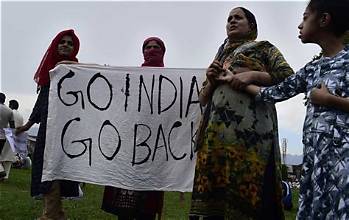
In October 2020, India introduced new land laws for Jammu and Kashmir, which for the first time in decades permitted non-residents to purchase land in the region. This move sparked immediate backlash from Kashmiri political leaders. Farooq Abdullah, former Chief Minister and President of the National Conference, warned, “They are finishing the identity of people… this is unacceptable.” The People’s Alliance for Gupkar Declaration termed the move as “colonial” in its intent. As reported by Al Jazeera on October 28, 2020, civil society members decried the law as a deliberate “land grab,” aimed at changing the region’s demography by economic and legal means.

The Indian government, in its own admission to Parliament in April 2023, stated that 184 non-resident investors had purchased land in Jammu and Kashmir following the legal changes. While the number may seem modest, it is significant in the highly sensitive context of Kashmir, where land ownership has long been tied to questions of identity, autonomy, and occupation. According to The Hindu, Indian Minister of State for Home Affairs Nityanand Rai confirmed this data and emphasized that the government had received 6,000 investment proposals for industrial projects in Jammu and Kashmir since 2019. The central narrative advanced is one of economic development and integration. However, many locals view these land sales as a backdoor method to alter the territory’s demographic composition.
Economic encroachment has often followed military occupation. In Kashmir, with boots already firmly on the ground, the strategy has entered its next phase: acquisition through capital. This is not development in its purest sense—it is a silent conquest, where deeds replace bullets and corporations serve where soldiers once stood. The fear among locals is that, much like in Palestine, economic transactions today will translate into irreversible demographic shifts tomorrow. “What is happening in Khunmoh is not a business deal,” said a local political activist to The Wire. “It’s an assault on our cultural and territorial integrity.”
The land sales are not limited to industrial plots. Dr Mahmood Hussain in a research article published by Strategic Vision Institute on January 23, 2025 clearly documented recent policies that open agricultural lands for non-agricultural purposes, enabling real estate investors from mainland India to acquire properties in scenic and strategically located areas. The investment of trillions of rupees in Jammu and Kashmir is not for the Indigenous citizens; it is an instrument of the Indian state to consolidate the occupation of the region and enhance its military capabilities.
This calculated erasure is being carried out under the legal veneer of constitutional reform and economic liberalization. But to those who live under the shadow of occupation, it feels far from liberating. International silence on these developments is equally troubling. Just as the world failed to act decisively when land transfers in Palestine turned into full-blown annexation, the Kashmir case risks becoming yet another footnote in the global narrative of occupation legitimized by law and commerce.
The global community must ask: Is silence acceptable when identity is erased not by tanks but by tenders? Is development valid when it thrives on dispossession?