Bhagwat’s US visit puts RSS’s fascist links under spotlight
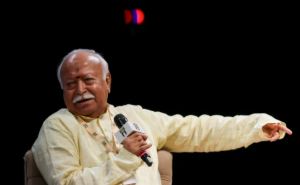
Islamabad : Rashtriya Swayamsevak Sangh (RSS) chief Mohan Bhagwat’s appearance at a large Hindu American gathering in New York has brought renewed attention to the organization’s ideology and its long-documented engagement with European fascism during its formative years.
According to Kashmir Media Service, Bhagwat, who heads the Hindutva organisation closely associated with India’s ruling Bharatiya Janata Party (BJP), is scheduled to address the “Universal Oneness Celebration” in Manhattan on Saturday.
The event has drawn opposition from New York Mayor Zohran Mamdani, who has described the RSS’ exclusionary ideological tradition as inconsistent with a pluralistic and secular India.
The controversy comes against a historical record that scholars have examined for decades.
The RSS was founded in 1925 by K.B. Hedgewar. In the following decade, senior Hindutva figures developed direct contacts with fascist Italy and studied European authoritarian movements.
One of the most significant links involved B.S. Moonje, a Hindu Mahasabha leader who was an important influence on the early RSS. In 1931, Moonje travelled to Italy, met fascist dictator Benito Mussolini and toured institutions including the Opera Nazionale Balilla, the Italian Fascist youth organisation.
Historian Marzia Casolari’s archival research found that Moonje was impressed by the organisation’s militarized structure and sought to adapt aspects of the fascist model for Hindu society. Her research argues that these encounters helped shape the organizational development of Hindu nationalism and, in turn, the RSS.
The relationship extended beyond admiration for Italian fascism. M.S. Golwalkar, who became the RSS’ second chief, wrote in his 1939 book We, or Our Nationhood Defined about racial and national homogeneity in terms that scholars have connected to contemporary European racial ideology. He argued that minorities in India should either adopt Hindu culture and identity or live in a subordinate position without citizenship rights. His book also referred favourably to Germany’s efforts to maintain racial and cultural unity.
Modern scholarship notes that the text praised the Nazi model and drew on ideas of “blood and soil” in defining national identity.
A 2020 study in Patterns of Prejudice, examining Hindutva as a form of right-wing extremism, described the connections between Hindu nationalism, Italian fascism and Nazism as well documented.
It notes that Savarkar, a major Hindutva ideologue and close associate of the RSS milieu, repeatedly referred to Nazi Germany’s treatment of Jews when discussing India’s Muslim population.
Historian Casolari, whose work is based heavily on archival records, has argued that these were not simply superficial similarities. Her research traces direct contacts between Hindu nationalist figures and fascist Italy and concludes that fascist ideas and organisational models influenced the development of Marathi Hindu nationalism and the RSS.
- The historical record, therefore, continues to fuel debate over the ideological foundations of the RSS and the evolution of Hindutva nationalism. Bhagwat’s appearance in New York has brought that history back into public focus, particularly amid growing international scrutiny of the organisation’s ideological influence in contemporary India.