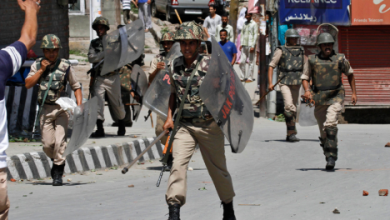
 The people of Indian illegally occupied Jammu and Kashmir (IIoJK) are still facing a military occupation that has continued for more than seven decades. On 27th October 1947, when the Indian army entered Srinagar, it marked the beginning of an era in which the basic rights of Kashmiris — including self-determination and human dignity — were completely denied.Over time, the violations of human rights have deepened, marked by state violence, media suppression, enforced disappearances, and the silencing of Kashmiri voices. The dispute of Kashmir is not only about land; it is about the denial of humanity and fundamental rights.
The root cause of the Kashmir conflict lies in the events that followed the partition of British India. On October 27, 1947, Indian forces entered Kashmir, claiming to act on behalf of Maharaja Hari Singh, who had signed a controversial agreement known as the Instrument of Accession and requested Indian military assistance. This act was supposed to be temporary until the United Nations supervised a plebiscite to allow the Kashmiri people to decide their own future.However, that temporary occupation gradually turned into a permanent military presence. The UN Security Council, through its resolutions, declared Kashmir a disputed territory and emphasized the right of self-determination for the Kashmiri people. Despite these declarations, the region was transformed into a militarized zone, where human rights are constantly violated, and where extrajudicial killings, torture, raids, surveillance, and curfews have become part of daily life.
The abrogation of Article 370 in 2019 officially placed Kashmir under the direct control of New Delhi, ending its limited autonomy. Overnight, thousands of people — including civilians, political leaders, and journalists — were imprisoned. The region’s communication networks were completely shut down, isolating it from the rest of the world. Kashmir became a hub of military operations, with soldiers present at every corner. The human cost of this long-lasting crackdown is staggering. According to international reports and civil rights organizations, thousands of Kashmiris have been killed, imprisoned, or disappeared. Every home in Kashmir carries a story of grief and loss, of loved ones who never returned after being taken away.The use of pellet-firing shotguns has become a symbol of brutality against unarmed civilians. Since 2010, many Kashmiris — including children and women — have been partially or completely blinded, victims of a weapon condemned globally as inhumane and indiscriminate.

In today’s world, control over the narrative is as powerful as control over land. India’s strategy in Kashmir has always aimed to suppress the truth. Journalists face oppression and intimidation, often being charged under the Unlawful Activities (Prevention) Act (UAPA) for reporting on human rights violations.Independent media outlets in Kashmir operate under constant fear and censorship. In 2023, several prominent news organizations, including The Kashmir Walla, were shut down. This has turned Kashmir into what many call a “media black hole.” The silencing of journalists ensures that Kashmiri suffering remains unheard and unseen, allowing the state’s narrative to dominate international discourse.Beyond physical violence, the people of Kashmir face an invisible psychological war. Living under constant surveillance and uncertainty has led to widespread trauma, anxiety, and depression. Studies show that almost every second person in the valley suffers from mental distress since the beginning of the occupation.
For many, life is defined by checkpoints and mourning. This psychological warfare is not only meant to control the people but also to break their spirit. Yet, the Kashmiris continue to resist — not only through protests and slogans, but through the quiet endurance of everyday life: sending their children to school, rebuilding destroyed homes, and documenting their truth for the world to see.Despite abundant evidence of human rights violations, global responses have remained muted. Factors like strategic interests, geopolitical alliances, and economic ties have outweighed moral responsibility. Reports issued by the UN and human rights organizations have not led to meaningful action.As India grows as a rising global power, many Western democracies remain cautious in their criticism — even though they are quick to condemn similar violations elsewhere. This selective silence exposes the hypocrisy of international order.
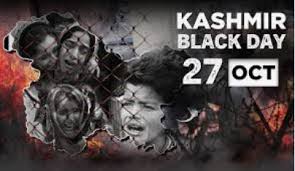
Despite decades of control and suffering, Kashmir’s identity has not been erased. Instead, it has evolved into a symbol of patience and resilience in the face of oppression. The youth of Kashmir are not only fighting with weapons but also with pens, art, and voices. Poets, writers, and artists continue to tell their stories, challenging the notion that occupation can erase history.Kashmir’s tragedy is not just a regional issue between India and Pakistan; it is a global human rights crisis. Every year, on October 27th — Kashmir Black Day — the world is reminded that justice delayed is justice denied.The occupation may have lasted for decades, but it cannot last forever. The international community and global courts must play their role in seeking justice by demanding independent investigations, repealing draconian laws, and restoring the Kashmiri people’s right to self-determination — so they can live with peace, dignity, and freedom.
Laiba Sarwar is a student of international relations at Quaid-i-Azam University, Islamabad, and is currently serving as an intern at the Kashmir Institute of International Relations (KIIR).