Choking the Lifeline of Kashmir’s Apple Growers
Humayun Aziz Sandeela
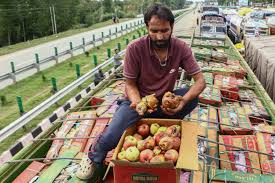 The images are heart-wrenching. Farmers in Sopore, Asia’s second-largest fruit market, break down in tears as their trucks—laden with apples, the Valley’s pride and livelihood—rot on the Srinagar–Jammu highway. Protesters clutch placards, pleading for what should be a basic right: the free movement of their produce. Yet day after day, the road stays blocked, and the apples decay.
The official explanations—landslides, security checks, logistics—mask a harsher reality. This is not an accident of circumstance. It is the deliberate throttling of an economy that sustains hundreds of thousands of Kashmiri families. The blockade of apple trucks, while other commodities like iron are waved through, has become emblematic of New Delhi’s larger project: weaken the economic backbone of the Valley, render its people dependent, and smother resistance by targeting their livelihoods.


Apple cultivation is not just another industry in Kashmir; it is its lifeline. With nearly seven lakh families directly or indirectly dependent on horticulture and the sector contributing around 8% of Jammu and Kashmir’s GDP, the apple trade is the oxygen of the Valley’s economy. By some estimates, Kashmir exports apples worth over ₹10,000 crore annually to Indian and international markets. A single disruption at harvest time can mean financial ruin for thousands of orchardists, transporters, and traders.
Farmers know this too well. “Our livelihood is dying on the road while the government watches silently,” one grower lamented. His words cut to the core: this silence is not bureaucratic negligence—it is policy by indifference.
Apples worth crores are rotting on Mandis. Govt. gestures are symbolic; in reality, farmers sell land, migrate, ‘prosperous farmers’ only exist in official gazettes and paid newspaper reports.”
Apple farmers in Kashmir staged protests across Kashmir on Monday. pic.twitter.com/viKJNE0RrL
— The Kashmiriyat (@TheKashmiriyat) September 15, 2025
What angers growers most is not just the blockade itself but its discriminatory application. Trucks carrying iron, cement, and other commodities glide past while apple-laden vehicles are forced to idle for days. The message is clear: Kashmir’s own produce is dispensable. In Sopore, Handwara, Shopian, Kulgam, and Anantnag, fruit mandis fell silent as growers shut down in protest, but their cries reverberate far beyond the mandis—they expose a system stacked against the Kashmiri farmer.
This is hardly the first time. Since the abrogation of Article 370 in 2019, Kashmiri industries—whether handicrafts, tourism, or horticulture—have repeatedly been subjected to structural and logistical chokeholds. Internet blackouts crippled e-commerce and trade networks; land allotments for non-locals threatened traditional livelihoods; now, highway blockades suffocate perishable goods at the peak of harvest.
Seen together, these are not isolated crises but building blocks of an economic strangulation strategy. The goal is unmistakable: to dismantle Kashmir’s self-sustaining sectors, force economic dependency on New Delhi, and make resistance costlier by attacking the very bread and butter of ordinary families.
The Indian government has been quick to showcase token solutions—like the cargo parcel train service recently flagged off by Lieutenant Governor Manoj Sinha, which promises to ferry 23–24 tonnes of apples daily to Delhi. But when juxtaposed with the Valley’s two million tonnes of annual apple production, this initiative appears less like relief and more like a publicity gimmick. It is a drop in the ocean, paraded as reform.
Delegations may thank Prime Minister Modi for the train, but farmers stranded on the highway know better: no parcel service can compensate for systemic blockade, discriminatory transport practices, and the sheer callousness that lets apples rot while families sink into debt.
What is at stake here is not only the economic future of Kashmir’s orchardists but the dignity of a people systematically deprived of their rights. The fruit growers’ demand is simple—unhindered passage of their goods. Yet even this is politicized, delayed, and denied. When Fayaz Ahmad Malik of the Sopore Fruit Mandi Association while addressing protesters called for the Chief Minister Omar Abdullah’s resignation, it is not mere rhetoric; it is an expression of utter despair at a governance structure that refuses to protect its own citizens.
The blockade of apple trucks is more than an economic crisis. It is a weapon of control, wielded under the guise of logistics but with the precision of policy. And like all such measures, it seeks not just to destroy produce but to break spirits.
If the global community fails to see this for what it is, a calculated attempt to dismantle the economy of Kashmir’s majority population, then the rotting apples on Kashmir’s highways will become a bitter symbol of an even deeper rot: the erosion of justice, dignity, and human rights in one of the world’s most militarized regions.