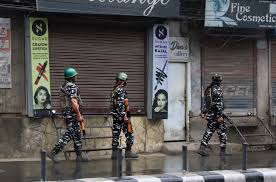
The Indian government, under the Bharatiya Janata Party (BJP), continues to propagate the misleading narrative of normalcy in Indian-Occupied Jammu and Kashmir (IIOJK), despite overwhelming evidence to the contrary. This narrative is aimed not only at the Indian public but also at the international community in an attempt to mask the ongoing human rights violations, political repression, and denial of basic freedoms in the region.
Failure to Suppress Kashmiri Aspirations
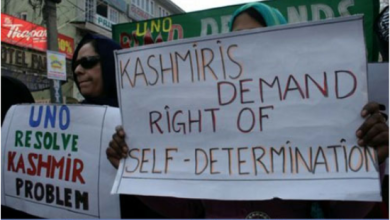
Since the revocation of Article 370 and 35 A in August 2019, the Indian BJP government has taken drastic steps to alter the political and demographic structure of Kashmir. However, these efforts have failed to suppress the Kashmiri people’s long-standing demand for plebiscite and the right to self-determination as recognized under UN Security Council Resolutions. The Kashmiri resistance remains resolute, despite decades of military occupation and repression.
Economic Deprivation and Militarized Misery
Beyond political repression, the people of IIOJK suffer from severe economic distress. Unemployment is rampant, especially among youth who have grown up in a heavily militarized conflict zone. The promises of “development” touted by Indian leadership remain unfulfilled, as locals continue to be denied access to their own resources, employment opportunities, and participation in administrative and policy-making roles.
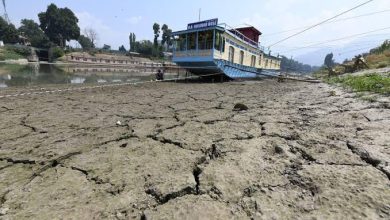
Key sectors such as agriculture, handicrafts, tourism, and small businesses are deteriorating. Artisans, hoteliers, marginal traders, and contractors struggle under surveillance and huge imposed laws and taxes and fear of state violence. The situation continues to worsen without any significant intervention or support.
Draconian Laws and Systemic Repression
The Indian state has institutionalized repression through a range of draconian laws. Indian forces operate under:
• Armed Forces Special Powers Act (AFSPA)
• Public Safety Act (PSA)
• Unlawful Activities (Prevention) Act (UAPA)
• National Security Act (NSA)
• Terrorist and Disruptive Activities (Prevention) Act (TADA)
• Prevention of Terrorism Act (POTA)
These laws give sweeping powers to Indian forces including army, paramilitary, police and agencies, shielding them from accountability. Thousands of Kashmiris have been arrested under these laws, often without trial. As of recent reports, over 3,000 Kashmiris remain detained under PSA and UAPA in various prisons in IIOJK and across India.
The Kashmir Bar Association and other human rights groups have documented widespread torture, fake encounters, and custodial killings. The Asian Centre for Human Rights and Association of Parents of Disappeared Persons (APDP) have reported that between 1989 and 2003 alone, 6,000 to 8,000 people disappeared in custody—figures also acknowledged in U.S. State Department reports.
Revocation of Identity and Demographic Engineering
India’s unilateral decision to abrogate Kashmir’s special status and introduce new domicile laws has enabled the settlement of non-Kashmiris mostly Indian forces, their families, labourer’s, bureaucratic, business men, students, employees, West Pakistan Refugees (WPR), Valmikis, a marginalised Hindu community, and Gorkhas have been provided with domiciles so far; new domicile laws were introduced in the region, an act widely condemned as demographic engineering. This policy directly violates the Fourth Geneva Convention, which prohibits an occupying power from transferring its own population into the territory it occupies.
Tens of thousands of non-locals have been granted domicile certificates, undermining the Kashmiri identity and paving the way for electoral manipulation and socio-political marginalization of indigenous Kashmiris.
International Silence and the Need for Accountability
Despite extensive documentation of atrocities by organizations such as Amnesty International, Human Rights Watch, and UN special rapporteurs, the international community has largely failed to hold India accountable. The Indian military, operating under the guise of counterterrorism, uses excessive force, including use of chemical and modern war technologies during cordon and search operations.
Arundhati Roy, a prominent Indian author, aptly described this reality in 2006, stating:
“The biggest myth of all times is that India is a democracy… In the Kashmir valley alone, some 80,000 people have been killed.”
India’s Double Standards on Terrorism
While projecting itself as a victim, India has shown clear double standards. In 2019, it acquitted Swami Aseemanand, the main accused in the Samjhauta Express blast, which killed 43 Pakistani civilians. Similarly, in the Bilkis Bano case involving gang rape during the 2002 Gujarat riots, 11 convicts were released prematurely.
India’s involvement in inciting terrorism inside Pakistan is widely established and documented. In November 2020, Pakistan had released a comprehensive dossier providing evidence of India’s involvement in subversive activities in Pakistan. The convicted, serving, Indian Naval commander Kulbhushan Yadav is undeniable proof of India’s direct involvement in sabotage and terror. Indian links to TTP and other elements inimical to Pakistan inside Afghanistan are also well known.
India’s “cowardly action” of missile strikes on May 7, 2025, targeting nine civilian and religious sites is a flagrant violation of the UN Charter, international law, and established norms of inter-state relations.
Justified under the pretense of the April 22 Pahalgam incident in Indian occupied Kashmir, this assault amounts to a direct act of aggression in violation of international law. It represents not only a grave breach of the United Nations Charter but also an open affront to human rights, international humanitarian law, and fundamental principles of state sovereignty. India’s actions violate numerous legal frameworks, including the Geneva Conventions, customary international law, and longstanding bilateral agreements such as the Indus Waters Treaty.
This aggression is not an isolated episode. It reflects a deep-rooted, ideologically motivated policy anchored in the Hindutva doctrine, which has systematically sought to destabilize Pakistan. A peace-seeking, nuclear-armed Islamic republic, Pakistan has repeatedly faced violations of its territorial integrity, including support for terrorism, cross-border subversion, and water weaponization. India’s latest military action, therefore, is not simply about one incident; it is the continuation of a sustained and deliberate campaign of hostility.
Conclusion: International Responsibility
India’s policies in IIOJK not only violate international human rights norms but also threaten regional stability. The international community must stop ignoring the plight of the Kashmiri people and:
• Demand an end to the use of draconian laws.
• Call for an independent investigation into human rights violations.
• Support the implementation of UN resolutions on Kashmir.
• Pressure India to restore civil liberties and release political prisoners.
Normalcy in Kashmir cannot be imposed through force or fabricated through propaganda. It can only be achieved by addressing the legitimate political aspirations of the Kashmiri people and upholding their right to self-determination.