41 years on, 1984 Sikh genocide continues to expose India’s hollow democracy
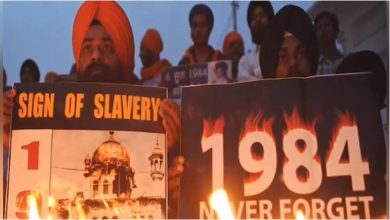
 New Delhi: Forty-one years after the 1984 anti-Sikh pogrom, the ghosts of that dark chapter continue to haunt India’s so-called democracy — a stark reminder of state-sponsored violence and the enduring denial of justice.
According to Kashmir Media Service, rights groups, genocide survivors, activists, and political leaders gathered at Jantar Mantar in New Delhi to mark the anniversary of the 1984 anti-Sikh genocide — not merely as an act of remembrance but as a reminder of the Indian state’s persistent failure to ensure accountability.
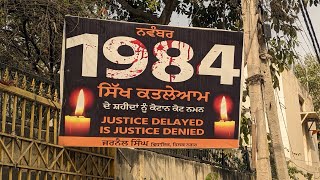
The event, organised by Lok Raj Sangathan and allied organisations, displayed banners reading “Punish the Organisers of the Sikh Genocide!” and “End State-Organised Communal Violence!” — reflecting the anguish that continues to define India’s broken promise of justice. “Justice delayed is justice denied,” read a banner fluttering against the Delhi sky.
A Genocide, not a Riot
“This was no spontaneous outburst — it was a meticulously planned massacre,” said S. Raghavan, President of Lok Raj Sangathan, citing evidence from various inquiry commissions that the killings were carried out with the tacit and active support of state machinery. “More than 10,000 Sikhs were killed. Yet, not a single orchestrator at the highest level of power has faced real punishment.”


Speakers stressed that what happened in 1984 was not an aberration but part of a recurring pattern of state-enabled communal violence — repeated in Gujarat in 2002, Muzaffarnagar in 2013, and Delhi in 2020. Despite changes in political leadership, the culture of impunity remains entrenched.
A Nation Divided by Design
Mohammad Salim Engineer of Jamaat-e-Islami Hind said the tragedy of 1984 was rooted in the communal politics fostered since Partition and exploited ever since. “From the genocide of Sikhs then to the lynchings of Muslims today, the playbook remains unchanged — the guilty are protected, the victims forgotten,” he observed.
Other speakers drew parallels between past and present injustices — the disenfranchisement of marginalised communities through voter list purges, the criminalisation of dissent under draconian laws like the UAPA and NSA, and the targeting of Bengali-speaking Muslims through the CAA–NRC. “It’s all part of a deliberate strategy to divide the people and divert attention from real issues — unemployment, inflation, and social decay,” said Sucharita of Lok Raj Sangathan.
Democracy Under Siege
“India’s own philosophy teaches that the state must protect life and dignity,” Raghavan reminded the gathering, “yet our institutions have repeatedly failed this duty.” The blatant violation of the legal principle of “innocent until proven guilty,” with thousands jailed without trial, was cited as proof of India’s authoritarian drift.
For many, the commemoration was also a reckoning with the limits of electoral politics. “Elections alone won’t change this system,” said Comrade Sheomangal Siddhanthkar of CPIML–New Proletarian. “A political process that thrives on hate cannot be cured by ballots. It must be confronted through united people’s resistance.”
Justice as a Collective Duty
Speakers including Dr SQR Ilyas of the Welfare Party of India, Deepak Dholakia of Citizens for Democracy, and Birju Nayak of the Communist Ghadar Party, underscored the urgent need for unity across communities and movements. “Communal violence is a weapon of the ruling elite,” Nayak declared. “The only way forward is to dismantle that power structure and uphold the right to conscience, dignity, and equality.”
The event concluded with a collective pledge to “remember and resist” — not merely to commemorate the victims of 1984, but to ensure that its lessons guide future struggles against state-orchestrated communal violence. As slogans of “Justice for 1984!” and “End State Terror!” echoed through Delhi’s historic protest space, the message was clear: India cannot move forward without confronting the violence buried in its past — and the violence that continues in its present.
Forty-one years later, the wait for justice endures. The participants’ pledge to “carry forward the struggle” was not a ritual close to an event, but a call to action — a warning that in forgetting 1984, India allows it to repeat itself in new and more insidious forms.