Allocation of private land to govt departments in IIOJK sparks fear of demographic engineering
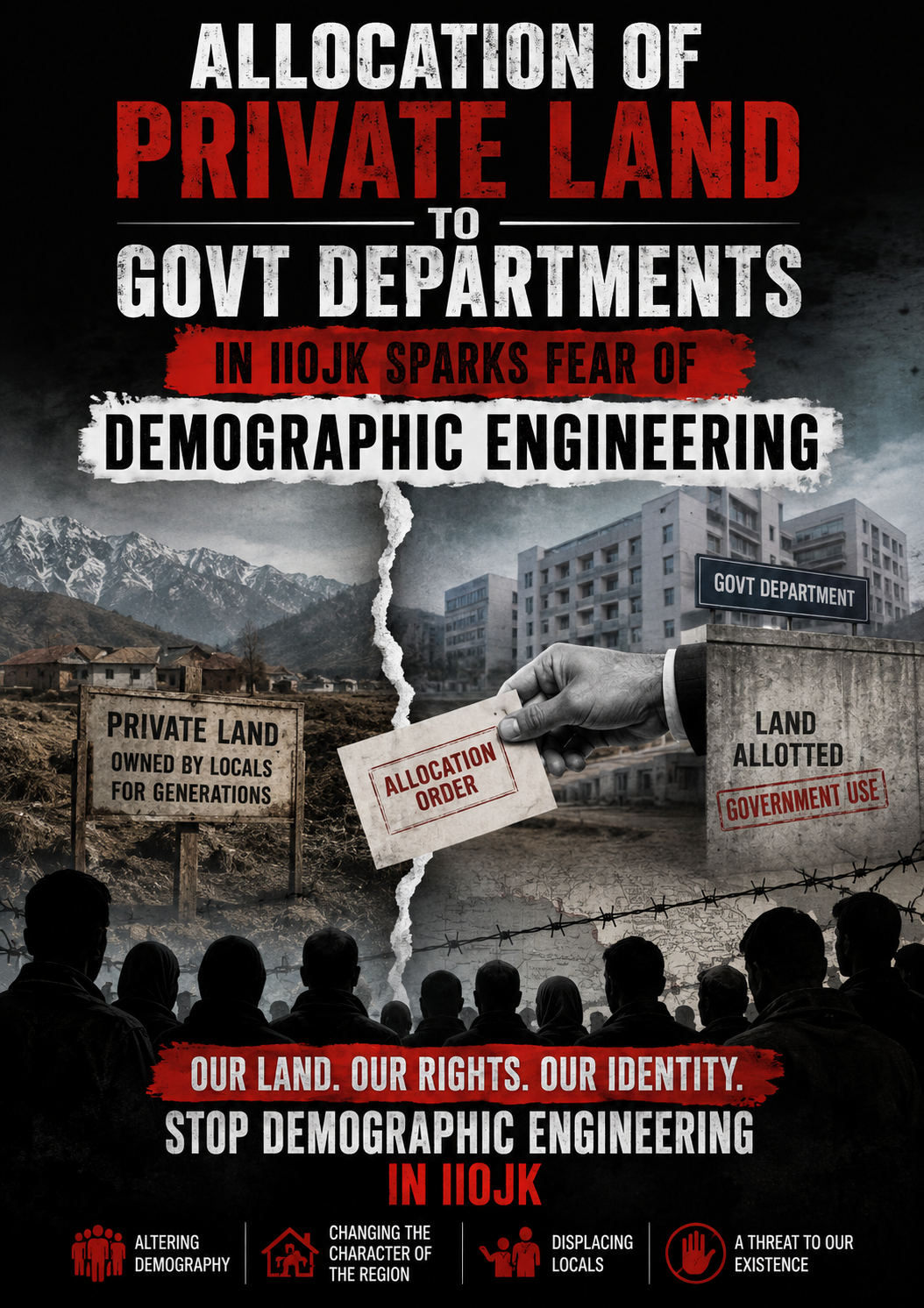
Srinagar: The BJP-led Indian government is continuously allocating private land in Indian illegally occupied Jammu and Kashmir (IIOJK) to various government departments, including intelligence agencies, in a clear violation of United Nations resolutions regarding the internationally recognized disputed territory.
According to Kashmir Media Service, political observers and experts say the move is aimed at altering the demographic composition of IIOJK and reducing its Muslim-majority status to a minority.
In this regard, a report said the Modi government had already planned in April last year to construct a new Civil Enclave at Udhampur Air Force Station. In August 2025, the Airports Authority of India said that around 27.6 acres of land would be required for the development of a terminal building, apron, taxiway and other associated infrastructure for the proposed Civil Enclave. The authority requested the IIOJK administration to transfer the required land free of cost and free from all encumbrances in favour of AAI for the development of the Udhampur Civil Enclave.


IIOJK revenue records indicate that the proposed land is privately owned and located near an existing military installation, raising questions over its acquisition. Reports further suggest that other security agencies also showed interest in the area.
In November 2025, the Tehsildar of Udhampur furnished revenue papers of land measuring 231 Kanals and 6 Marlas situated in village Kashirah, Tehsil Udhampur, confirming that the land is privately owned and adjacent to the existing Air Force Station having plain topography and suitable for the aforesaid purpose. The Central Reserve Police Force (CRPF) also showed interest in the same land and obtained its documents.
IIOJK Revenue Department confirmed that stamp duty rates for the year 2026 for un-irrigated soil in village Kashirah is 660,000 per kanal, and for acquisition proceedings a formal indent and tentative amount of 70 crore is required.
The report added that not only in occupied Jammu and Kashmir but also in the Indian state of Punjab, people are being affected by similar land grabbing approach of the Indian government and Indian forces.
Indian Punjab shares an approximately 553-kilometre border with Pakistan, of which nearly 461 kilometres is fenced. Defence requirements, including border fencing, BSF and Army access routes, roads and related infrastructure, have historically restricted or affected farmers’ access and ownership rights over agricultural land in border areas.
Approximately 50,000 acres of land lies beyond the border fence, of which nearly 22,000 acres is agricultural land belonging to farmers residing in around 220 villages, according to Punjab Border Area Kisan Union data. Other estimates suggest that nearly 17,000 to 21,500 acres of cultivable farmland, along with government land, lies between the border fence and the Zero Line, affecting thousands of farmers in districts including Amritsar, Tarn Taran and Ferozepur.
The report said that farmers in these border regions continue to face security-related restrictions, including timed access, mandatory permissions and movement limitations for cultivation activities.
Political observers and experts argue that India’s deliberate encroachment, seizure and securitisation of civilian land in IIOJK and other border areas under various administrative and defence pretexts constitute a clear violation of international law and United Nations resolutions on the disputed territory. KMS-20S