 The recent open debate at the United Nations Security Council on “Upholding the Purposes and Principles of the UN Charter and Strengthening the UN-Centered International System” was more than a routine diplomatic exercise. For millions of people living under occupation, enduring unresolved conflicts, and waiting for justice promised decades ago, the debate represented a rare moment of cautious hope. Among them were the 23 million people of Jammu and Kashmir who continue to look toward the United Nations as the guarantor of their right to self-determination.
At a time when the world is shaken by wars in Gaza, Ukraine, Sudan, and other troubled regions, the Security Council debate exposed a deeper crisis confronting the international system: the widening gap between the lofty principles of the UN Charter and the inconsistent manner in which those principles are applied.
Ambassador Sanita Pavļuta-Deslandes of Latvia reminded the Council that “it is our duty to protect the UN Charter, in order for the UN Charter to protect us.” Russian Ambassador Vassily Nebenzia similarly described the Charter as the “cornerstone document” of international peace and security, warning against the growing disregard shown toward it.
These statements were important because they reaffirmed a truth often forgotten in modern geopolitics: the UN Charter was not designed to serve the interests of powerful nations alone. It was meant to protect weak and strong states alike through equal application of international law.
Pakistan’s Deputy Prime Minister and Foreign Minister Senator Mohammad Ishaq Dar rightly emphasized that the Charter upholds the peaceful settlement of disputes and guarantees peoples the right to self-determination. He reminded the Council that these principles are “sacrosanct” for Pakistan and form the basis of its engagement with the world. Most importantly, he drew attention to the unresolved dispute of Jammu and Kashmir, which has remained on the Security Council’s agenda for nearly eight decades despite multiple UN resolutions promising the Kashmiri people the right to determine their own future.
His argument went beyond Kashmir alone. He highlighted a painful reality that much of the Global South increasingly recognizes: when sovereignty is defended in one conflict but ignored in another, the credibility of the international order is weakened. When occupations are condemned selectively, justice loses its meaning. When Security Council resolutions are enforced against some states but conveniently forgotten in other cases, smaller nations begin to question whether international law truly applies equally to all.
Interestingly, even India’s Permanent Representative Ambassador Harish Parvathaneni acknowledged that concerns about the legitimacy and effectiveness of the United Nations are growing. He spoke about the challenge of “double standards” and stressed that brute force and power politics cannot strengthen multilateralism.
Those words momentarily raised hope that India might finally connect its rhetoric about the UN Charter to the unresolved question of Kashmir. After all, Jammu and Kashmir remains one of the oldest disputes before the Security Council, and its people continue to await implementation of the very resolutions adopted by that body.
Yet that hope quickly faded.
Rather than engaging substantively with the issue of Kashmir or the principle of self-determination, the Indian representative reverted to familiar accusations centered on terrorism and bilateral hostility with Pakistan. The shift was revealing. It demonstrated once again how discussions on Kashmir are frequently diverted away from the central issue: the political rights and aspirations of the Kashmiri people themselves.
George Bernard Shaw once observed, “Progress is impossible without change; and those who cannot change their minds cannot change anything.” That observation remains painfully relevant to South Asia today.
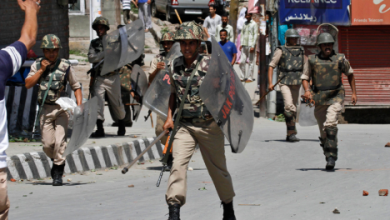
Pakistan’s rebuttal, delivered by Counsellor Saima Saleem, sought to bring the focus back to the ground realities in Kashmir. She argued that India could neither deny nor conceal the internationally recognized status of the dispute and pointed to reports of civilian suffering, suppression of freedoms, arbitrary detentions, and denial of self-determination in the occupied territory. At the same time, she reiterated Pakistan’s commitment to resolving disputes peacefully in accordance with the UN Charter and Security Council resolutions.
But amid this diplomatic exchange, one essential truth often gets lost: it is the people of Kashmir who continue to pay the highest price.
An African proverb wisely states, “When two elephants fight, it is the grass that gets hurt.” In the case of Kashmir, generations have grown up amid uncertainty, militarization, political alienation, enforced silence, and recurring cycles of violence. India and Pakistan may continue their arguments for decades, but it is the ordinary Kashmiri man, woman, and child who bears the burden of delay. This is precisely why the role of the United Nations remains indispensable.
UN Secretary-General António Guterres correctly observed that “The Charter remains humanity’s best hope for peace. But it is only as strong as the commitment of those responsible for upholding it.” He also reminded the Security Council that the world is demanding “action, not just words.”
Those words should resonate profoundly in the context of Kashmir.
The international community, especially the permanent members of the Security Council, must recognize that leaving Kashmir indefinitely unresolved is not a formula for stability. It is a recipe for perpetual tension between two nuclear-armed neighbors and continued suffering for millions of people.
A sustainable settlement cannot emerge solely through military management or rhetorical confrontation. It requires courageous diplomacy, international engagement, and meaningful dialogue involving all parties concerned — India, Pakistan, and the authentic leadership of the Kashmiri people.
History has repeatedly shown that entrenched conflicts are rarely resolved without outside facilitation. From Northern Ireland to East Timor, mediation and sustained international involvement helped create pathways toward peace where bilateral hostility alone had failed. Kashmir deserves the same seriousness of purpose.
If the United Nations genuinely wishes to restore confidence in the Charter and reaffirm the credibility of international law, it cannot afford selective implementation of its own resolutions. The principles of justice, self-determination, and peaceful settlement of disputes cannot remain conditional upon political convenience.
The debate at the Security Council demonstrated that world leaders still invoke the ideals of the UN Charter with passion and conviction. The true test, however, lies not in speeches delivered in New York chambers, but in whether those principles are applied consistently to the unresolved conflicts that continue to threaten global peace. Kashmir remains one of those tests. And the world is still watching.
(The writer is Chairman of World Forum for Peace & Justice)