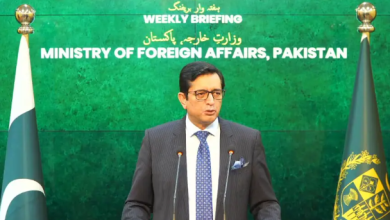
Pakistan retains ‘all options’ against India’s Chenab-Beas water diversion project: FO
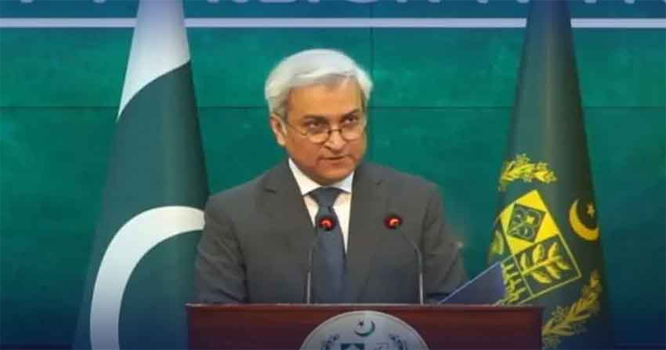 Islamabad: Pakistan has strongly rejected India’s proposed plan to divert water from the Chenab River to the Beas River system, asserting that it retains “all options” necessary to safeguard its rights under the Indus Waters Treaty (IWT) and protect its vital national interests.
According to Kashmir Media Service, Foreign Office spokesperson Tahir Hussain Andrabi, speaking at a weekly media briefing, said Pakistan remains committed to peace and stability in the region and continues to pursue constructive engagement with the support of friendly countries.
Responding to questions regarding India’s invitation of bids for the proposed Chenab-Beas water transfer project, he said the inter-basin diversion of Chenab waters would constitute a serious violation of the Indus Waters Treaty, as well as international law governing treaties and transboundary water resources.
He said the project would breach the provisions of the treaty, the principles enshrined in the Vienna Convention on the Law of Treaties, and broader international water law, including norms reflected in the 1997 UN Convention on the Law of the Non-Navigational Uses of International Watercourses.


“Pakistan retains ‘all options’ necessary to safeguard its rights and entitlements under the treaty and to protect its vital national interests,” the spokesperson emphasized.
Tahir Hussain Andrabi also described the proposed silt flushing of the Salal Dam reservoir in Reasi district of Indian Illegally Occupied Jammu and Kashmir as a deeply concerning development.
He noted it would provide water control capability that is not permissible either under the Indus Water Treaty or the 1978 Salal agreement.
The spokesperson said India has neither officially communicated nor shared any notice of these projects nor it has sought consultations in this regard.
He said these projects confirm that India seeks to weaponize water, adding that it carries dangerous implications, not only for Pakistan’s economy, but also for regional stability and international peace and security.
Tahir Andrabi said Pakistan has exercised restraint and responsibility and we remain committed to dialogue and peaceful resolution of disputes. However, he warned that any attempt to undermine Pakistan’s water, food, or economic security would be unacceptable.
“Any illegal action that threatens the survival and well-being of Pakistan’s 250 million people will be viewed with utmost seriousness,” he said.
He said such actions amount to further destabilization of South Asia with potential grave consequences for the people of the entire region.
The spokesperson urged the international community to call upon India to desist from any form of water coercion, abandon projects that seek to stop, reduce or divert water flow legally belonging to Pakistan and restore full and faithful implementation of the Indus water treaty.
Responding to a question regarding the visit of Switzerland’s ambassador to India and Indian illegally occupied Jammu and Kashmir, the spokesperson reiterated Pakistan’s position that Jammu and Kashmir remains an internationally recognized dispute.
He said the visit of any international personality does not alter the status of Jammu and Kashmir as an internationally recognised dispute whose resolution is to be achieved through independent and impartial plebiscite.
Commenting on recent remarks by US President Donald Trump suggesting progress in talks with Iran, the spokesperson welcomed the positive tone. He said Pakistan remains ready to again host US-Iran and would like an agreement to be reached sooner rather than later.